
What if the best mailing campaign isn’t the one that reaches the most homes? With usps eddm, you choose postal carrier routes and mail to addresses along those routes, rather than selecting individual recipients from an addressed list. The key is choosing coverage that fits your offer, not simply sending more pieces.
Broad reach can be a practical way to introduce a business, promote an offer, or build awareness across a service area. But it may not suit every audience. If only a narrow group is likely to respond, a more selective targeted mailing may make better sense. And USPS preparation requirements can feel like a lot to manage alongside planning the campaign.
This guide explains how route-based EDDM works, how to plan coverage, and what to consider when preparing a mailpiece. You’ll also learn when broad coverage fits and when targeted mail may be the better approach.
We Mail America supports campaigns nationwide, coordinating route research, design, printing, mailing preparation, and daily delivery tracking updates. Custom QR codes and Mail-to-Mobile texting can connect a tangible postcard with a digital response. The result is a coordinated process from route choice to mailbox.
Key Takeaways
- Plan usps eddm around your offer and intended audience before choosing carrier routes.
- Compare broad route-based coverage with targeted mail to select an approach that fits your audience.
- Make your mailpiece easier to act on with a focused message and a clear response method.
- See how coordinated campaign support can simplify route research, preparation, and mailing for businesses across all 50 states.
What Is USPS EDDM, and How Does Route-Based Mail Reach Households?
Every Door Direct Mail (EDDM) distributes eligible mailpieces to selected USPS carrier routes. Instead of choosing named individuals from an addressed mailing list, a business selects delivery areas and sends its mailpiece to households covered by those routes. USPS EDDM is a route-based approach to broad household visibility.
For a business with an offer relevant to a wide range of households, this approach can put a tangible message in front of people without first building an individual-address audience. A restaurant promotion, for example, might appeal to households throughout several selected routes. The fit depends on the offer and who is likely to value it, not just on how much coverage a route provides. EDDM is one form of advertising mail, the broader category of promotional mail sent to potential customers.
How USPS carrier routes shape an EDDM mailing
A carrier route is a USPS delivery area served along a carrier’s route. A route map helps a marketer see how those delivery areas are arranged and compare possible coverage before planning a mailing. We Mail America creates a Custom Geographic Report and carrier-route map for each client to support that planning.
Route selection differs from address-by-address audience selection. With a named list, a campaign can be directed to chosen recipients. With EDDM, the decision centers on which carrier routes to cover. A route map gives the business a geographic view of potential reach, but it doesn’t identify each household as a likely customer.
What EDDM can and cannot tell a marketer
The practical advantage is straightforward: a business can plan household coverage without building an individual-address list for that campaign. This can simplify planning when the offer has broad relevance and the goal is to make households along selected routes aware of it.
But broad coverage can include people outside a narrow ideal-customer profile. A specialized service, for instance, may appeal to only a particular type of household. In that case, route coverage may include recipients who are less likely to need the offer. Consider the balance: does the offer make sense for a broad range of households, or does it depend on reaching a more specific audience?
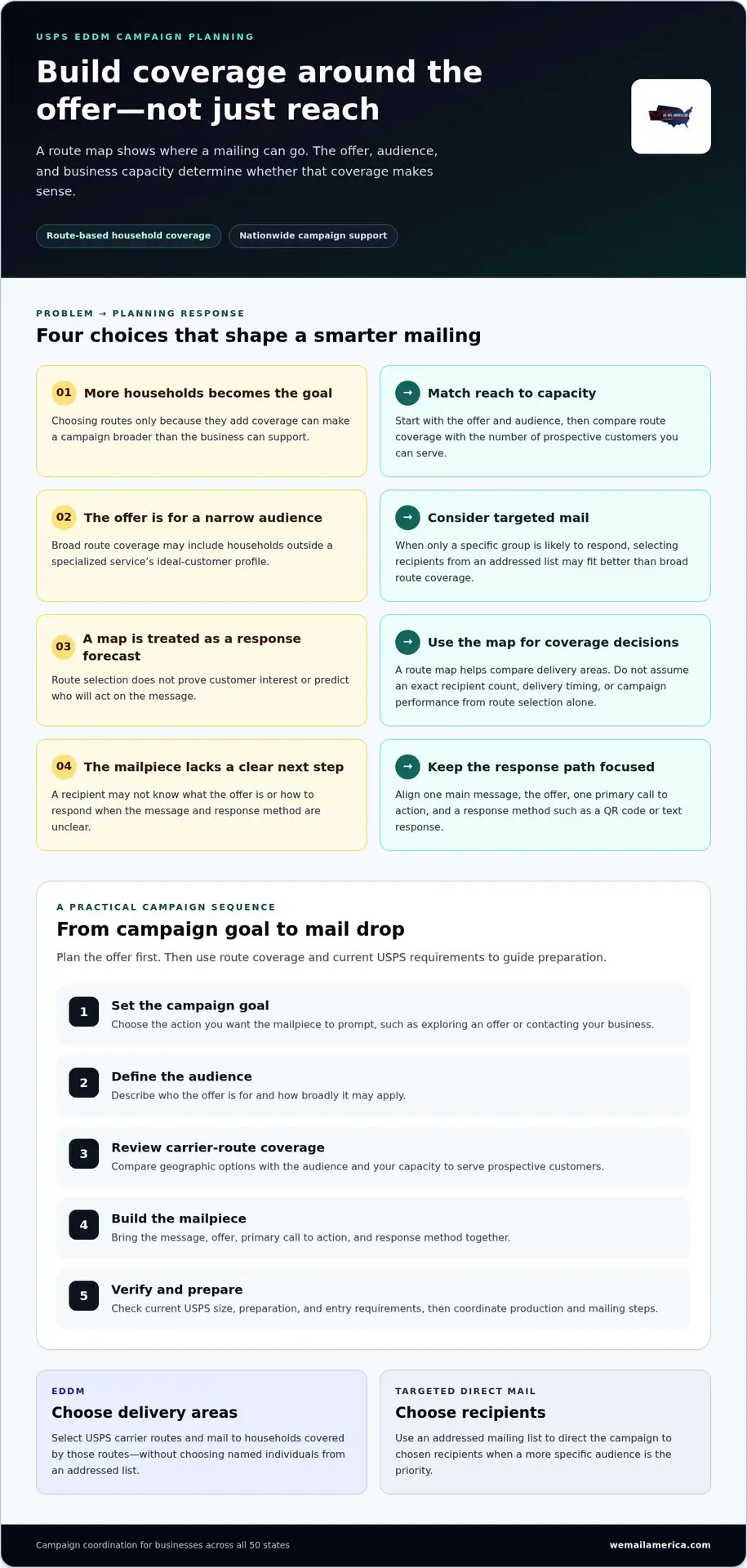
Route selection is a planning choice, not proof of customer interest or a promise of response. A map helps visualize the campaign’s coverage, but it can’t predict who will act on the message. Nor should a business assume an exact recipient count, delivery timing, or campaign performance from route selection alone. Treat the map as a tool for making an informed coverage decision. Start with a clear offer, a realistic view of its audience, and routes chosen to match both.
How to Plan a USPS EDDM Campaign: Route to Mail Drop
A practical usps eddm campaign starts with the offer, not the map. Define what you want recipients to do, who is most likely to value the offer, and how many prospective customers your business can serve. Then compare those needs with route coverage and plan the mailpiece and preparation workflow.
Campaign sequence: set the goal and offer, define the audience, review carrier routes, create a focused mailpiece, verify current USPS requirements, then coordinate printing, preparation, and mailing.
Choose routes that make sense for the offer
Think through your service area or customer profile before reviewing coverage. For example, a business with capacity to serve a broad base of potential customers may prioritize wider route coverage. A specialized offer may call for a closer look at whether selected routes are likely to include enough relevant prospects. Match reach to capacity so the campaign isn’t broader than the business can support.
We Mail America develops a Custom Geographic Report and carrier-route map to help clients assess coverage before committing to a campaign. Use that view to compare route options against your offer and audience, rather than choosing routes only because they add more households. For planning tools and service details, consult the USPS Every Door Direct Mail official page.
Prepare the mailpiece and mailing workflow
Once you have a coverage plan, make the creative easy to understand and act on. Decide on the main message, the offer, one primary call to action, and a response method, such as a QR code or text response. These choices should work together: the offer gives the recipient a reason to respond, and the call to action makes the next step clear.
Before describing a mailpiece as eligible or finalizing preparation details, verify USPS’s current size, preparation, and entry requirements. Rules and instructions can change, so use current USPS guidance rather than relying on an old checklist. This keeps planning grounded in the specifications that apply when you prepare the mailing.
- Set the campaign goal. Choose the action you want the mailpiece to prompt, such as exploring an offer or contacting your business.
- Define the audience. Describe who the offer is for and how broadly it may apply.
- Review route coverage. Compare geographic options with the audience and the number of prospects you can serve.
- Build the mailpiece. Align the message, offer, call to action, and response method.
- Verify and prepare. Check current USPS specifications, then coordinate production and mailing steps.
We Mail America provides one-on-one design support and coordinates printing, mailing preparation, sorting, and USPS handoff as part of campaign execution. The all-inclusive per-piece service brings route research, market analysis, strategic route selection, design, printing, postage, and mailing preparation together. If you’re ready to map a campaign around your offer, use the advertising campaign inquiry form to start the conversation.
USPS EDDM vs. Targeted Direct Mail: Which Approach Fits Your Audience?
Choose a mailing method based on how broadly your offer applies. USPS EDDM organizes distribution around carrier routes. Targeted direct mail narrows the audience using selected characteristics. We Mail America supports both approaches, so the campaign can be planned around the reach and audience fit you need, rather than treating one method as right for every business.
Audience selection
EDDM: Choose carrier routes for household delivery. It doesn’t select recipients by individual profile.
Targeted direct mail: Select a narrower audience using characteristics such as home value, income, and owner occupancy.
Coverage
EDDM: Provides broad, route-based household reach across the routes selected.
Targeted direct mail: Focuses delivery on a more selective audience rather than covering every household along a route.
Planning considerations
EDDM: Assess how well the offer fits households across each route.
Targeted direct mail: Define which audience characteristics matter and how narrowly the campaign should focus.
When route-based EDDM may be the better fit
EDDM can suit a business launch, a broad awareness campaign, or an offer likely to interest many households in selected routes. Route-based planning can simplify audience selection because the campaign doesn’t depend on choosing named recipients individually. The trade-off is selectivity: route coverage may include households that don’t match a narrow ideal-customer profile. Consider EDDM when broad visibility matters more than filtering for specific household characteristics.
When targeted mail may better match the campaign
A more selective mailing may be a better fit when the offer depends on a narrower audience or particular household characteristics. For example, a business might use home value, income, or owner occupancy as planning filters when those factors relate to its offer. Targeting can focus distribution, but it doesn’t guarantee stronger response or return. The right choice depends on audience fit, the campaign goal, and how broadly the offer can serve potential customers.
Use a simple decision test: if the offer makes sense for many households in the routes you’re considering, route-based EDDM may align with the campaign. If relevance depends on more specific characteristics, targeted direct mail may be a closer match. Either way, make the audience decision before settling on coverage.
For USPS preparation and mailing details, refer to the USPS EDDM User Guide. For a deeper look at how the two approaches differ, read our guide to EDDM and targeted direct mail.
How to Improve USPS EDDM Mailpiece Relevance and Measure Response
A route-based mailing can reach households, but the message still needs to earn attention. Make the offer relevant to the audience, state its value plainly, and give readers one clear next step. A focused mailpiece is easier to scan and gives your campaign a more useful response signal than a design crowded with competing messages.
Make the offer and response path easy to understand
Build the message around one customer problem and one clear benefit. Then make the primary action prominent, such as scanning a QR code or responding by text. Keep supporting copy concise and organize it so the main offer stands out at a glance. A physical mailpiece gives you space to make an impression, but more copy and more calls to action can make the next step less obvious.
We Mail America includes a custom QR code on every direct-mail campaign. Use it to give readers a direct path to an online response, and decide in advance what action you’ll measure after the scan, such as a visit to a campaign page or an inquiry. Mail-to-Mobile texting is available on each postcard at no additional charge, and mobile coupon texting can add a text coupon to a direct-mail campaign. Choose the response path that suits the offer and is practical for your team to monitor.
Connect mail delivery with trackable follow-up
Delivery updates and customer responses measure different things. Daily delivery tracking updates help show mailing progress; they don’t tell you whether someone scanned a QR code, contacted your business, or redeemed an offer. Track those actions separately, then compare them with the campaign’s purpose. That distinction helps you interpret activity without treating delivery as proof of customer interest.
Before launch, agree on how your team will record responses. If the mailpiece promotes a specific offer, use a dedicated response path or a clearly identified offer so inquiries and redemptions can be associated with the mailing. Keep the process simple for the recipient and for the staff who will review results. A response method only helps if it’s visible on the piece and manageable after the campaign begins.
Use this quick checklist before approving the creative:
- Audience fit: Does the offer speak to the households the selected routes are meant to reach?
- Message hierarchy: Can readers quickly identify the offer and its main benefit?
- Primary action: Is there one prominent next step?
- Response method: Have you chosen a QR code, text response, or another practical way to record engagement?
- Measurement plan: Will you review delivery progress separately from leads, inquiries, or redemptions?
Clear creative and a simple measurement plan make it easier to learn from a mailing without assuming a response is guaranteed. If you’re ready to connect your offer, mailpiece, and response path, plan a nationwide direct mail campaign.
How We Mail America Helps Businesses Execute USPS EDDM Nationwide
A successful usps eddm campaign takes more than choosing routes. The route plan, mailpiece, printing, preparation, and mailing all need to work together. We Mail America coordinates these steps for businesses across all 50 states, helping simplify execution while keeping the campaign centered on its audience and goals.
What full-service EDDM campaign support covers
Planning starts with a Custom Geographic Report and carrier-route map created for each client. These tools help businesses review potential coverage and make route choices with their offer and audience in mind. From there, one-on-one design support helps shape a mailpiece that carries the campaign message clearly.
We Mail America coordinates printing and mailing preparation, bringing key production steps together instead of leaving the business to manage each piece separately. The all-inclusive per-piece service includes carrier-route research, market analysis, strategic route selection, targeted filtering, professional design, full-color printing, postage, mailing preparation, sorting, and USPS handoff. Daily delivery tracking updates provide visibility into mailing progress. They’re useful for following delivery activity, but they don’t predict when every recipient will act or whether the campaign will generate a response.
For business owners, the value is having route planning and campaign execution connected. You can focus on the offer, audience, and coverage goals while research, creative support, print coordination, and mailing preparation are managed as parts of one process. The mailpiece remains tangible, and each operational step has a clear place in the workflow.
Extend a mailbox campaign across screens
A physical mailpiece can also point recipients toward a digital response. Each direct-mail campaign includes a custom QR code, which can give readers a convenient path to take the next step online. Mail-to-Mobile texting is another way to connect postcard exposure with a text response. These tools create response paths, but they don’t guarantee engagement or results.
Campaigns can also incorporate targeted email or Connected TV advertising as additional channels. These extensions can coordinate a campaign across mail and screens, depending on the audience and communication plan. The right mix starts with a clear purpose: decide whether the priority is a direct response from the mailpiece or a broader campaign with multiple ways to encounter the message. For more on combining mail with television advertising, see our Direct Mail and Connected TV guide.
To make planning productive, be ready to describe the offer, the audience you want to reach, and the coverage you’re considering. Those details help shape route research and keep the mailpiece aligned with the campaign’s purpose. You can bring the planning and execution steps together with a nationwide advertising campaign request.
Make Your Next Mailing a Deliberate Move
Your next campaign doesn’t need to cover every route or appeal to every household. Start by identifying the offer you want people to act on, the audience it’s meant for, and the coverage your business can support. Those choices give your usps eddm campaign a clear direction before production begins.
Then decide what you’ll learn from the campaign. A defined response path can help you understand whether the message prompted inquiries, scans, or another meaningful action. Use those observations to guide future creative and coverage decisions. Each campaign can build on what you learn, helping your direct mail become more purposeful over time.
We Mail America helps businesses turn campaign goals into a coordinated nationwide mailing plan. Share what you’re promoting, who you want to reach, and the coverage you have in mind. Request a nationwide direct mail campaign and take the next step with a plan built around your business.
Frequently Asked Questions
Does USPS EDDM require a mailing list?
No. USPS EDDM uses selected delivery routes rather than a marketer-supplied list of named recipients. You still need to choose routes that fit your campaign goal. For example, a broadly relevant introductory offer may suit wider household coverage, while an offer for a narrower audience may call for targeted mail. Route coverage determines where the piece is distributed, not whether each household is interested or will respond.
Can EDDM reach households across the United States?
Yes. We Mail America supports campaigns across all 50 states, with route selection shaped by the campaign’s intended coverage. A campaign won’t automatically include every route. Start with the audience and coverage you want, then use current USPS route tools to review options and mailing requirements. This helps keep a nationwide plan grounded in the routes that fit your campaign.
What happens if an EDDM route reaches more households than my business can serve?
A route may create interest beyond your immediate capacity, so weigh route coverage against staffing, appointment availability, inventory, and follow-up resources. Compare candidate routes before finalizing the mailing, and consider whether your offer applies broadly enough to justify that scope. If you can’t respond promptly to inquiries or fulfill demand, adjust the campaign plan or prepare your team before the mailpiece arrives.
Can EDDM target households by income or home value?
EDDM is selected by carrier route, not by filtering individual households on income or home value. We Mail America offers targeted-mail campaigns that can use home value, income, and owner occupancy as audience filters. If those household characteristics matter to your offer, compare the selectivity of targeted mail with the broader route coverage of EDDM. Choose based on how precisely you need to define the audience.
How often should a business send an EDDM campaign?
There isn’t one schedule that fits every campaign. Consider how often your offer changes, how frequently your audience may need the service, your capacity to handle responses, and whether the goal is a one-time announcement or ongoing visibility. Keep the message consistent when appropriate, and leave enough time to review delivery progress and customer responses before deciding on another mailing. Don’t treat a fixed cadence as a performance guarantee.
Can an EDDM postcard include a QR code or text response option?
Yes. We Mail America includes a custom QR code on every direct-mail campaign and offers a Mail-to-Mobile text option on each postcard at no additional charge. Either can give recipients a direct way to respond, such as visiting a page or sending a text. Make the requested action easy to spot and decide how your team will review scans or texts. These options don’t guarantee engagement or conversions.