Could a postcard make a stronger impression than a folded mailer, or does your boutique’s offer need more room to sell? The right choice depends on what you’re promoting, who should receive it, and what you want them to do. Boutique retail marketing mailers work best when you plan the format, audience, and offer as one campaign.
Choosing the wrong format can leave an offer unclear, while broad distribution may reach households that aren’t a fit. A postcard puts a focused promotion front and center; a trifold gives you more room to explain products or tell a brand story. Audience strategy matters too: EDDM provides geographic distribution, while targeted mail can focus on a more defined audience.
This guide will help you match an offer to a postcard or trifold, choose an audience strategy, and plan a campaign with a clear response path. You’ll also see how design, printing, postage, and optional digital advertising can come together in a coordinated direct mail campaign serving businesses across all 50 states.
Key Takeaways
- Choose boutique retail marketing mailers by matching the format to the offer’s complexity and the action you want customers to take.
- Compare EDDM and targeted mailing based on whether you need broad geographic distribution or a more defined audience.
- Build the message around a customer need, one main offer, useful supporting details, and a clear response action.
- Use a focused visual hierarchy so the headline, imagery, and supporting copy work together rather than compete.
- Write a campaign brief that aligns the objective, audience, offer, format, and response tracking before production begins.
Why Boutique Retail Marketing Mailers Can Give Offers a Physical Presence
A boutique can make a product, offer, event, or brand message tangible by putting it in a customer’s mailbox. Direct mail and digital advertising don’t have to be competing choices. A printed piece gives customers something to hold and revisit, while digital channels can reinforce the same message and make it easier to take the next step.
A mailer can stay visible after a quick screen view has passed. Customers may set an offer aside, share event details, or refer back to the piece when deciding what to do. That doesn’t guarantee a response, but it gives the campaign another way to present its message. For a neutral overview of the channel, see this explanation of direct mail marketing.
Begin with the campaign goal. It should guide who receives the mailer, which format carries the message, and what action you want customers to take. Broad geographic distribution may call for a different approach from a campaign aimed at a defined audience. In either case, choose a format that supports the offer rather than distracts from it.
Which boutique retail goals can mailers support?
Give each promotion one clear customer action. A new product announcement might invite customers to visit and see the item. A seasonal offer can ask them to redeem a promotion, while an event mailer can prompt them to attend or respond for details. A specific action helps customers understand what to do and gives you a response to track.
Mailers can also introduce a new look, product category, or shopping experience. Decide what customers should remember before adding secondary details. A focused message is easier to carry consistently across print and digital promotion.
What makes a mailer different from a digital ad?
A mailer is a physical piece delivered to a mailbox. Unlike a digital placement on a screen, it can be picked up, set aside, revisited, or shared. Digital promotion has its own ways to reach and engage customers. Neither channel is automatically right for every campaign.
If you use both, coordinate the core message, offer, and response action. Customers should recognize the same promotion whether they see it in print or online. Consistent messaging connects the touchpoints without requiring one channel to replace the other.
How to Choose a Boutique Retail Mailer Format for Your Offer
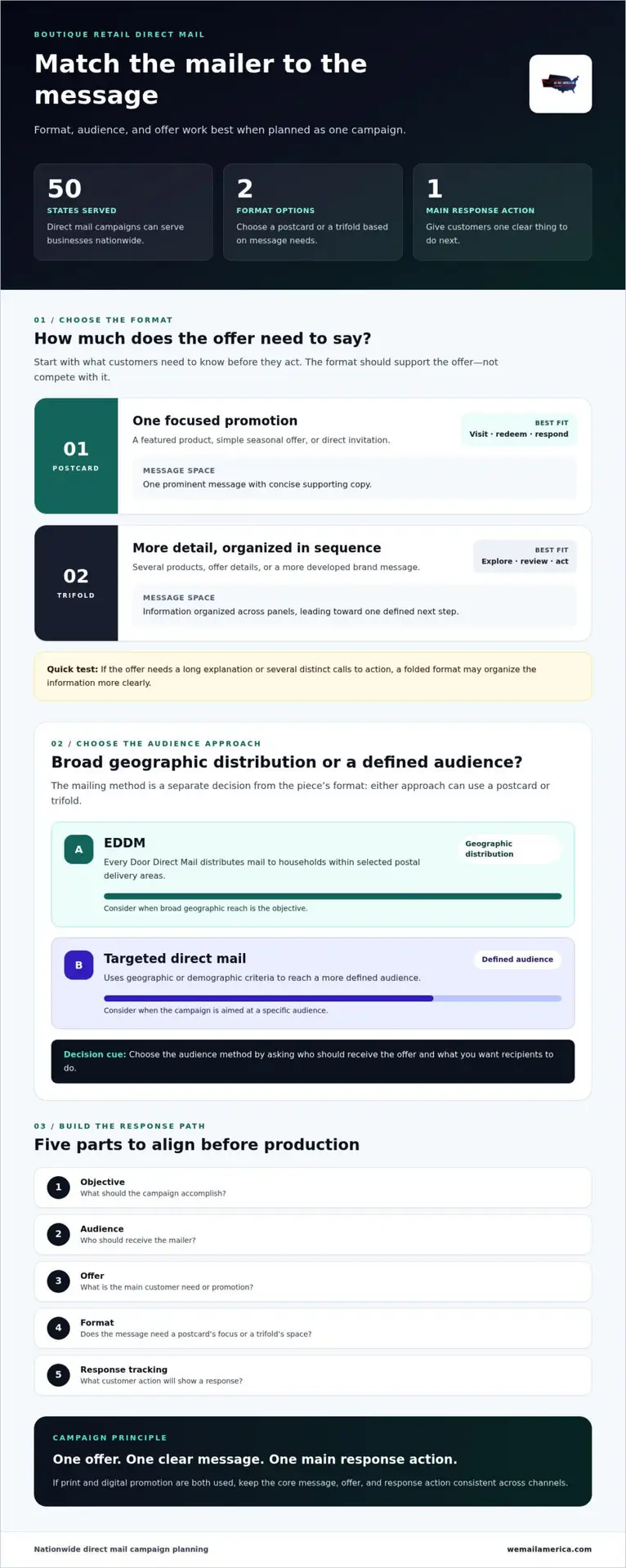
Choose a format according to what customers need to know before they act. A focused promotion may fit on a postcard. An offer with several products, conditions, or details may need the space and sequence of a trifold. Neither format is automatically more effective; the right fit depends on the message and the action you want customers to take.
| Format | Message space | Offer complexity | Best suited customer action |
|---|---|---|---|
| Postcard | One prominent message with concise supporting copy | A featured product or straightforward promotion | Visit, redeem, or respond to one clear offer |
| Trifold | Information organized across panels | Multiple products, offer details, or a more developed message | Explore options, review details, then take a defined next step |
When does a postcard fit a boutique campaign?
A postcard is worth considering for a featured product, a simple seasonal promotion, or a direct invitation. The Impact Post Card – 6 X 11 is We Mail America’s primary postcard offering. Make the offer easy to spot, keep the copy concise, and give customers one main response action. For broader postcard guidance, see Postcard Marketing: The Ultimate Guide.
This focused layout keeps secondary details from competing with the main message. If the offer needs a long explanation or several distinct calls to action, consider whether a folded format would organize the information more clearly.
When might a trifold suit a more detailed offer?
A trifold organizes information across panels, giving a boutique room to introduce several products, explain offer details, or guide readers through a brand message. We Mail America offers the Mini Trifold and Sizeable Trifold. Use the first panel to establish the main reason to read, then arrange supporting details in an order that leads toward one clear action.
Before choosing, review the offer from the customer’s perspective: what must they know, and how much space will it take to explain clearly? For more postcard guidance, revisit Postcard Marketing: The Ultimate Guide. Format and audience strategy are separate decisions. For example, USPS Every Door Direct Mail is a geographic mailing approach, whether the piece itself is a postcard or trifold.
Once you’ve narrowed down the format, a direct mail campaign inquiry can help connect the piece to the rest of your campaign plan.
How Boutique Retailers Can Choose Between EDDM and Targeted Mail
Choose the mailing approach according to whether the campaign needs broad geographic distribution or a more defined audience. Every Door Direct Mail (EDDM) distributes mail to households within selected postal delivery areas. Targeted direct mail uses geographic or demographic criteria to reach a defined audience. Both approaches can support nationwide campaigns, but they suit different objectives.
We Mail America supports direct mail campaigns for businesses across all 50 states. Use your campaign brief to choose the audience and mailing method: consider what you’re promoting, who you want to reach, and what you want recipients to do. For more background, see EDDM vs. Targeted Direct Mail: The 2026 Guide to Nationwide Marketing Strategy.
When is EDDM a practical option for a retailer?
EDDM can suit a campaign designed to reach households across selected postal delivery areas. For example, a boutique promoting a seasonal offer might distribute the same piece across the areas included in its campaign. EDDM is based on delivery areas, rather than selecting named individuals or demographic profiles.
Consider EDDM when geographic distribution supports the campaign objective. Define which delivery areas the campaign should cover and what you want recipients to do. Broad distribution still needs a focused offer and a clear response path, such as visiting or responding for more information.
When can targeted direct mail make more sense?
Targeted mailing can suit a campaign built around a more specific customer profile. Geographic and demographic criteria help define the intended audience instead of distributing the same piece broadly across delivery areas. For example, a boutique can set audience criteria for a particular offer and then present that offer clearly in the mailer.
Use the campaign brief to decide, rather than assuming one method is always better. Clarify the offer, intended audience, geographic scope, and response action first. If broad distribution supports the objective, EDDM may fit. If audience precision is central, targeted mail may be the better approach. We Mail America coordinates consultation, targeting, custom design, printing, and postage as part of campaign support, bringing planning and execution together.
What to Include in a Boutique Mailer for a Clear Customer Response
A strong mailer makes the next step obvious. Build it around one customer need and one main offer, then arrange the details so readers can understand and act without sorting through competing headlines or calls to action. This gives boutique retail marketing mailers a clear purpose: connect the offer to a response you can track.
- Audience need: Identify what matters to the people receiving the mail. A product announcement, for example, should quickly explain why the featured item may interest them.
- Main message: State the campaign’s central idea in a direct headline. Focus on one promotion or reason to engage.
- Offer: Explain what the customer can receive or do. Make the offer easy to understand and state relevant conditions clearly.
- Proof: Support the message with useful, accurate details, such as product features or event information. Avoid unsupported claims.
- Response action: Tell readers exactly how to take the next step, such as visiting, responding, or following a campaign URL.
How should a boutique present its offer?
Give the headline and offer the strongest visual priority. Use product imagery and familiar brand cues to reinforce the main message, not compete with it. Supporting copy should answer the questions customers need resolved before acting, including any relevant offer conditions. Leave out details that don’t clarify the offer or help readers respond.
Choose a response path that fits the action. A QR code can take readers to a digital destination, and a campaign URL can provide another trackable route. Make the prompt clear and ensure the destination continues the same offer and message. Tracking activity through a defined response path can help you assess engagement, though it won’t establish every campaign outcome.
How can mail and digital follow-up work together?
Use the printed piece to introduce the offer, then connect it to a relevant digital follow-up. A QR code might lead to product information or event details; mobile advertising, email campaigns, texting, or connected TV can reinforce the same message. Keep the offer and response action consistent across channels so customers recognize the promotion.
For more on measuring cross-channel activity, see Direct Mail Attribution: Merging Physical and CTV Data. To bring these creative decisions into a coordinated campaign, plan a boutique mailer campaign.
How to Launch a Boutique Retail Mailer Campaign With Less Complexity
A clear campaign brief makes decisions easier before design and production begin. It aligns the offer, audience, format, and response path so each step supports the same goal. For boutique retail marketing mailers, start with these essentials:
- Objective: Decide what the campaign should accomplish, such as introducing a product or promoting an event.
- Audience: Describe who you want to reach and whether broad geographic distribution or a more defined audience fits the goal.
- Offer: Gather the promotion details, key message, and any conditions customers need to understand.
- Format: Choose a postcard or trifold based on how much information the offer needs.
- Response action: Specify what recipients should do and how you’ll track the response.
What should a retailer prepare before campaign planning?
Along with the brief, gather approved brand assets, product imagery, offer details, and any campaign copy that’s ready to use. Note the timing the promotion needs to support, then choose a measurement approach that matches the response path. A QR code or campaign URL, for example, can connect the printed piece to a digital destination and help assess engagement there.
Keep the measurement plan practical. For an event campaign, define the response you’ll track. If the offer leads to a digital page, include that destination in your measurement plan. Decide how you’ll evaluate the campaign before the mailer goes out.
What does full-service campaign support cover?
We Mail America brings consultation, geographic and demographic targeting, custom design, printing, and postage together in its campaign process. This coordinated approach reduces the need to manage each execution step separately and keeps decisions tied to the original brief. Campaigns can use EDDM for broad delivery-area coverage or targeted mail when audience criteria are central to the plan.
Campaign scope can be tailored to the project. Optional digital integrations, including mobile advertising, email campaigns, texting, or connected TV, can support a coordinated approach when they fit the objective. For a broader view of the service, see Direct Mail Advertising Services for Business Growth.
With the brief in place, the format and audience strategy can move into production as one connected plan. Start planning your direct mail campaign.
Turn Your Boutique Mailer Plan Into a Campaign
Effective boutique retail marketing mailers bring the offer, audience, format, and response action together. Choose a postcard for a focused message or a trifold when the offer needs more room. Then decide whether broad geographic distribution or targeted mailing better fits your campaign goal.
A clear brief makes the next steps easier. Define what you’re promoting, who you want to reach, and how customers can respond. We Mail America supports businesses nationwide across all 50 states, coordinating consultation, targeting, custom design, printing, and postage. Optional digital integrations can extend the campaign when they fit your plan.
Ready to move from idea to execution? Start planning your boutique retail mailer campaign with a coordinated approach built around your goals. A clear plan can help put a tangible offer in customers’ hands and make each campaign step easier to manage.
Frequently Asked Questions
Are direct mailers effective for boutique retail marketing?
Direct mail can support boutique marketing by giving an offer a physical presence and a clear way to respond. Results depend on factors such as the audience, offer, format, and campaign execution, so no mailer can guarantee a particular outcome. Use boutique retail marketing mailers to complement other promotion, and set a specific objective, such as event attendance or offer redemptions, so you can evaluate the campaign against its goal.
What type of mailer works best for a boutique retail promotion?
The best format depends on how much information the promotion needs and what customers should do next. A postcard can suit a focused message, featured product, or straightforward offer. A trifold can organize several products or more detailed information across panels. We Mail America offers the Impact Post Card – 6 X 11 and trifold formats. Keep one main message prominent and make the response action easy to spot.
Should a boutique use EDDM or targeted direct mail?
Choose EDDM when you want to distribute mail to households across defined geographic delivery areas. Targeted direct mail uses geographic or demographic criteria to reach a more defined audience. The choice depends on whether broad geographic distribution or greater audience precision better fits your objective. We Mail America serves businesses across all 50 states, with campaign targeting shaped around each mailing’s goals.
How much do boutique retail marketing mailers cost?
Campaign fees are project-based, so the total depends on the scope of the mailing. Planning can include consultation, geographic and demographic targeting, custom design, printing, and postage. Optional digital advertising, such as texting or connected TV, may also be included with a mail campaign. Since there isn’t one fixed campaign price, define the audience, format, and campaign components to establish the project scope.
Can boutique mailers include a QR code or digital response option?
Yes. A boutique mailer can include a QR code or campaign URL that directs customers to a digital destination, such as product information or event details. Make sure the destination matches the printed offer and clearly guides visitors to the next step. Mail campaigns can also be coordinated with optional digital advertising integrations, including mobile ads, email campaigns, texting services, and connected TV advertising.
How do I measure responses from a boutique direct mail campaign?
Choose a response path that connects to your campaign objective. For example, use a unique campaign URL or QR code for online visits, or track how many customers redeem a specific printed offer. Record the response you’ve chosen to measure, then compare it with the campaign goal. Tracking helps you understand engagement through that path, though it won’t necessarily capture every way a mailer influences a customer.
Can a direct mail company manage design, printing, and mailing together?
Yes. We Mail America provides full-service campaign support that brings consultation, targeting, custom design, printing, and postage together. This coordinated approach can reduce the work of managing separate campaign steps. Businesses can choose EDDM or targeted mailing based on their audience strategy, and add digital advertising integrations when they fit the campaign. We Mail America serves customers nationwide across all 50 states.