
What if a broad mailing could reach more people without losing sight of who’s most likely to respond? That’s the opportunity behind well-planned bulk mail advertising. You may be weighing a wide geographic mailing against a more targeted campaign, while deciding how to manage audience selection, printing, and follow-up.
The key is to plan reach, audience, and response as parts of one campaign. Start with a defined audience, a relevant offer, and a clear next step. Coordinating physical mail with digital advertising can create additional opportunities for prospects to notice the message and respond.
This article explains how broad and targeted mailing approaches differ, how geographic and demographic targeting can shape a campaign, and how to connect a mail piece to measurable responses. You’ll also see how consultation, design, printing, and mailing can work together with digital follow-up to reach customers across all 50 states.
Key Takeaways
- Choose a broad or targeted bulk mail advertising approach based on your campaign goal, audience, and capacity to follow up.
- Use geographic targeting to define where your mail goes and demographic targeting to refine who it’s intended to reach.
- Match the mail format to your message: postcards offer a direct visual experience, while tri-folds can support more detailed content.
- Build the campaign around one clear offer and a primary response action, then decide how you’ll track and follow up on responses.
- Coordinate consultation, targeting, design, printing, and postage with a partner that supports campaigns nationwide.
What Is Bulk Mail Advertising, and When Does It Fit a Business Goal?
Bulk mail advertising is a coordinated mailing of promotional materials to a sizable intended audience, planned around a specific marketing goal and response. The number of pieces sent doesn’t determine whether a campaign succeeds. Recipients need a reason to care, and the mailer needs to make the next step clear.
Unlike digital messages competing for screen attention, a physical mail piece arrives in a mailbox and can be handled, set aside, or revisited. That tangible presence gives a business another way to present its message. Advertising mail, also known as direct mail, is a key component of bulk mail advertising. The format works best when the mailing has a defined purpose, such as building awareness, generating leads, promoting an offer, or re-engaging past customers.
Match the campaign’s reach to its objective. A broad mailing can introduce a brand or announcement to a wide audience. A more selective campaign can focus on people who fit a defined customer profile. In either case, clarity matters more than sheer volume: recipients should quickly understand what’s being offered and what action to take.
How does a bulk mail advertising campaign work?
Plan before production. Set the goal and decide how you’ll recognize a response. Then define the intended audience and choose a mailing approach that fits. Shape the offer and call to action before designing the piece, so the headline, visuals, and copy all point toward the same response.
Next come design, printing, and mailing, followed by tracking and response handling. These stages connect, but preparing and sending a mail piece is not the same as giving it a useful marketing focus. A mailing can be delivered yet fall short of its purpose if the offer is unclear or no one is ready to handle responses. Keep one offer or action at the center, such as requesting information, visiting a website, or redeeming a promotion. That gives recipients a clear path and gives the business a practical basis for reviewing responses.
Which businesses can use bulk mail advertising?
Bulk mail advertising can suit businesses seeking broad awareness as well as organizations with a defined audience. A service business might introduce an offering and invite inquiries. A retailer could promote a seasonal deal. A nonprofit or membership organization might share a program update and encourage people to learn more. These are campaign possibilities, not guaranteed outcomes: relevance and a clear response path still matter.
A national campaign doesn’t have to use identical messaging for every recipient. A business can organize its audience into meaningful segments and adapt the offer or message for each group while keeping the overall goal consistent. For example, different customer groups may need different information before taking the same primary action. This approach helps make a large mailing more purposeful without losing its direction.
How Bulk Mail Advertising Combines Audience Targeting and Mail Formats
Audience and format work as a pair. Geographic targeting defines where a campaign is sent, such as selected delivery areas within a national campaign. Demographic targeting defines who the campaign is designed to reach, using audience characteristics relevant to the offer. A business can use either approach or combine them, depending on how specifically it needs to focus its message.
Every Door Direct Mail (EDDM) is a broad geographic approach, while targeted direct mail uses audience selection to focus a mailing on a defined group. Broad reach can support general awareness; a more selective audience may make sense when an offer is intended for a particular customer profile. The USPS explains its Every Door Direct Mail (EDDM) service. Compare EDDM and targeted direct mail against the audience and response you want, rather than choosing by reach alone.
When should a business use EDDM or targeted direct mail?
Consider whether your goal depends more on coverage or audience fit. EDDM can help put a message into a broad geographic area. Targeted mail suits campaigns that need to speak to a more specifically defined audience. For example, a general brand introduction may call for wider reach, while a specialized offer may benefit from a more selective audience definition. The right choice depends on the campaign objective and the information recipients need.
Before choosing an approach, write down who the offer is for and what you want recipients to do. If the audience description is broad, geographic reach may be central to the plan. If the audience includes distinct customer characteristics, targeted selection can help shape a more relevant message. We Mail America’s direct mail advertising services bring audience planning and mail production together.
How do postcards and tri-fold mailers serve different messages?
A postcard puts the message in view at a glance. It suits a concise offer, a strong visual, and one prominent response action, such as visiting a website or requesting information. The Impact Post Card – 6 X 11 is one available format. Its role is to carry a focused message, not to guarantee a particular response.
A tri-fold mailer gives the reader a more structured experience. Its panels can organize a sequence: introduce the offer, explain key details, then present the next step. That can help when a campaign needs to communicate several related points, but each panel should support the same central message. Too much copy can compete with the offer and make the response action harder to find.
Use this simple match-up:
- Concise offer: choose a postcard with a clear headline and visible response action.
- More information: use a tri-fold to guide readers through the story in sections.
- Broad coverage: consider a geographic approach like EDDM.
- Defined audience: consider targeted selection and tailor the message to that group.
Make the decision in order: define the audience, clarify the offer, choose the response action, then select the format that presents all three with the least friction. This keeps the mail piece focused and makes the campaign easier to evaluate.
How to Compare Bulk Mailing Approaches Before You Commit
Compare mailing approaches against the job they need to do, not just their reach or appearance. Start with three questions: What is the campaign objective? How specifically can you define the audience? Can your team manage responses and follow-up? These criteria help you weigh broad geographic distribution against a more selective audience, then choose a mail piece that fits the message.
Audience breadth guides who receives the mail, while message complexity guides how much space the mail piece needs. Use that distinction to evaluate the approach and the format separately. A larger piece doesn’t automatically make an offer clearer or a campaign more effective.
Decision factor
Broad geographic reach
More selective targeting
Audience selectivity
Prioritizes coverage across a defined delivery area.
Prioritizes a defined audience profile.
Message complexity
Often pairs well with one memorable message for a wide audience.
Can tailor the message to a specific group or offer.
Follow-up needs
Plan how to capture broad interest and direct responses.
Prepare a response path suited to the intended audience.
What should you compare when selecting a mailing approach?
Consider whether you can define the audience by where recipients are or by characteristics that make them a closer fit for the offer. Then assess the copy. A single benefit and one action may need little explanation; a service with several features may need more room to make its value clear. Finally, decide whether mail will stand alone or connect with digital touchpoints, such as texting or connected TV. Include those channels when your team can coordinate the message and handle responses.
How should campaign goals shape format and targeting choices?
For awareness, define the reach strategy first, then build a recognizable central message that makes sense quickly. For lead generation, focus the offer on a specific need and make the response action easy to understand. A postcard may suit a concise promotion, while a tri-fold can organize additional details. Neither format is automatically better; select it based on what recipients need to know before acting.
Keep measurement distinct from format selection. Before mailing, decide what counts as a response and how you’ll record it, such as inquiries or visits tied to the campaign. Afterward, review the response against the original objective. That helps you assess whether the audience, offer, and follow-up plan worked together, rather than treating a large mailing or eye-catching format as proof of success.
How to Plan a Bulk Mail Advertising Campaign Step by Step
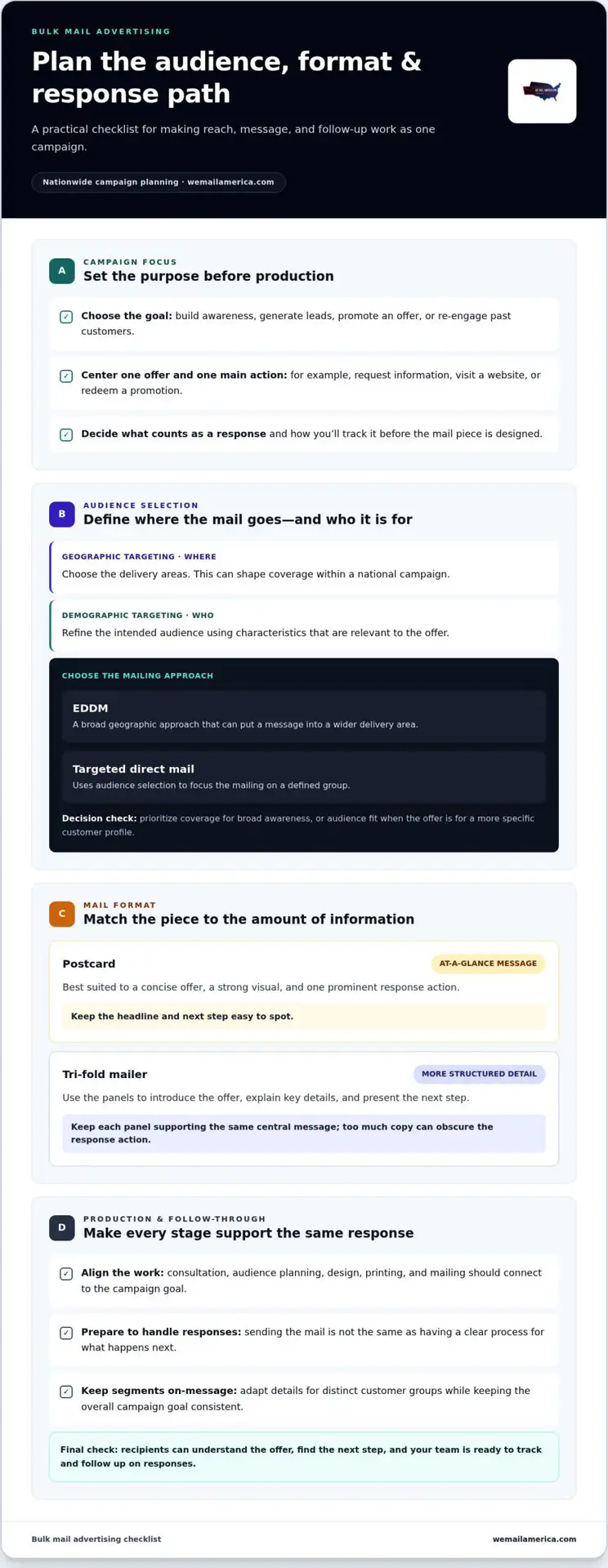
A strong campaign moves from a clear business objective to a mail piece and follow-up plan that support it. Use this sequence to make the key decisions before production begins.
- Define the goal. Decide whether the campaign should build awareness, generate inquiries, promote an offer, or re-engage customers. Choose a practical signal of progress, such as inquiries received or visits to a campaign destination.
- Describe the audience. Identify who should receive the message and what makes the offer relevant to them. This description will guide your mailing approach and the language you use.
- Select the approach. Choose broad geographic reach or more selective targeting based on the goal and audience. Consider the scope your team can coordinate and support.
- Shape the offer. Lead with one benefit and make one primary response action easy to spot. Recipients should quickly understand what’s being offered and what to do next.
- Plan follow-up. Decide who will handle inquiries, how responses will be recorded, and whether digital touchpoints will reinforce the mail campaign.
Plan in order: set the goal, define the audience, choose the mailing approach, focus the offer, and prepare follow-up before production. That sequence keeps the campaign connected from the first decision through the response.
How do you prepare the offer and creative for mailing?
Start with the benefit that matters most to the intended audience. Keep the headline and main visual focused on that benefit, then make the next step prominent, whether it’s calling or visiting a campaign destination. Supporting details should answer useful questions without competing with the offer. If the piece feels crowded, remove information that doesn’t help recipients decide or respond.
Before approving production, pause for a review. Confirm that the audience fits the offer, the creative makes the benefit and action clear, the mailing scope matches the objective, and the teams responsible for production and responses are coordinated. This checkpoint can catch mismatches while changes are still manageable.
How can you connect mail with campaign follow-up?
Prepare your response process before the mailing begins. Assign responsibility for incoming calls or inquiries, decide how staff will record them, and make the next step clear for each response. A trackable direct mail response starts with a response mechanism that fits the offer, such as a dedicated campaign destination or a clear prompt to call. Choose a method your team can monitor consistently; don’t assume every response will be attributed perfectly.
Digital follow-up can extend the campaign rather than replace the physical mail. Mobile ads, email, texting, or connected TV may reinforce the same offer across channels. Keep the message and response action consistent, then review the results against the original goal.
To coordinate audience planning, creative, printing, mailing, and follow-up, start planning your direct mail campaign with We Mail America.
How We Mail America Supports Nationwide Bulk Mail Advertising
Planning, production, and follow-up all shape a mail campaign. We Mail America brings these stages together for businesses reaching audiences across all 50 states. Coordinate campaign consultation, geographic and demographic targeting, custom design, printing, and postage around one defined objective instead of treating each task as a separate project.
The process starts with the campaign itself: its goal, intended audience, offer, and response action. Those decisions guide the mailing approach and creative direction. The Impact Post Card – 6 X 11 is the primary postcard offering, while the right piece and message depend on what the campaign needs to communicate. The focus is on connecting audience and offer, not making unsupported promises about results.
What does full-service campaign support bring together?
Coordinated support connects the work from planning through mailing. Consultation helps frame the campaign; targeting defines whom it’s meant to reach; custom design brings the offer and response action into a clear mail piece; printing and postage prepare it for mailing. When these stages are aligned, decisions made early can inform the work that follows.
This brings planning, creative production, printing, and mailing together in one campaign. You still set the business objective and approve the message. The aim is to keep each component organized around that shared plan.
How can a nationwide campaign add digital touchpoints?
Physical mail can anchor a campaign, with digital advertising extending the message onto screens. Depending on the campaign plan, mobile ads, email, texting, or connected TV can reinforce the same offer and response action. For example, a mail piece might introduce a service, while coordinated digital messaging helps keep the offer visible to the intended audience. Digital follow-up complements the mail; it doesn’t replace the tangible piece.
Keep the core message consistent across channels, but shape each touchpoint for how people encounter it. The mailer can carry a focused offer and next step, while digital placements repeat or support that message. This helps the campaign stay recognizable across formats and gives the business a coordinated way to guide interest toward a response.
To discuss an integrated direct mail and connected TV campaign, share the objective, audience, offer, and desired follow-up in the advertising inquiry form. We Mail America can coordinate the campaign plan, mail production, and digital touchpoints.
Turn Your Campaign Plan Into the Next Step
Make your first campaign a clear starting point for what comes after. Decide what response you’ll watch, how you’ll record it, and what you might adjust in a future mailing. A focused test of your audience, offer, or response action can give your team useful direction for future planning without requiring every campaign decision to be made at once.
With bulk mail advertising, progress starts with a practical plan: define what you want to learn, give recipients a clear way to respond, and make time to review what happens. That turns a mailing into more than a one-time announcement and gives your next decision a stronger foundation.
Start your bulk mail advertising inquiry and take the next step toward a campaign built around your business goal. Your next customer connection can start with a well-planned piece of mail.
Frequently Asked Questions
How much does bulk mail advertising cost?
Bulk mail advertising is priced according to the campaign’s scope, rather than at one standard rate. We Mail America charges on a per-campaign project basis for full-service work. The total depends on the selected mail format, audience and mailing scope, production needs, postage, and any digital advertising included. Before requesting a campaign estimate, outline what you want to send and whom you want to reach.
Is bulk mail advertising effective for small businesses?
It can be a practical option for a small business when the intended audience and offer are clearly defined. For example, a business with a new service could use a mailing to introduce it and invite inquiries. Start with an audience you can serve and a response process your team can manage. Evaluate the campaign against its stated purpose, such as generating inquiries, rather than expecting mail volume alone to produce results.
What is the difference between bulk mail and EDDM?
Bulk mail describes a sizable coordinated mailing, while Every Door Direct Mail (EDDM) is a particular geographic delivery approach offered by USPS. EDDM suits broad delivery-area coverage; other bulk campaigns can use audience selection to focus on a defined customer group. Decide whether coverage or audience selectivity matters more before shaping the offer and production plan.
Can bulk mail advertising be personalized?
Yes. A campaign can tailor its message to audience segments, such as presenting different benefits to different customer groups. Personalization doesn’t require every piece to have entirely unique content. Even adjusting the headline, offer, or response prompt by segment can make the message more relevant. Keep the campaign’s central objective consistent, and make sure each variation is accurate and easy for its intended reader to understand.
How many pieces do you need for a bulk mail campaign?
There isn’t one quantity that fits every campaign. The appropriate volume depends on the selected mailing approach, how broadly you want to reach, and the audience you can serve. Set the audience and campaign scope first, then plan the number of pieces around that decision. Formal postal classifications may have specific preparation and volume rules, so confirm applicable USPS details for the chosen mailing method before production.
How can a business measure responses to bulk mail advertising?
Choose a response indicator before mailing. A dedicated campaign webpage, a promotion code, or a phone number used for that offer can help your team identify responses associated with the piece. Record inquiries consistently and compare them with the campaign’s goal. These methods support measurement, but don’t guarantee that every response will be attributed to the mail, especially if customers encounter other marketing along the way.
Can bulk mail advertising be combined with digital ads?
Yes. A mail campaign can be coordinated with mobile ads, email, texting, or connected TV. For example, a mailer might introduce an offer, while a digital message reinforces it and directs recipients to a response destination. Keep the core message aligned across channels, but adapt its presentation to each format. Treat digital advertising as an extension of the physical mail, not a replacement for it.