

What if one direct mail campaign could reach multiple ZIP Codes without sending every audience the same message? Coordinating multi-zip code mailings means treating the campaign as one coordinated effort while planning for each market as a distinct segment. Different areas may call for different audience criteria, creative versions, quantities, or schedules. Without a clear plan, those moving parts can be difficult to track.
A repeatable process makes the work more manageable. It helps you choose the right targeting approach for each market, organize files and mailing details, and keep the message consistent where it matters. This guide explains how to plan ZIP Code segments, coordinate campaign components, and evaluate results. It also compares targeted mail and EDDM, which can support different goals, from reaching selected households to building broader geographic coverage across the country.
Key Takeaways
- Set one campaign objective, then define the audience, offer, quantity, and timing for each ZIP Code segment.
- Choose targeted mail or EDDM based on whether you need to reach selected households or cover eligible carrier routes.
- Organize artwork, audience files, quantities, and segment instructions in one version-control system to reduce mix-ups.
- Use a repeatable workflow, from segment planning through reporting, to make coordinating multi-zip code mailings easier.
- Bring consultation, geographic and demographic targeting, design, printing, and postage together to manage a nationwide campaign across all 50 states.
Why coordinating multi-ZIP code mailings takes more than one address list
A multi-ZIP mailing is one coordinated direct mail campaign sent to audiences in multiple ZIP Code areas. ZIP Codes help identify geographic areas for postal delivery, but a list of codes alone doesn’t define who should receive each piece or what they should see. Learn about the ZIP Code system as geographic context, then build a campaign plan that connects each area to its audience, offer, creative, quantity, and schedule.
That’s the difference between coordinating multi-zip code mailings and simply combining addresses. A campaign can have one business objective while its market segments require different decisions. For example, a national brand might promote the same core service everywhere but adjust the offer or supporting message for distinct customer groups. Make those choices explicit before production begins.
What needs coordinating when a campaign spans ZIP Codes?
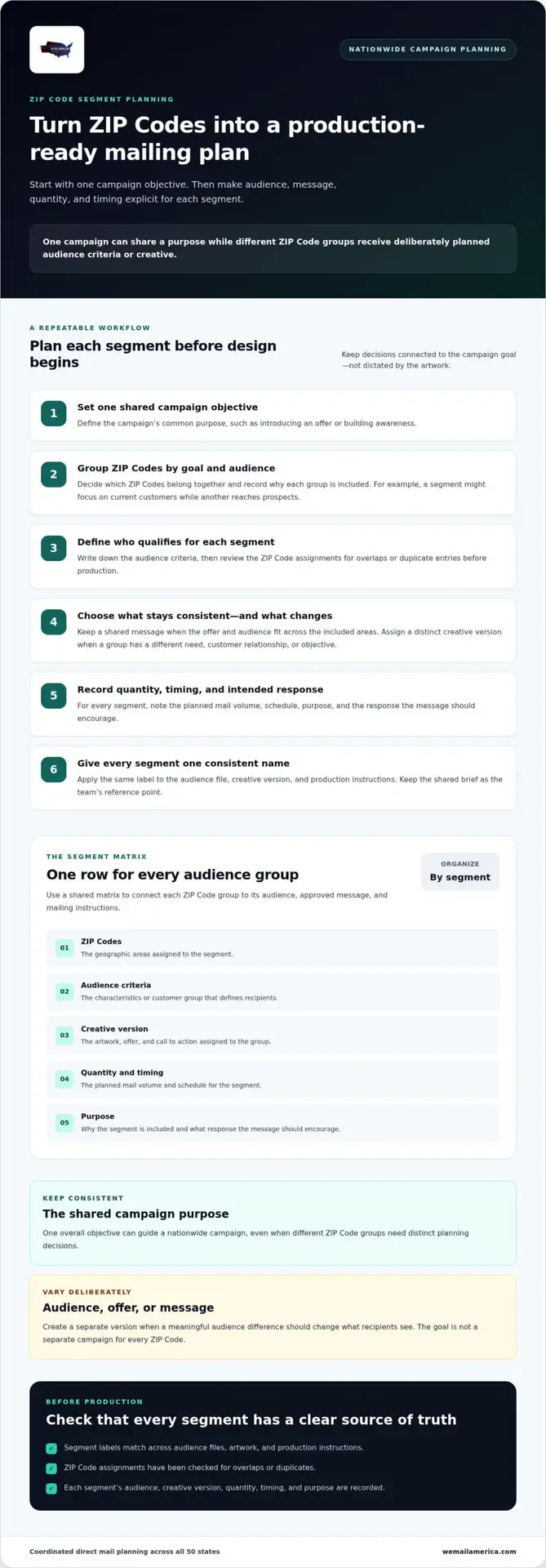
Give each segment a consistent name and record its key details in a shared campaign brief. This keeps variations visible and connects the right files, artwork, quantities, and schedules to each audience.
- Audience: Define who qualifies for each segment and which ZIP Codes it includes.
- Offer and creative: Note whether the segment uses the shared message or a specific version.
- Quantity and schedule: Track the planned mail volume and timing for that segment.
Use a repeatable naming pattern, such as “Segment A, Core Audience” or “Segment B, New Customers.” Apply the same label to the audience file, creative version, and production instructions. A shared brief gives the team one reference point for what stays consistent and what changes by market. That’s more reliable than depending on memory or scattered notes.
When should one campaign use multiple market segments?
Create segments when a meaningful difference should change the audience, offer, or message. A business serving customers nationwide might separate current customers from prospective customers, or pursue different campaign objectives across ZIP Code groups. Those distinctions help you plan relevant mail while preserving the campaign’s shared purpose.
Keep one message when the offer and audience fit across all included areas. Vary the creative when a segment has a different need, customer relationship, or objective. For example, a general awareness message may work across the campaign, while a customer-focused version may suit an existing-customer segment. The goal isn’t to create a separate campaign for every ZIP Code. It’s to make deliberate choices for each segment and manage them under one plan.
How to structure ZIP Code segments before designing a mailing
Set the campaign plan before creative work begins. Start with one shared objective, such as introducing an offer or building awareness. Then decide which ZIP Codes belong together, who qualifies for each audience, and whether each group needs its own message. This sequence keeps design decisions connected to campaign goals instead of letting the artwork dictate the audience.
Build a segment matrix to make the plan easy to review. Give every segment a consistent name and record:
- ZIP Codes: The geographic areas assigned to the segment.
- Audience criteria: The characteristics or customer group that define recipients.
- Creative version: The artwork, offer, and call to action assigned to that group.
- Quantity and timing: The planned volume and schedule for the segment.
- Purpose: Why the segment is included and what response the message should encourage.
Build a segment map that connects ZIP Codes to campaign goals
Group ZIP Codes according to both the campaign objective and the intended audience. One segment might focus on current customers, while another reaches prospects in areas included in the campaign. Record the reason for each grouping and the action you want the mailer to prompt. Before production, look for overlapping or duplicate ZIP Code entries so you can resolve them deliberately instead of discovering them in the files.
Keep the overall goal distinct from segment-level choices. A nationwide campaign can share one objective while using different audience criteria in different ZIP Code groups. If geography determines delivery rather than a selected recipient profile, the USPS guide to Every Door Direct Mail (EDDM) provides useful background on route-based planning.
Match audience and creative decisions to each segment
Decide what stays consistent across the campaign, such as brand identity or the core offer, and what changes by audience. Assign each segment an approved creative version, offer, and call to action in the matrix. This gives design, printing, and mailing instructions one clear source of truth.
Variable data can support personalization when the campaign calls for it and the relevant information is available and organized for use. Before finalizing audience criteria, review your records and use this practical guide to cleaning a mailing list. A well-organized file makes segment assignments easier to review. Once your plan is ready, discuss your direct mail campaign with We Mail America. We coordinate targeting, design, printing, and postage for businesses across all 50 states.
Targeted ZIP Code mailings vs. EDDM: choose the right approach
A ZIP Code is a geographic starting point, not a guarantee that two mailing approaches will reach the same households. Targeted mail selects recipients using available audience criteria within the chosen areas. EDDM, or Every Door Direct Mail, uses eligible carrier routes to provide broad geographic coverage rather than selecting individual households by profile. The USPS Every Door Direct Mail guide explains the route-based option.
Choose based on the campaign’s intended reach. If you need to focus on a defined customer group, targeted mail lets you align audience criteria with ZIP Code segments. If broad coverage across eligible routes is the priority, EDDM may be a better fit. For more on the tradeoffs, see our EDDM versus targeted direct mail guide.
| Planning factor | Targeted mail | EDDM |
|---|---|---|
| Targeting control | Select recipients using available audience criteria. | Choose eligible carrier routes for geographic coverage. |
| Intended reach | Reach a defined audience within selected ZIP Code areas. | Reach broadly across selected routes. |
| Message variation | Assign different creative or offers to distinct audience segments. | Use a shared message for broad route coverage, or coordinate planned variations by segment. |
| Planning needs | Define audience criteria and organize recipient data by segment. | Map the routes and areas that support the campaign’s coverage goal. |
When does a targeted mailing list fit a multi-ZIP campaign?
Use targeted mail when the campaign defines who should receive the piece, not just where delivery should happen. Audience criteria can distinguish customer groups across ZIP Codes. For instance, one segment might be intended for existing customers and another for prospects. Assign each group its approved creative or offer in the campaign plan. This approach supports audience selection, but it doesn’t guarantee a particular response or business result.
When is EDDM worth considering across multiple ZIP Codes?
Consider EDDM when broad geographic coverage matters more than selecting households individually. Its route-based structure can suit a campaign designed to reach a wider audience across chosen areas. A ZIP Code may contain multiple routes, so plan around the intended coverage rather than assuming that choosing a code alone defines the audience.
When coordinating multi-zip code mailings, match the method to each segment’s goal. A campaign can use targeted mail where audience criteria matter and EDDM where route coverage is the priority. We Mail America coordinates consultation, targeting, design, printing, and postage for campaigns nationwide. Plan a multi-ZIP mailing campaign with support across all 50 states.
A practical workflow for coordinating production across ZIP Codes
Once the segments are set, move each one through the same production checkpoints. A repeatable sequence keeps artwork, audience files, quantities, and mailing instructions connected from approval through reporting.
Use this sequence: approve the segment map, assign creative versions, confirm quantities, review proofs and destination assignments, release the mailing, then measure responses by segment. Reusing the same workflow gives every ZIP Code group a clear path through production.
Keep files, versions, and mailing instructions aligned
Use one shared version-control system, such as a master campaign tracker with links to approved files. Apply the same segment identifier to each audience file, creative version, quantity record, and production instruction. If artwork changes, update the tracker and mark the approved version. Avoid relying on separate email threads or filenames that don’t clearly identify the intended segment.
Before release, reconcile each planned quantity with the audience assigned to that segment. Then compare the final proof with the segment map. Confirm that the creative version, offer, call to action, and destination instructions match. A preproduction check can catch mix-ups while they’re still straightforward to correct:
- Segment match: Does each ZIP Code group point to the intended audience file?
- Creative match: Is the approved artwork assigned to the correct segment?
- Quantity match: Do the planned quantities align with each segment’s audience and mailing approach?
- Release check: Are proofs and destination assignments approved before materials move forward?
Measure results by segment, not just by campaign total
Campaign-wide totals can hide differences between markets. Assign each segment a consistent response-tracking method, such as a distinct response code or landing page. Record the method in the campaign tracker so you can connect results to the right audience and creative version.
Compare segments using the same response definitions and, where possible, the same observation window. That makes comparisons more useful without implying that geography alone caused a result. If the campaign also includes digital advertising, track and connect channel activity deliberately. The direct mail attribution guide discusses ways to consider physical mail alongside connected TV data.
Coordinating multi-zip code mailings works best when one source of truth follows the campaign from segment approval through measurement. We Mail America brings consultation, targeting, design, printing, and postage together for businesses across all 50 states. Plan your multi-ZIP mailing workflow.
How We Mail America supports nationwide multi-ZIP mailing campaigns
Coordinating multi-zip code mailings takes more than choosing areas on a map. Each segment needs to connect to the campaign goal, audience, message, and production plan. We Mail America brings consultation, geographic and demographic targeting, custom design, printing, and postage together in one coordinated process for businesses across all 50 states.
Bring campaign planning and mailing components together
Start with the campaign objective and ZIP Code segments. Consultation helps establish the targeting approach, while geographic and demographic criteria can shape which audiences belong in each segment. Then keep creative and production decisions tied to the plan: connect each design version to its intended audience, and align quantities and mailing instructions with the same segment structure.
This coordinated workflow gives campaign components a shared reference point without requiring every market to receive identical content. Clear segment labels help keep audience files, artwork, quantities, and instructions aligned from planning through printing and mailing. Explore direct mail campaign planning to see how those pieces can come together for a national mailing.
Mail can also anchor a broader campaign. Mobile ads, texting, email, or connected TV can be optional extensions when they support the campaign’s goals. They aren’t requirements for a coordinated ZIP Code mailing. Use them selectively, with clear segment and measurement plans, so each channel has a defined role.
Decide what to include in the campaign brief
A concise brief gives everyone a clear starting point. Include the campaign goal, ZIP Code segments, audience criteria, core message, and desired timing. Then identify which segments share creative and which need distinct versions. Note the offer and call to action for each version, along with planned quantities and other production details relevant to the campaign.
- Campaign scope: State the objective and the ZIP Code areas included.
- Audience: Describe the criteria for each segment.
- Creative: Assign the message, offer, and version to each group.
- Timing: Share the desired schedule without assuming a specific delivery date.
- Extensions: Identify any optional digital channels and the role they should play.
The more clearly the brief connects goals to segments, the easier it is to coordinate targeting, design, printing, and postage. Keep the campaign organized from the first planning conversation through execution. Plan a multi-ZIP mailing campaign with We Mail America.
Make Your Next Multi-ZIP Campaign Easier to Manage
A coordinated mailing starts with one clear campaign goal, then builds distinct ZIP Code segments around audience, message, quantity, and timing. Choose targeted mail when you need to reach selected audiences, or consider EDDM when broad route coverage better fits the objective. Keep files, creative versions, and instructions aligned so each segment moves through production with less confusion.
Coordinating multi-zip code mailings doesn’t mean every recipient must receive an identical message. It means managing market variations under one organized plan. We Mail America supports businesses nationwide across all 50 states, bringing consultation, targeting, design, printing, and postage together to keep campaign components connected.
Ready to put your segment plan into action? Plan your multi-ZIP mailing campaign with We Mail America. A clear plan and coordinated production help your campaign reach audiences across the country with purpose.
Frequently Asked Questions
How do you coordinate a direct mail campaign across multiple ZIP Codes?
Coordinating multi-zip code mailings means managing one campaign through clearly defined segments. Set a shared goal, group ZIP Codes by geography or audience criteria, then choose targeted mail or EDDM for each segment. Assign its audience, creative, offer, quantity, and schedule. Keep identifiers consistent across files and artwork, review proofs and destination details before release, and track responses by segment. This organizes broad reach without treating every market as one audience.
Can one postcard campaign use different messages for different ZIP Codes?
Yes. One postcard campaign can use different creative, offers, or calls to action for distinct ZIP Code segments. Start with a shared campaign objective, then decide which details should stay consistent and which should reflect audience needs or campaign goals. For example, one version might address current customers while another speaks to prospective customers. Label each approved version clearly and match it to the intended segment before production.
Is EDDM the same as targeting individual ZIP Codes?
No. EDDM is a route-based approach for broad geographic coverage, while targeted mail selects recipients using available audience criteria. Choosing a ZIP Code doesn’t mean both approaches select the same households. With EDDM, the plan focuses on eligible carrier routes. With targeted mail, the focus is on the selected audience within chosen areas. Choose the method that best fits whether the campaign prioritizes broad reach or audience selection.
How many ZIP Codes can be included in one direct mail campaign?
There isn’t one universal number that applies to every campaign. The workable scope depends on the campaign’s goals, targeting approach, audience criteria, creative versions, quantities, and production plan. A campaign may cover multiple ZIP Codes or audiences nationwide, but each segment should be documented and organized. We Mail America serves businesses across all 50 states, coordinating campaign components around the planned markets and mailing approach.
What information should a multi-ZIP mailing plan include?
Include the campaign objective, ZIP Codes assigned to each segment, audience criteria, offer, creative version, planned quantity, and desired timing. Record what each segment is meant to accomplish and identify any shared or distinct messaging. Use consistent segment names across audience files, artwork, and production instructions. This gives the team a practical reference for reviewing the campaign, resolving overlaps, and keeping each version connected to its intended audience.
How can I measure results from mail sent to multiple ZIP Codes?
Use a consistent tracking method for each segment, such as a distinct response code or landing page, and record the audience and creative version it corresponds to. Compare outcomes using the same response definitions and, where possible, the same observation window. Review results by segment as well as for the campaign overall, since total responses can hide differences between audiences. If digital channels are included, track their activity separately and consider how it connects to mail.