

What if the best way to reach families isn’t to send every household the same offer? A family with toddlers may have different priorities from one with teenagers, and household needs can’t be reduced to stereotypes. Effective direct mail marketing to families starts with understanding who you want to reach and giving them a clear reason to respond.
It’s not always obvious whether to cast a wide geographic net or use targeted outreach. Even a well-targeted campaign can fall flat if the message feels generic or the next step is unclear. This guide shows you how to connect mail to relevant household needs, choose an approach that fits your audience, and create a straightforward response path. You’ll also learn how tangible mail can reinforce digital advertising, from mobile ads and texting to connected TV. With coordinated planning, businesses can reach households across all 50 states and keep each step, from targeting through mailing, organized.
Key Takeaways
- Build your audience from customer knowledge, not assumptions about family structure or purchase intent.
- Choose geographic saturation or demographic targeting based on your campaign goal. Neither guarantees every recipient fits your audience.
- Make direct mail marketing to families actionable by setting a clear objective, defining the audience, focusing the message, and tracking responses.
- Use one clear benefit, an easy-to-read layout, and a direct next step so recipients know what to do.
- Coordinate planning, targeting, design, printing, and mailing to keep a nationwide campaign organized from start to finish.
Why Direct Mail Marketing to Families Starts with Relevance
Family households aren’t one audience with one routine. They include different household structures, children at different stages, caregivers with varied schedules, and adults making decisions around different priorities. Start by identifying what the advertised business can genuinely help with, then shape the offer for people who may value it. That’s the foundation of direct mail marketing to families.
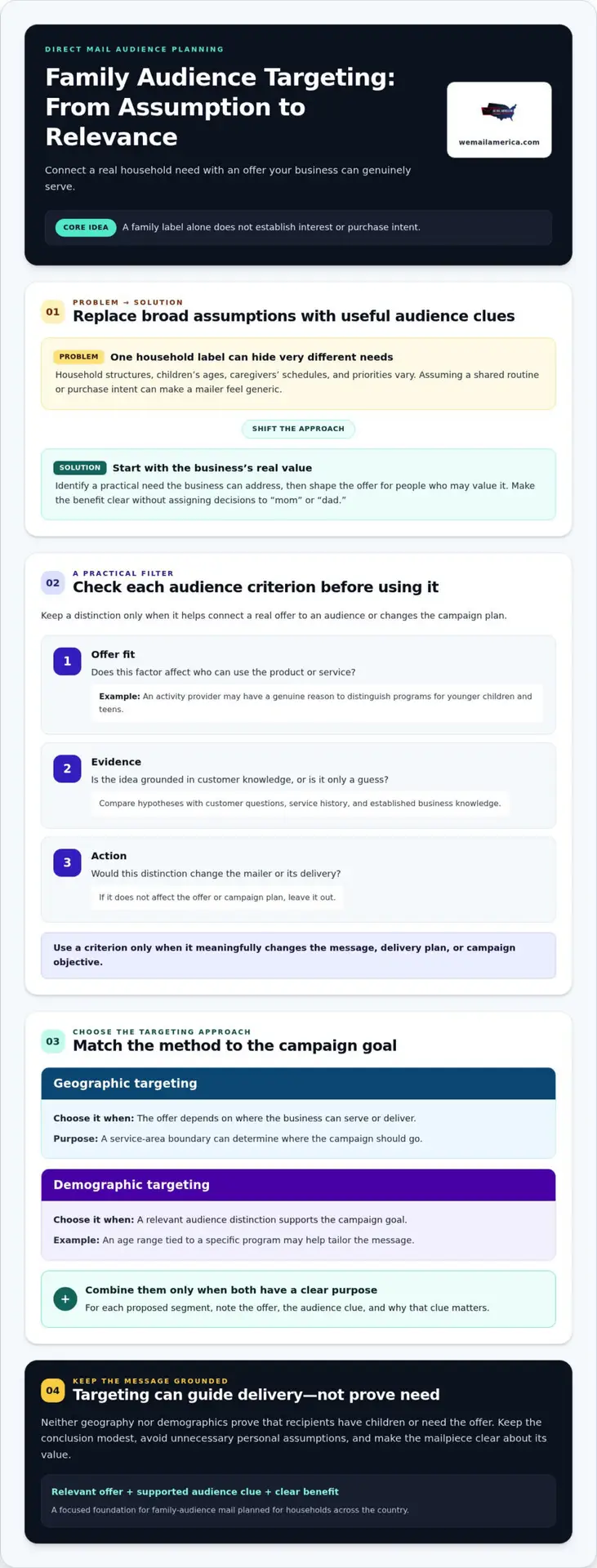
Family-focused direct mail is messaging and delivery planned around relevant household needs, not a one-size-fits-all assumption about parents, children, or family life. The distinction matters. A household with young children may welcome one kind of practical offer, while adults caring for teens or older relatives may value something else. A family label alone doesn’t establish interest or purchase intent.
Direct mail includes different formats and targeting methods. Advertising mail offers a broader overview. For a campaign, the practical question is simple: does the piece give its intended recipient a clear, useful reason to pay attention?
What makes a message relevant to family households?
Start with a practical need your business can address. A healthcare provider might highlight a service that helps patients plan appointments; a family-oriented restaurant could promote a convenient meal option. These are examples, not universal family preferences. Speak to adults inclusively, avoid assigning decisions to “mom” or “dad,” and make the benefit easy to grasp at a glance. One focused promise is stronger than a pile of unrelated offers.
Before approving the mailer, review it from the recipient’s perspective:
- Does the offer connect to a need the business actually serves?
- Can a household understand the main benefit quickly?
- Does the wording avoid assumptions about who shops, cares for children, or makes decisions?
If the answer to any question is no, refine the message. A tangible postcard can earn a second look, but clarity gives the reader a reason to keep it or act.
Why is family marketing broader than back-to-school?
School season can provide a timely angle when the offer fits, but it’s only one possible occasion. Household needs can also connect with everyday services, changing routines, celebrations, or other milestones. Use these moments selectively. A business unrelated to school supplies won’t become relevant simply by adding a classroom image or seasonal headline.
Schedules and shopping habits vary. Some households follow school calendars closely; others don’t. Children’s ages and family structures differ, too. Build the campaign around the business’s real value and the audience information available, rather than treating a broad demographic label as proof of need. That keeps the message respectful, specific, and useful to recipients across the country.
How to Understand and Segment Family Audiences
Start with a question, not a demographic label: what makes this offer useful to a household? For direct mail marketing to families, separate what you suspect from what you know. A business may hypothesize that households with school-age children are interested in a service, but that isn’t proof of purchase intent. Compare the assumption with customer questions, service history, and other established business knowledge before using it to shape the campaign.
Responsible segmentation narrows relevance without reducing families to stereotypes. It uses audience distinctions that help connect a real offer with people who may find it useful. More filters don’t automatically create a better campaign. Include a criterion only when it meaningfully changes the message, delivery plan, or campaign objective.
Which family-life factors can shape a campaign?
Consider a child’s age or household stage only when it affects the offer. For example, an activity provider might have a genuine reason to distinguish between programs for younger children and teens. A general household service may have no such reason. Customer questions, service patterns, and the business’s direct experience can help form hypotheses. Keep sensitive or unnecessary personal assumptions out of the message strategy.
Use this simple filter before adding an audience criterion:
- Offer fit: Does this factor affect who can use the product or service?
- Evidence: Is the idea grounded in customer knowledge, or is it only a guess?
- Action: Would this distinction change the mailer or its delivery?
If a factor doesn’t affect the offer or campaign plan, leave it out. This keeps segmentation practical and prevents a mailer from implying that every household with a particular characteristic wants the same thing.
When should a campaign use geographic or demographic targeting?
Choose geographic targeting when an offer depends on where the business can serve or deliver. Choose demographic targeting when a relevant audience distinction supports the campaign goal, such as an age range tied to a specific program. A business can combine both when each criterion has a clear purpose. We Mail America’s direct mail advertising services can bring these decisions together in a coordinated campaign plan.
For each proposed segment, write down the offer, the audience clue, and why that clue matters. A service-area boundary may determine where a campaign should go; a relevant age distinction may help tailor the message. But neither geography nor demographics prove that recipients have children or need the offer. Keep the conclusion modest, then make the mailpiece clear about its value rather than implying personal knowledge you don’t have.
When the audience definition is ready, align targeting with the campaign’s purpose and delivery plan. A direct mail campaign inquiry can help turn those choices into a coordinated plan for consultation, targeting, design, printing, and mailing.
EDDM or Targeted Mail: Which Approach Fits a Family Campaign?
The right mailing approach depends on what you know about the audience and what the offer requires. Geographic saturation can reach households across selected areas without relying on a defined family profile. Targeted mail focuses on chosen audience characteristics when those distinctions directly support the campaign. Neither method guarantees that every recipient has children or needs the offer. Choose based on fit, not the assumption that one approach is always more precise.
Approach
EDDM: Broad delivery across selected geographic areas. Useful when the offer has wide appeal within the business’s service area.
Targeted mail: Delivery shaped by selected audience characteristics. Useful when those characteristics are relevant to the offer and supported by appropriate data.
Key trade-off: EDDM can include households outside the intended family audience. Targeting can narrow the audience, but depends on the available data and chosen criteria.
When can geographic saturation make sense?
Consider geographic saturation when a business wants broad coverage across areas it can serve and the offer could be useful to a range of households there. For example, a business promoting a generally useful service may value broad exposure more than a narrowly defined audience profile. The trade-off is that delivery can include households that don’t fit the intended family audience. Geography provides coverage, not proof of family attributes or interest.
Keep the decision tied to the campaign goal. If the priority is awareness across selected service areas, broad coverage may suit the plan. Don’t describe saturation as a way to identify households with children. Instead, make the offer clear enough that relevant recipients can recognize its value, while understanding that not every household will be a match.
When can audience-targeted mailing make sense?
Targeted mailing may be a better fit when a defined audience characteristic changes the offer’s relevance. A program designed for a particular age group, for instance, may give the campaign a practical reason to focus on that distinction. Targeting relies on available, appropriately selected audience data; it doesn’t establish that every recipient has a need or will respond. Avoid adding criteria that don’t affect the campaign.
Compare the approaches against three questions: Does the offer depend on a serviceable area? Do you have audience knowledge that supports a meaningful distinction? Is the objective broad awareness or a more focused message? The answers help set a sensible balance between reach and relevance. For a deeper look at the trade-offs, review this EDDM versus targeted direct mail comparison.
For campaigns reaching households across the country, the same principle applies: match the delivery method to the offer and audience evidence, then judge results against the campaign objective. We Mail America coordinates targeting through printing and mailing as part of a full-service campaign. Use the direct mail campaign inquiry to shape the plan around your goals.
How to Plan Family-Focused Mail Creative and Response
A strong mail piece does more than look appealing. It connects an audience, a useful offer, and a response path in a way recipients can understand quickly. For direct mail marketing to families, keep the planning sequence simple: decide what the campaign should accomplish, shape the audience, focus the creative, then choose how to track response.
- Set the objective. Decide whether the mailer should encourage an appointment, introduce a service, or prompt another specific action. One primary goal keeps the message focused.
- Define the audience. Use criteria that genuinely relate to the offer. The audience definition should guide the message, not lead to assumptions about every household.
- Build the message. Put one clear benefit first. Support it with concise details and a direct next step.
- Choose response tracking. Select a method that fits the action, such as a trackable URL, QR code, or call tracking when appropriate. Decide what response you’ll measure before the mail goes out.
What should a family-focused mail piece say?
Lead with a specific benefit that matters to the intended audience, then make the next action easy to spot. A clear headline, readable type, and simple visual hierarchy help recipients understand the offer at a glance. Use imagery and language that reflect varied family experiences respectfully. Keep relevant terms close to the offer, and avoid crowding the piece with competing claims or calls to action.
For example, a service that helps households manage a practical need could state that benefit plainly, then direct readers to book, visit a webpage, or call. Choose the action the campaign is designed to support. A postcard marketing guide can offer more context on format and creative fundamentals.
How can a business connect mail with digital advertising?
A QR code or memorable, trackable URL can take the reader from a physical mailer to a relevant online page. Make sure the destination continues the same offer and message rather than sending recipients to a generic page. If the campaign’s goal is a phone response, call tracking may help distinguish responses when it fits the campaign setup. Tracking should make measurement clearer, not add friction for the recipient.
Digital channels can reinforce the mailer by repeating its core benefit and response action. Mobile advertising, email, texting, or connected TV can support a coordinated campaign, with each channel adapted to its format while keeping the central message consistent. The mailer remains tangible; digital touchpoints provide another route to engage.
We Mail America coordinates direct mail planning, targeting, design, printing, and mailing, with digital advertising options that can complement the campaign. Discuss a family-focused direct mail campaign and connect the creative, delivery, and response plan.
Turn Family-Audience Planning into a Nationwide Campaign
A family-focused plan becomes a campaign when its decisions line up from the first objective to the final review. Keep the sequence visible: define the goal, select an outreach approach, create the mailer, coordinate delivery, and review responses. This structure helps teams avoid disconnected choices, such as choosing a format before deciding what the message needs to accomplish.
- Define the goal: Decide what action or awareness the campaign should support.
- Select an approach: Match geographic or demographic targeting to the offer and the audience knowledge available.
- Create the mailer: Choose a format and message that make the benefit easy to understand.
- Coordinate delivery: Align mailing plans with the campaign’s intended reach across the country.
- Review response: Compare what happened with the objective and use the findings to refine future campaigns.
Direct mail marketing to families benefits from clear ownership of each step. We Mail America’s full-service campaigns bring together consultation, geographic and demographic targeting, custom design, printing, and postage. That coordination helps keep the audience plan and creative aligned as a campaign reaches customers across all 50 states.
What can an integrated campaign include?
The physical mailer should fit the amount of information and the action you want recipients to take. A postcard can present a focused offer; a tri-fold can provide room for more detail. We Mail America offers postcard and tri-fold formats, including the Impact Post Card at 6 x 11 and the Mini Trifold at 9 x 11. Match the format to the message, audience, and purpose rather than choosing a larger piece simply because it has more space.
Digital channels can complement the mailer when they reinforce the same offer. Mobile ads, texting, email, or connected TV can provide additional campaign touchpoints, but they aren’t replacements for a clear benefit and response path. Keep the central message consistent while adapting each execution to its channel. No format or combination guarantees a particular result.
How should marketers assess campaign learning?
Review results against the original objective. If the goal was to encourage a specific response, use the campaign’s tracking method to assess that action. Then consider what the results suggest about the audience assumptions, message, format, and response path. A weak response alone doesn’t prove which element needs changing, so evaluate the pieces together and refine one or more choices deliberately.
Keep a record of what the campaign tested and what you would adjust next time. That turns response review into useful planning, not just a tally of activity. A coordinated campaign can make those lessons easier to carry forward from one mailing to the next.
Start planning a nationwide direct mail campaign with coordinated targeting, creative, printing, mailing, and digital options.
Make Your Next Campaign More Intentional
The next step is to turn audience understanding into a focused campaign decision. Choose one objective, then make sure the offer, creative, delivery approach, and response measure all support it. For direct mail marketing to families, that discipline helps keep the message useful without assuming every household shares the same needs or routines.
Use each campaign as a chance to learn. Record the audience assumptions behind your plan, note which message and response path you used, and review what the results can teach you. Those observations can guide future choices and help your outreach become more relevant over time.
Ready to put your plan in motion? Plan your next direct mail campaign with a clear goal and a thoughtful path from mailbox to response. We Mail America can coordinate targeting, creative, printing, mailing, and digital options for your campaign.
Frequently Asked Questions
Is direct mail marketing effective for families?
It can be effective when the offer solves a need for the intended audience and the campaign gives recipients a clear next step. Direct mail marketing to families shouldn’t rely on the family label alone. For example, a tutoring service might present information about its programs, while a home service could focus on a practical household benefit. Track responses against the campaign’s goal to learn whether the audience, offer, and timing were a good fit.
Can a business reach families without a list of parents?
Yes. A business can use geographic outreach to reach households in areas it serves, or use appropriate audience data when a relevant characteristic supports the offer. A family-specific list isn’t essential if the message has broad household appeal. For example, a useful home service can be promoted to a wider set of households without claiming every recipient has children. Keep the offer clear so people can quickly decide whether it applies to them.
How can family-focused mail avoid stereotypes?
Use language that addresses recipients as individuals, not as fixed family roles. Avoid assuming one parent makes household decisions or that every child has the same interests and schedule. Choose visuals that represent varied households without implying that one image stands for all families. Before printing, review the piece for claims about who buys, cares, or decides. If a detail doesn’t help explain the offer, remove it.
When should a business send direct mail to families?
Choose timing based on when the advertised service or offer is useful, not simply on a presumed family calendar. A seasonal promotion may fit an offer tied to that season; an ongoing service may be more relevant around a customer decision or planning moment. Consider the audience’s likely preparation time and make any time-sensitive details easy to understand. If timing is uncertain, test different mailing periods and compare responses against the same objective.
Can direct mail and digital ads work together for a family campaign?
Yes. A campaign can use mail to introduce an offer and digital channels to make its next step easy to take. For example, a postcard could direct recipients to a campaign-specific webpage, while mobile ads or email reinforce the same message. Keep the offer and destination consistent across channels, and use tracking that helps distinguish responses. Digital advertising can complement mail, but it can’t make an unclear offer more relevant.
What should a direct mail piece for families include?
Include a clear offer, the practical benefit, and the information recipients need to act. If the promotion has conditions or an end date, state them plainly. Give the reader one obvious response option, such as visiting a relevant webpage or calling the business. Check that the landing page repeats the mailer’s key details, so recipients don’t have to search for the offer or wonder whether they’ve reached the right place.
Is EDDM the same as targeted direct mail?
No. EDDM is a geographic delivery approach, while targeted direct mail selects recipients using chosen audience criteria. EDDM can suit an offer intended for broad household reach; targeted mail can make sense when a specific, relevant distinction shapes the offer. Neither approach confirms that a recipient has children or wants the product. The practical choice depends on whether the campaign needs broad area coverage or a data-informed audience focus.