

What if a deadline makes your mailer feel less trustworthy instead of more compelling? Recipients already have plenty to sort through, and a vague offer or arbitrary cutoff can give them another reason to wait. Knowing how to create urgency in a mailer starts with a real reason to act, not louder language.
It’s understandable to want a response soon while protecting the credibility your business has worked to build. A relevant offer, an honest deadline, and an easy response path can make the next step feel timely without relying on pressure or false scarcity.
This guide explains how to choose an incentive that fits your goal, state the deadline clearly, and make responding straightforward. You’ll also learn how to connect the mailer to a measurable campaign objective and coordinate it with digital channels so every part of the campaign supports the same next step.
Key Takeaways
- Choose a real urgency trigger that fits the offer, customer decision, and campaign goal.
- Learn how to create urgency in a mailer with a clear offer, credible deadline, and straightforward response action.
- Use a strong message hierarchy, then test whether an urgency-led or benefit-led headline works better.
- Set one primary conversion goal before building and measuring the campaign.
- Coordinate direct mail with digital channels to reinforce the offer and make the next step easier to take.
Why urgency in a mailer can turn attention into action
A mailer can catch someone’s eye and still end up set aside for later. A credible deadline gives the recipient a reason to decide now, but it only works when the offer is clear and relevant. The practical answer to how to create urgency in a mailer is to connect a real reason to act with a simple next step.
Credible urgency in direct mail is a truthful reason to respond by a clearly stated deadline, paired with an offer the recipient understands and a straightforward way to act. A date by itself is not a compelling offer. If recipients can’t tell what they’ll gain, whether it matters to them, or how to respond, a deadline won’t fix the problem.
Scarcity can influence decisions, as discussed in Scarcity (social psychology). But perceived scarcity is not a substitute for an honest reason to act. Claims such as “only a few left” or a countdown that resets without explanation can create pressure and weaken trust when the limit isn’t genuine.
What makes urgency feel credible to a recipient?
Give the deadline a real basis. It might be tied to an actual offer period, a scheduled event, or a genuine operational limit. State the terms plainly, including what ends and when. Then keep those details consistent wherever the recipient responds, whether that’s a landing page, a phone line, or another response destination. If a mailer says the offer ends on a certain date, the next step should reflect that same date and offer.
Skip unsupported scarcity and inflated claims. A straightforward explanation is more reassuring than pressure. Recipients should be able to see why the timing matters without having to guess whether the deadline is real.
What should a recipient understand at a glance?
Make four things easy to find: who the offer is for, what benefit it provides, when the opportunity ends, and how to respond. These details should work together, not compete for attention. Use one primary call to action so the recipient knows which step matters most. A QR code, phone number, or web address can support that action, but avoid presenting several equally prominent choices.
For example, a mailer could state, “Bring this offer to your appointment by [date] to receive [stated benefit].” The benefit and date must match the actual offer, and the response instructions should explain exactly what to do. That’s the core of how to create urgency in a mailer: make the reason, timeframe, and next step clear enough to act on without sacrificing trust.
Choose an urgency trigger that fits your direct mail offer
The trigger should fit what you’re asking the recipient to do. A booking deadline may suit a scheduled service; a seasonal offer can connect to a timely need; an event-based message can encourage attendance or participation. Limited availability can work too, but only when inventory or capacity is genuinely constrained. Choose based on the customer’s decision, buying cycle, and campaign objective, not on which phrase sounds most urgent.
Consider how much time recipients need to evaluate the offer. A straightforward decision may suit a shorter response window, while a more considered purchase may need a longer one. Match the mailer format to the message: a postcard can spotlight one timely benefit, while a trifold gives you more room to explain details. A thoughtful postcard marketing strategy starts with that fit.
When should a mailer use a deadline or event?
Use a deadline when the offer or booking window truly ends on a set date. For example, a business promoting appointments could invite recipients to book by a stated date if that booking period is real. Event-based urgency should point to an actual launch, appointment period, or scheduled occasion. Seasonal messaging also needs a genuine connection to the recipient’s needs, rather than a seasonal label added just to make an offer feel urgent.
State the date plainly and explain any conditions in readable language. If an offer applies only to a particular service or action, say so near the offer. The response destination should carry the same terms so recipients aren’t surprised after they act.
How should you use limited availability responsibly?
Only say “limited spots” or “while supplies last” when capacity or inventory really is limited. Avoid invented countdowns, vague scarcity, and promises the business can’t honor. If availability changes, make sure the wording still reflects the actual offer. Pressure may prompt a quick response, but a claim that doesn’t hold up can weaken confidence in the brand.
Consider the customer’s next-best option, too. If someone misses the deadline, a later appointment period or another relevant offer may give them a clear path forward, provided that alternative is genuinely available. This keeps the message useful without pretending the original window is still open.
To plan a campaign around a real offer and response window, explore direct mail campaign planning. A well-matched trigger gives your mailer a practical reason to be acted on while keeping the message aligned with what your business can deliver.
Build urgency into the mailer without sacrificing clarity
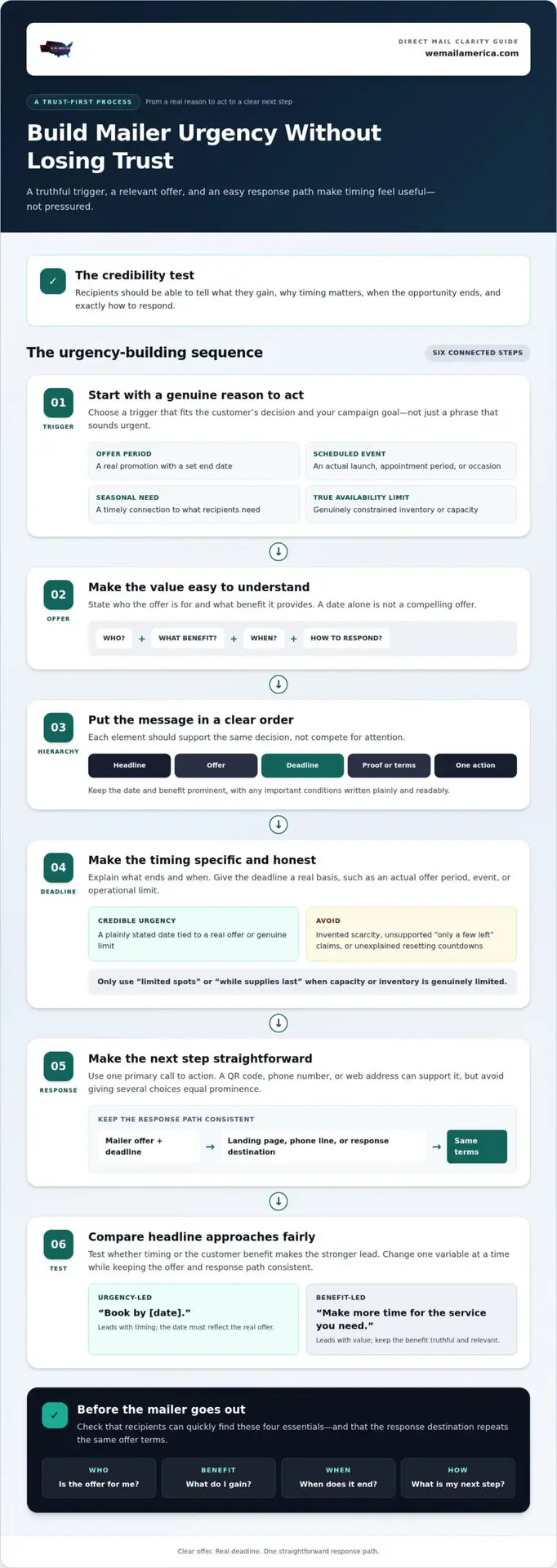
An urgent message only works if recipients can quickly understand the offer and what to do next. Build the mailer in a clear order: lead with the headline, explain the offer, place the deadline beside it, add concise proof or key terms, then show one primary response action. Each element should support the same decision rather than compete for attention.
Choose a headline based on the strongest reason to respond. An urgency-led headline foregrounds timing, such as “Book by [date].” A benefit-led headline leads with the value, such as “Make more time for the service you need.” Keep the date and benefit truthful, then test which headline approach better fits the audience. Change one variable at a time, such as the headline, while keeping the offer and response path consistent. That makes results easier to interpret.
Where should the deadline and call to action appear?
Place the core benefit and call to action where they’re easy to spot, and keep the deadline close to the offer it limits. Don’t hide a key condition in fine print. Use a direct instruction, such as “Scan to book by [date],” and tell recipients what happens next, such as reaching a booking page. Make sure that page repeats the same offer, deadline, and terms as the mailer.
Use this simple hierarchy when planning the creative:
Headline: An urgency-led headline emphasizes the response window; a benefit-led headline emphasizes the value.
Deadline: State the real end date beside the offer. Don’t separate it from the terms it applies to.
Call to action: Give one clear instruction and make the response destination match it.
How can design support the message?
Use contrast and whitespace to give the offer, date, and action room to stand out. Supporting details matter, but they shouldn’t overwhelm the main message. Choose a postcard when the offer can be communicated simply; use a trifold when recipients need more space to understand several details or steps. The format should serve the message, not force it into a crowded layout.
For a practical approach to how to create urgency in a mailer, review the entire path from the printed piece to the response destination. A strong layout sets expectations clearly, while coordinated campaign execution keeps the message consistent from design through mailing. Explore direct mail advertising campaign support when planning the pieces and response path together.
Create and test a mailer urgency campaign step by step
A disciplined workflow keeps the offer, deadline, audience, and measurement aligned. Start with one primary conversion goal, such as booking an appointment or making a purchase. Then choose an urgency trigger that supports that goal. This makes how to create urgency in a mailer a campaign-planning decision, not just a copywriting exercise.
What steps turn an offer into a ready-to-mail campaign?
Work through these steps before the mailer goes to print:
- 1. Set the goal. Decide what one action matters most. Use that conversion to guide the offer and response path.
- 2. Define the audience and offer. Identify who the mailer is for and what relevant benefit you’re presenting.
- 3. Choose a genuine trigger. Use a real deadline, event, seasonal reason, or availability limit. Make sure the business can honor the terms.
- 4. Set the response deadline and action. State when the offer ends and how recipients can respond. Keep the instructions simple.
- 5. Select the mailing approach. Targeted mailing can support a campaign aimed at a defined audience. Every Door Direct Mail (EDDM) can fit a strategy focused on reaching households along selected delivery routes. Choose based on the audience strategy and campaign goal.
- 6. Review the complete experience. Check that the mailer and response destination show consistent offer terms and deadlines. Test the QR code, URL, or other response method before mailing.
Keep the core message consistent as you prepare the campaign. If you’re comparing versions, change one element, such as the headline or deadline presentation, while holding the offer and audience meaningfully comparable. Otherwise, you won’t know which difference influenced the result.
How can you measure whether urgency helped?
Use a campaign-specific code, QR code, phone number, or URL to connect responses to the mailer. Then track more than initial inquiries. Review whether recipients completed the primary action and whether those conversions fit the campaign goal. A higher number of inquiries may not mean the offer is working if few people take the next step.
Compare results carefully. Differences in audience, offer, timing, or response path can affect performance, so avoid attributing a change to urgency alone when several variables changed. Record what you tested and use the findings to shape the next campaign.
Ready to put the workflow into action? Plan a direct mail campaign with a clear goal, audience, and response path.
Turn a high-urgency mailer into a coordinated campaign
A mailer can introduce a timely offer, while digital channels make it easier for recipients to take the next step. A QR code can lead to a matching offer page; texting or email can reinforce the same response instructions; mobile ads or connected TV can support broader campaign awareness when they fit the goal. Use only channels that help move the audience toward the intended action. Integration gives the campaign a consistent path, but it doesn’t guarantee a particular result.
How can direct mail and digital follow-up work together?
Keep the offer, deadline, and core language consistent across every touchpoint. If the mail piece states that an offer ends on a particular date, the landing page and follow-up message should reflect the same terms. Give each channel a clear role: mail can put a tangible offer in the recipient’s hands, while a digital destination can explain details or capture a response. Don’t add channels just to make the campaign feel larger.
We Mail America supports direct mail campaigns from targeting through design, printing, and postage. Its full-service process brings the physical mail piece and response path together, whether you’re planning a targeted mailing or a campaign using Every Door Direct Mail.
What information should you prepare before planning?
Start with the essentials. A clear brief helps connect the urgency trigger to the campaign’s audience and goal:
- Goal: Name the primary action you want recipients to take.
- Audience: Describe who should receive the offer.
- Offer and deadline: Explain the benefit, the genuine reason to act, and when the opportunity ends.
- Response method: Decide how recipients will respond and what they’ll see or do next.
- Reach strategy: Consider whether geographic saturation or audience targeting better matches the campaign objective.
These decisions shape how to create urgency in a mailer that feels connected to the rest of the campaign, rather than like a standalone piece. We Mail America serves businesses across all 50 states, with direct mail planning and execution coordinated around campaign needs. Share your goals, audience, offer, deadline, and preferred response path through the inquiry form to start planning a direct mail campaign.
Start planning a direct mail campaign
Make Your Next Mailer Easier to Act On
Effective urgency doesn’t rely on pressure. It gives recipients a genuine reason to respond, a clear deadline, and one simple next step. The right trigger should fit the offer and audience, while the mailer and its response destination keep the same terms. Set a primary campaign goal, then track meaningful conversions to learn what worked.
That’s the foundation of how to create urgency in a mailer without putting trust at risk. A coordinated campaign can carry the offer from a tangible piece of mail to a relevant digital response path. We Mail America provides full-service support from consultation and targeting through design, printing, and postage. Campaigns can also combine direct mail with mobile advertising, texting, email, or connected TV when those channels fit the goal.
Ready to put a clear offer and response plan into motion? Plan your next direct mail campaign with support from a team serving businesses across all 50 states. A focused, well-coordinated mailer is a practical next step toward your campaign goals.
Frequently Asked Questions
How do you create urgency in a mailer without sounding pushy?
Give recipients a genuine reason to act and explain it plainly. A real offer period, scheduled event, or booking window can create urgency without pressure. Pair it with a benefit that matters to the audience and a clear next step. Avoid exaggerated claims or repeated demands to respond. The goal of how to create urgency in a mailer is to make timely action useful, not to make recipients feel cornered.
What are effective urgency phrases for a direct mail postcard?
Use phrases that state a real timeframe or event, such as “Book by [date],” “Offer ends [date],” or “Reserve your place for [event].” Add the benefit so recipients understand why the deadline matters, for example, “Book by [date] to receive [offer].” Replace bracketed details with accurate terms. Avoid vague language such as “Hurry!” if it doesn’t explain what’s ending or when.
Should a mailer include an expiration date?
Include an expiration date when the offer genuinely ends on a specific date. A clear date helps recipients decide when to respond and gives the campaign a concrete timeframe. Place it near the offer, and make sure the response page or other destination shows the same terms. If there’s no real cutoff, don’t invent one. You can instead connect the message to a genuine event or another timely reason to act.
How do you make a limited-time offer feel credible?
Make the time limit real, explain what the offer includes, and keep its terms consistent wherever recipients respond. For example, if a promotion ends on a stated date, don’t imply on the landing page that it has a different deadline. Use availability claims only when capacity or inventory is actually limited. A truthful explanation helps recipients understand the offer; unsupported scarcity can undermine confidence in the business.
Where should the deadline appear on a direct mail piece?
Place the deadline close to the offer it applies to, where readers can notice it without searching through fine print. Keep the main benefit, deadline, and call to action visually connected. For example, a postcard might place “Offer ends [date]” beside the offer details, then direct recipients to scan a QR code or visit a URL. Make sure the destination repeats the same deadline and conditions.
How can you measure whether urgency improved mailer responses?
Track responses with a campaign-specific code, QR code, phone number, or URL, then measure completed conversions against the campaign’s primary goal. To test urgency, compare versions that keep the audience, offer, and response path meaningfully similar while changing one element, such as the deadline framing. Review response quality as well as inquiry volume. More inquiries alone don’t show whether recipients completed the action that matters.