
The most elaborate political fundraising mailer isn’t automatically the best fit for your campaign. A postcard can deliver a focused appeal, while a folded mailer can make room for more detail. Choose based on who you want to reach, what they need to know, and what you want them to do next.
Every piece needs a clear reason to give or take another action. Strong campaign mail aligns the format, audience, creative, and response plan from the start. That means deciding on the goal and audience before writing copy or choosing a layout.
This guide compares postcard and folded-mailer formats, explains how geographic and demographic targeting can shape audience planning, and offers practical ways to build a credible appeal with a direct next step. It also covers measurement, so your campaign can evaluate its mail effort without assuming results in advance.
We Mail America supports coordinated direct mail campaigns across all 50 states, with consultation, targeting, design, printing, and postage in one workflow. Use the steps below to develop a practical plan for political fundraising mailers, whether mail stands alone or works alongside digital advertising.
Key Takeaways
- Match political fundraising mailers to the audience, campaign goal, and action you want recipients to take.
- Choose broad coverage or more focused geographic or demographic targeting based on the audience and objective.
- Pick a postcard or trifold based on how much information the appeal needs and how readers should move through it.
- Build a response-focused message around a clear reason to give, one primary ask, and a trackable response path.
- Coordinate consultation, targeting, design, printing, and postage in a nationwide campaign workflow serving all 50 states.
What political fundraising mailers can do for a campaign
A fundraising mail piece has a different job from a general campaign flyer. It needs to make the case for support and show recipients exactly how to act. Political fundraising mailers are printed campaign communications that ask recipients to contribute, renew their support, or take part in a specific fundraising activity. That purpose should guide the audience, message, format, and response plan from the outset.
Mail gives an appeal a physical presence. Recipients can read it at their own pace and return to its instructions later. Use that space to present a candidate’s priorities, explain a fundraising need, and make the next step easy to find. A mail piece doesn’t guarantee a donation. Results depend on the audience, the relevance and credibility of the message, and how clearly it asks for action.
Which campaign goals can a fundraising mailer support?
Start by deciding who you’re asking and what you want them to do. Donor acquisition introduces the campaign and its fundraising purpose to potential supporters. That message may need to explain who the candidate is, what the campaign is working toward, and why a contribution matters. Keep the action specific, such as donating through the response path provided.
Existing supporters may need a different appeal. Re-engagement mail can acknowledge their prior support and invite them to contribute again. Event-focused mail can give recipients a clear way to support a fundraiser, such as registering or responding to an invitation. Give each piece one primary action. If it asks for a donation, an event response, and several unrelated actions at once, the main next step can be harder to identify.
What makes political fundraising mail different from general campaign mail?
General campaign mail may focus on candidate recognition, positions, or issues. Fundraising mail can include that context, but it also needs a direct ask and a clear response path. Recipients should understand why the campaign is raising money and what to do next. The broader Campaign finance context helps explain why fundraising is a distinct part of campaign activity, not simply another awareness message.
Audience familiarity should guide tone and detail. A first-time recipient may need a concise introduction and a stronger explanation of the campaign’s priorities. A known supporter may respond better to an appeal that recognizes their connection to the campaign. In either case, make the request credible, straightforward, and consistent with the campaign’s voice.
Before production, review election-related content and applicable requirements with campaign counsel or official sources. Include that review in campaign planning alongside the fundraising objective and response method. Once those decisions are established, plan the audience and mailing approach together.
How to plan political fundraising mail around your audience
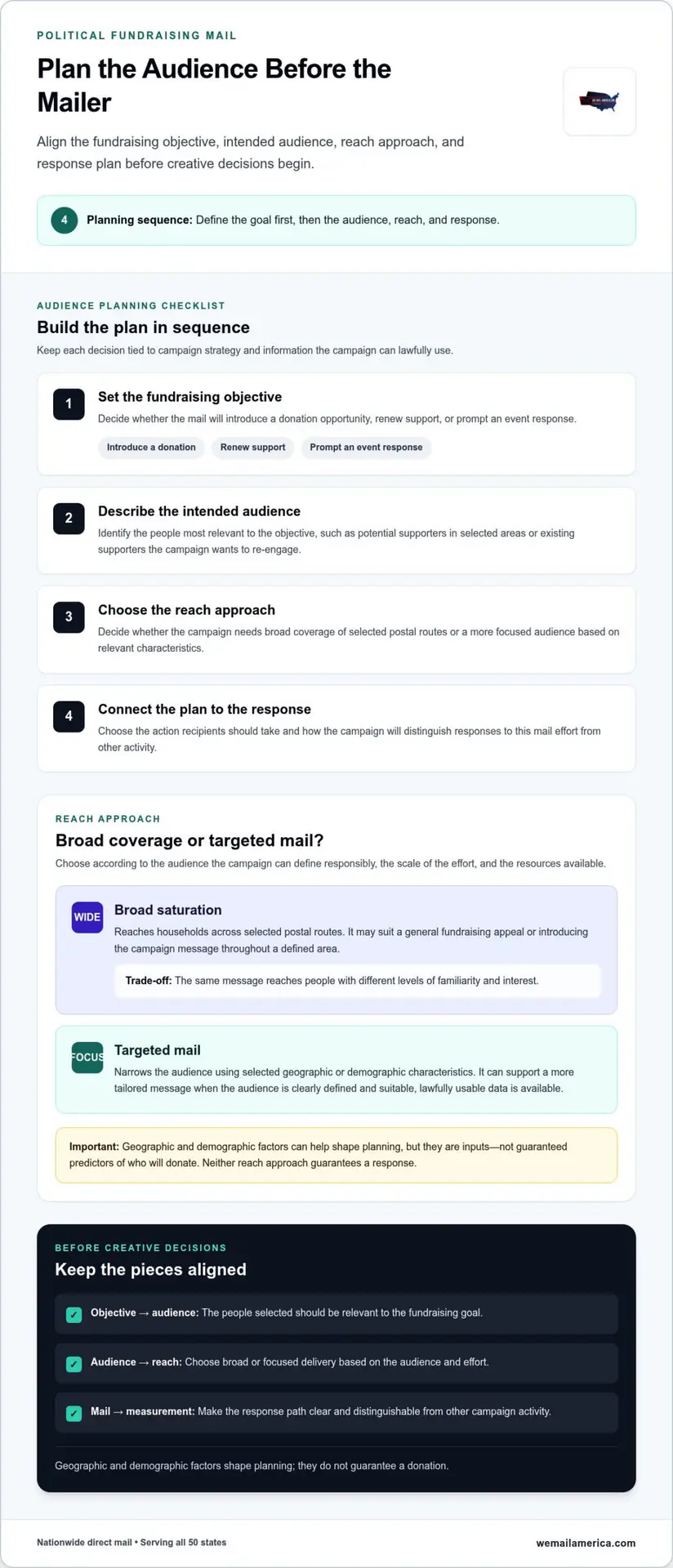
Audience planning starts with the fundraising objective, not the design. Define the audience before choosing a mail format, because the people you want to reach determine what the message needs to say and how it should be delivered. A campaign seeking new donors may need a different approach from one re-engaging known supporters or inviting people to a fundraising event.
How should a campaign define the mail audience?
Build the plan in sequence. Keep the criteria tied to campaign strategy and information the campaign can lawfully use. Geographic and demographic factors can help shape planning, but they’re inputs, not guaranteed predictors of who will donate.
- Set the fundraising objective. Decide whether the mail effort will introduce a donation opportunity, renew support, or prompt an event response.
- Describe the intended audience. Identify the people most relevant to that objective, such as potential supporters in selected areas or existing supporters the campaign wants to re-engage.
- Choose the reach approach. Decide whether the campaign needs broad coverage of selected postal routes or a more focused audience based on relevant characteristics.
- Connect the plan to the response. Choose the action recipients should take and how the campaign will distinguish responses to this mail effort from other activity.
This sequence creates a practical brief before creative decisions begin. It also keeps the audience, appeal, and response method aligned instead of treating them as separate tasks.
When does broad reach or targeted mail make more sense?
Broad saturation can reach households across selected postal routes when the campaign needs wider geographic coverage. It may suit a general fundraising appeal or an effort to introduce the campaign message throughout a defined area. The trade-off is that the same message reaches people with different levels of familiarity and interest.
Targeted mail narrows the audience using selected geographic or demographic characteristics. It can support a more tailored message when the campaign has a clear audience definition and suitable, lawfully usable data. Neither approach guarantees a response. Choose based on the scale of the effort, the audience the campaign can define responsibly, and the resources available to plan and execute the mailing.
Campaigns planning political fundraising mailers should also consider how mail fits with other outreach. A coordinated digital follow-up, such as texting or connected TV advertising, can extend the campaign’s message across channels while keeping the mail piece’s primary ask clear. Review relevant rules with campaign counsel or official sources; Ballotpedia’s overview of federal campaign finance laws can provide background for that review.
For help turning an audience plan into a coordinated mailing, explore direct mail campaign planning.
Choose a political fundraising mailer format for the message
Choose the format based on what recipients need to understand, not on the assumption that one mail piece always performs better. A concise appeal with one main point may fit a postcard. A campaign story that needs more explanation may benefit from a trifold’s separate panels. Either way, guide the reader from the opening message to one unmistakable fundraising action.
Map the content before selecting the format. Write down the headline, the main reason to give, the ask, and the response information. If those elements fit comfortably in a short, scannable layout, a postcard may work well. If the explanation feels crowded or needs a deliberate reading sequence, consider a folded mailer. Extra space can provide context, but it shouldn’t bury the primary ask.
When is a postcard a practical campaign format?
A postcard suits an appeal that can be communicated quickly. Give the headline strong visual priority, then add a short supporting message that makes the fundraising purpose clear. Put the donation direction and response information where recipients can find them at a glance. Keep secondary details from competing with the main action.
We Mail America offers the Impact Post Card – 6 X 11 as one format. Its larger postcard canvas can accommodate a prominent lead, concise explanation, and response details while keeping the piece easy to scan. Plan the copy and layout together so the ask stays clear instead of filling every available area with extra text.
When might a folded mailer better fit the appeal?
A trifold can divide a longer appeal into distinct reading panels. For example, one panel might introduce the campaign’s fundraising need, another explain the campaign story or priorities, and another present the giving action. This structure can help readers follow the message in sequence. We Mail America offers trifold formats, including the Mini Trifold – 9 X 11.
Use the extra room with discipline. A platform explanation, personal campaign story, or several giving options may call for more space, but the piece still needs one primary ask. If you include several options, make their differences clear and keep the preferred next step visually prominent.
| Consideration | Postcard | Trifold |
|---|---|---|
| Message scope | Best suited to a concise appeal with one central point. | Can accommodate more context across separate panels. |
| Reading flow | Supports a quick scan from headline to ask. | Can guide readers through an introduction, explanation, and action. |
| Creative priority | Make the headline, donation direction, and response information easy to spot. | Use panel order to build the case, while keeping the main ask prominent. |
For postcard creative, keep the visual hierarchy simple: one lead, one supporting idea, and a clearly placed response path. A postcard campaign plan can bring format, message, and production decisions together.
Build a response-focused message and measurement plan
A clear ask gives the mail effort a defined purpose and guides the copy, response path, and evaluation. Before production, decide on the primary action and how the campaign will recognize responses connected with this mailing. Build political fundraising mailers around one consistent path from the first message to the next step.
What should a fundraising mailer say?
Lead with a reason the recipient should care. That might be a campaign priority, a fundraising need, or a concise explanation of what support will help the campaign do. Keep the claim specific and credible. A broad appeal without a clear reason to give can leave recipients unsure why they should act.
Organize the message in a simple hierarchy:
- Attention-getting lead: State the central issue or fundraising purpose plainly.
- Reason to give: Explain why support matters to the campaign, using accurate, approved details.
- One primary ask: Tell recipients directly to donate and make that action prominent.
- Response path: Show how to complete the action, such as visiting a designated page or using a QR code.
Keep secondary actions, such as following the campaign or learning more, visually subordinate to the donation ask. Before finalizing the piece, verify candidate or organization details, claims, and any deadlines with the appropriate campaign team. Accurate, approved copy protects credibility and makes the intended action easier to understand.
How can a campaign track mail responses?
Choose a response method before designing the mailer. A campaign-specific landing page or QR code gives recipients a direct route to the donation action and can help distinguish this mailing from other campaign outreach. If the campaign tests different audiences or creative versions, use separate response paths where practical. Keep the destination simple and make sure it reflects the appeal recipients saw in the mail.
Set a measurement plan that matches the campaign objective. Record the audience, format, creative version, and distribution period for each mailing. Then compare responses associated with the designated path against the campaign’s stated goal. For example, assess a mailing intended to re-engage supporters in relation to that objective, rather than judging it only by total activity across all fundraising channels.
Tracking has limits. Recipients may respond through another channel, share the mail with someone else, or see other campaign messages before acting. A QR scan or landing-page visit shows activity, but it doesn’t prove the mail piece caused a donation. Treat results as useful evidence for planning and comparison, not as a guarantee or complete account of influence.
With the ask and response plan aligned, plan a political fundraising mail campaign with coordinated targeting, design, printing, and postage.
Work with We Mail America to execute a nationwide mail campaign
A nationwide mailing is easier to manage when planning and production follow one coordinated workflow. We Mail America serves campaigns across all 50 states, bringing consultation, geographic and demographic targeting, custom design, printing, and postage together. Start with your campaign goals, intended audience, chosen format, and response plan. Those decisions shape a mail program around the campaign rather than forcing every message into the same approach.
What does full-service campaign mail coordination involve?
Consultation translates the campaign’s objective into a practical mail plan. Geographic and demographic targeting can then inform audience selection. Creative development turns the campaign message into a mail piece, whether that means a postcard for a concise appeal or a trifold for a message that needs more room. Printing and postage complete the mail execution workflow.
Bringing these steps together can simplify coordination across a mailing. Campaign teams can work from a shared plan, align the audience and creative, and keep production decisions connected to the original goal. The scope is tailored to the campaign’s needs, without assuming a particular quantity, schedule, or result.
Format selection is part of that planning. We Mail America offers postcard formats, including the Impact Post Card – 6 X 11, as well as trifold options. A focused fundraising appeal may call for a concise postcard, while a campaign story or fuller explanation may benefit from panels that organize information. In either case, keep the main action clear and the message consistent with campaign-approved content.
This coordinated approach supports mail programs for campaigns operating across the country. Geographic planning can accommodate broad coverage or more focused audience choices, while design and production can reflect the specific appeal. Mail remains a tangible communication that recipients can hold and revisit.
How can campaigns add digital touchpoints to direct mail?
Digital channels can extend a mail appeal when they support the same campaign objective. Available options include mobile ads, texting, email campaigns, and connected TV. For example, a campaign can align the language in a mail piece with a digital reminder directing recipients to the same fundraising action. The mailer remains the central physical touchpoint; digital outreach is an optional extension, not a promise of additional donations.
Coordination matters. Keep the core message and primary ask consistent across channels, and make each digital touchpoint useful rather than repetitive. Campaign teams can also plan how they’ll review responses across the effort, while recognizing that activity across several channels may not show exactly what prompted an individual to act.
With consultation, targeting, creative, printing, and postage aligned, We Mail America can help bring the mail plan together for a campaign serving audiences nationwide. Start planning your mail campaign.
Turn your campaign plan into the next step
Before production begins, bring the campaign team around one concise brief: the fundraising objective, intended audience, approved message, and response method. This shared starting point helps resolve open questions early and gives the mail plan a clear basis for review. It also keeps creative choices connected to campaign priorities instead of adding details that compete with the central appeal.
Use the brief to align political fundraising mailers with the campaign’s wider calendar and communication approach. Set the intended action, identify how the team will review responses, and confirm that campaign details and content have been reviewed through the appropriate channels. A deliberate plan gives the team a practical path from idea to execution without treating donations as a guaranteed outcome.
When you’re ready to move from planning to production, We Mail America can coordinate the direct mail workflow around your campaign’s goals. Plan a nationwide political fundraising mail campaign.
Frequently Asked Questions
How are political fundraising mailers different from campaign awareness mail?
Political fundraising mailers ask recipients to take a fundraising action, while awareness mail primarily builds recognition or communicates a candidate’s position. A fundraising piece should connect its message to a clear next step, such as donating through a campaign page. For example, an awareness piece might introduce a candidate’s education priorities, while a fundraising version would explain why support matters and direct readers to contribute.
Can political fundraising mailers reach audiences across all 50 states?
Yes. We Mail America can plan direct mail campaigns for audiences across all 50 states. Nationwide reach doesn’t require sending the same mail piece to every household. A campaign can choose broad distribution across selected postal routes or use geographic and demographic criteria to focus its audience. The right approach depends on the campaign’s goal, intended audience, and data it can lawfully use.
What should a political fundraising postcard include?
A fundraising postcard should make the appeal and next step easy to understand at a glance. Include a clear reason to support the campaign, a concise explanation, and a prominent donation direction, such as a campaign web address or QR code. Keep candidate or organization details accurate and approved. Before printing, review the finished copy and response information together so the appeal doesn’t direct readers to an incorrect or outdated destination.
Is a postcard or trifold better for political fundraising?
Neither format is automatically better. A postcard may suit a short appeal with one central point, while a trifold can provide more room for a campaign story or additional context. Consider how familiar recipients are with the campaign and how much explanation the fundraising request needs. Then make sure the chosen format keeps the donation action easy to find and supporting details from overwhelming it.
How can a campaign tell whether a fundraising mailer generated responses?
Give the mail effort a distinct response path, such as a campaign-specific landing page or QR code, and record which audience and distribution period it corresponds to. Then compare activity through that path with the campaign’s objective. This can help identify patterns, but it won’t capture every response or prove the mail caused a donation. Recipients may act through another channel or after seeing other campaign messages.
When should a campaign send political fundraising mailers?
Plan mail around meaningful campaign milestones, such as a fundraising event, a public announcement, or a defined contribution goal. Work backward from when recipients should have the appeal, allowing the campaign team to coordinate review, printing, postage, and related outreach. Actual delivery timing can vary, so don’t treat a planned mailing date as a guaranteed arrival date.
Do political fundraising mailers need campaign-specific disclosures?
Disclosure obligations can depend on the campaign and the specific communication, so don’t rely on a general template or assume one rule covers every mail piece. Have campaign counsel review the planned content and consult current official guidance before approving it for production. Include required information in the format and placement directed by those sources. That review helps the team address compliance before printing and mailing.
Can direct mail be combined with digital fundraising outreach?
Yes. A campaign can coordinate its mail appeal with digital outreach, such as mobile ads, texting, email campaigns, or connected TV. Keep the central message and donation destination consistent so recipients encounter a coherent request across channels. Digital touchpoints can extend the campaign’s communication plan, but they don’t guarantee additional donations. Decide what each channel should contribute and assess its activity without assuming one caused another’s response.