
An attractive whitening offer won’t fill the schedule if the postcard leaves patients guessing what to do next. Teeth whitening promotion postcards work best when the offer, audience, and response path fit together. To choose the right promotion, start with the appointment goal: decide whether you want to introduce whitening to prospective patients, reconnect with existing patients, or invite inquiries about a consultation.
This guide shares adaptable postcard concepts and practical ways to clarify an offer, reach relevant audiences, and give recipients a simple next step, such as a campaign-specific URL or QR code. You’ll also see how to coordinate audience targeting, custom design, printing, and mailing in a nationwide campaign, with digital touchpoints as an optional extension. Whether you’re reaching existing patients or prospective patients across the United States, the goal is the same: make the offer easy to understand and the path to an appointment easy to follow.
Key Takeaways
- Build the offer around a clear appointment goal, not just a discount.
- Adapt teeth whitening promotion postcards to distinct audiences, with a relevant offer, headline, and next step.
- Match the postcard format to the amount of information the campaign needs to present.
- Choose a response route and record inquiries consistently to assess campaign activity.
- Coordinate audience, offer, format, design, printing, and mailing through one nationwide campaign plan.
Why teeth whitening promotion postcards need more than a discount
A dental practice wants whitening interest to lead somewhere: an inquiry, a call, or a booked consultation. A discount can attract attention, but it can’t do the whole job. Recipients also need to understand which service is being promoted, whether the offer is relevant to them, and how to respond.
A promotional postcard presents a service, a reason to act, and a clear response route. Unlike a fleeting digital impression, a physical postcard gives a time-limited offer a visible format that recipients can set aside and revisit. That visibility matters only if the message is credible. For background on whitening approaches and causes of discoloration, Teeth whitening offers a broad overview.
Keep promotional language separate from clinical claims. A postcard can describe an offer and invite readers to discuss treatment with the practice, but treatment-related statements should be accurate and approved by the dental team. Avoid promising a particular shade or outcome. A discount is an incentive, not a substitute for a clear audience, relevant message, and easy next step.
What makes a whitening promotion feel clear and credible?
Name the service and intended audience in plain language. Make the offer easy to spot, while giving the headline room to communicate the main message. Keep supporting details brief and readable. Use descriptions the practice has reviewed and can stand behind, rather than guaranteed shade results. Before printing, have the practice approve the offer terms and every treatment-related statement.
Which campaign goal should the postcard support?
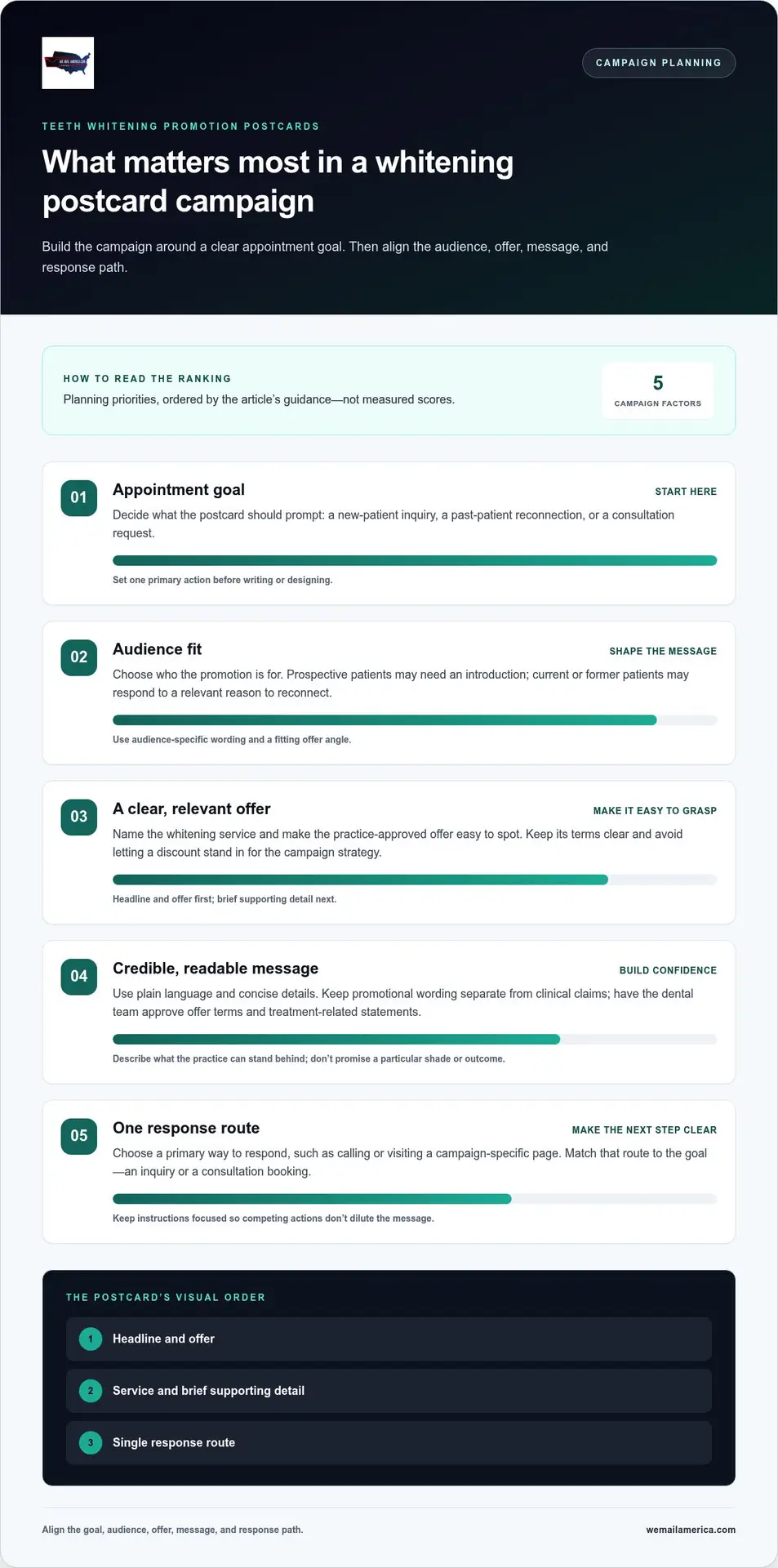
Decide whether the campaign is intended to attract new patients or re-engage existing ones. Those audiences may need different messages. A prospective patient may need a simple introduction to the service, while a current patient may recognize the practice and need a timely reason to reconnect. Choose one primary action, such as calling or visiting a campaign landing page, then set a response goal before drafting copy or choosing a design.
That goal keeps the postcard focused. If the priority is inquiries, make the contact route prominent. If the aim is consultation bookings, direct readers to the page or phone line used to arrange them. One primary action prevents competing instructions from diluting the message.
For practices planning teeth whitening promotion postcards, the offer is only one part of the campaign. Audience fit makes the message relevant, clear wording builds confidence, and a direct response route gives interested readers a next step. Define those pieces first so the discount supports the strategy instead of standing in for one.
Five teeth whitening postcard examples to adapt for your practice
Use these teeth whitening promotion postcards as creative starting points, not as ready-made clinical claims or fixed offers. The dental practice supplies and approves the service details and offer terms. For each concept, make the offer and headline prominent, then add a short supporting detail and one response action so the message is easy to scan.
New-patient welcome offer
Audience: Prospective patients in the selected mailing audience. Offer angle: A practice-approved welcome offer tied to a whitening consultation or service. Headline direction: “New to our practice? Ask about teeth whitening.” Name the service, then show the approved offer beneath it. Response: Invite readers to call or visit the campaign page to request an appointment.
Seasonal appointment invitation
Audience: People the practice wants to reach around a relevant calendar moment. Offer angle: A limited-time whitening promotion, with dates and terms set by the practice. Headline direction: “Make time for a brighter-smile consultation this season.” Use the seasonal reference to explain timing, not to promise a clinical benefit. Response: Direct recipients to one booking route, such as a campaign landing page.
Past-patient re-engagement
Audience: Former patients selected for a promotional campaign, rather than a general appointment reminder. Offer angle: An invitation to explore whitening and discuss options with the practice. Headline direction: “Thinking about whitening? Let’s talk.” Use familiar practice branding and concise service information. Response: Ask recipients to call or use a campaign-specific page to inquire about an appointment.
Practice-defined referral invitation
Audience: Current patients who may know someone interested in learning about whitening. Offer angle: A referral-themed invitation using only terms the practice has established and approved. Don’t imply a reward or benefit unless those details are defined. Headline direction: “Know someone curious about whitening?” Response: Point recipients to a dedicated page or phone route that explains how to share the invitation.
Consultation-first promotion
Audience: Prospective patients who want information before deciding whether to pursue treatment. Offer angle: Promote a conversation with the practice, with any associated offer clearly stated and approved. Headline direction: “Start with a whitening consultation.” Response: Send readers to a page where they can request an appointment. This approach focuses on a next step, not a guaranteed result.
Across all five concepts, use a simple visual order: headline and offer first, service and brief supporting detail next, response route last. A single proof point, such as a practice-approved description of the consultation process, can add context without crowding the design. Explore how direct mail postcards fit into a broader postcard-marketing approach, then tailor the creative to the audience and response goal. For help coordinating a campaign, share your plan through the advertising inquiry form.
Choose the right postcard format, audience, and offer
Start with the campaign goal, then match the audience, format, offer, and response route to it. A postcard should give the main message room to stand out without asking recipients to sort through competing promotions. We Mail America’s primary postcard offering, the Impact Post Card – 6 X 11, gives the campaign a defined format to plan around. Dimensions affect available design space, not guaranteed campaign results.
| Campaign goal | Audience approach | Format consideration | Response mechanism |
|---|---|---|---|
| Re-engage existing patients | Use an appropriate practice audience | Choose space for a concise offer and familiar practice details | Dedicated phone number or campaign page |
| Introduce whitening to new households | Use address-based targeting or geographic saturation | Prioritize a clear headline, offer, and simple explanation | QR code or campaign page |
| Promote a time-limited offer | Define recipients based on campaign objectives | Give the offer and its approved terms clear visual priority | One direct booking or inquiry route |
Target existing patients or reach new households?
An existing practice audience can suit a campaign focused on patient re-engagement. Geographic saturation can support broader household awareness when the practice wants to introduce its whitening service to households across the United States. Address-based targeting and Every Door Direct Mail suit different planning needs: address-based targeting uses a defined audience, while EDDM is designed around delivery to households along postal routes. Choose the approach based on the campaign objective and available audience information, not simply on the offer.
Match the postcard layout to the message
Make the offer and primary action the strongest elements. Use supporting copy for practical details, such as how to inquire or where to find the offer terms. Avoid squeezing multiple promotions into the same layout. A larger format can provide more design space, while a compact layout calls for tighter copy. Neither size guarantees a stronger response. Review the 6 x 11 Impact Post Card as a format reference, and treat any case-study results as context rather than a forecast for your campaign.
Before choosing dimensions, write down the essential content: headline, service, approved offer terms, and response route. If the copy feels crowded, simplify it or consider a format with more room. The advertising inquiry form can help start a conversation about coordinating format, audience targeting, and campaign needs.
Plan the response path and measure postcard campaign activity
Plan the postcard’s response path before it goes to print. Decide what action recipients should take, make that action easy, and set up a consistent way to identify resulting inquiries. With teeth whitening promotion postcards, a clear measurement plan helps the practice understand campaign activity without assuming every response came from the mail.
- Select one action. Choose the primary next step, such as calling, requesting an appointment online, or using a campaign-specific offer code. One prominent action keeps the response path focused.
- Provide a direct route. Use a dedicated phone number, campaign page, or QR code. A phone number supports people who prefer to speak with staff. A campaign page can explain the offer and collect inquiries. A QR code gives recipients a quick way to reach that page, but include a readable URL as an alternative.
- Record responses consistently. Agree on how staff will identify postcard-related calls and appointment requests. If using an offer code, train staff to record it the same way each time and include it in the campaign materials.
- Review the results. Compare inquiries, appointment requests, and code use with the campaign period and original objective. Note which response route was used, then assess whether the campaign met its intended goal.
Make the next step easy to complete
Use a clear action verb, such as “Call,” “Request,” or “Visit,” and make the selected route easy to find. Contact details should be legible and match the route described in the copy. If the postcard points to a campaign page, that page should repeat the offer and explain what happens after someone submits a request. Consistency reduces confusion between the mailed message and its destination.
Choose a tracking method staff can maintain. A dedicated phone number can help distinguish calls made through the postcard. A campaign page can capture online requests separately from general website activity. A QR code can lead to that same page, while a campaign-specific offer code provides another signal when the practice records its use reliably. Don’t add tracking methods the team won’t use.
Review signals without overstating attribution
Record the campaign source when staff handle a call or appointment request, and track inquiries and bookings against the mailing period. Keep mail-attributed activity distinct from responses tied to other marketing, while recognizing that someone may have encountered more than one message before responding. Review the results against the campaign’s own goal, not an unsupported response-rate benchmark.
Response varies with the audience, offer, execution, and measurement process. Tracking makes the activity easier to assess, but it doesn’t prove that every inquiry was caused by the postcard. Set a baseline, document the method, and use the findings to guide the next campaign. Plan a trackable postcard campaign with coordinated support for targeting, design, printing, and mailing.
Launch a nationwide teeth whitening postcard campaign with one coordinated partner
A strong campaign starts with a handful of clear decisions: what the practice wants to achieve, whom it wants to reach, which whitening offer it has approved, how recipients should respond, and which postcard format fits the message. With those pieces defined, the campaign can move from concept to mailing through one coordinated workflow instead of a series of disconnected tasks.
What to prepare before requesting a campaign
Bring the campaign essentials together before planning begins. Define the objective and intended audience, then provide the practice-approved offer and exact terms the postcard should communicate. Choose one response action and decide how the practice will track inquiries or appointments. A clear starting brief helps align the message, targeting, format, and response path.
- Objective and audience: State whether the campaign is intended to introduce the whitening service or reconnect with an existing audience.
- Offer and terms: Supply the approved details and any timing or conditions recipients need to understand.
- Response and tracking: Identify the call, page, or other action, along with the method for recording campaign responses.
Move from postcard concept to coordinated mailing
We Mail America supports the campaign from consultation through mailing. The team coordinates audience targeting, custom design, printing, and postage around the practice’s goal and approved offer. This connects key decisions: the creative reflects the audience, the layout supports the response action, and the mailing plan follows the campaign’s intended reach. Project fees are based on the campaign scope.
This coordinated approach can support practices planning teeth whitening promotion postcards for audiences across all 50 states. Geographic and demographic targeting helps shape who the campaign is designed to reach nationwide. Choose a format that suits the message, whether the postcard needs a concise offer or more room for supporting details.
Direct mail can also be coordinated with optional mobile advertising, texting, email, or Connected TV as campaign extensions. Consider these channels alongside the postcard when they fit the project’s audience and objectives. They extend the campaign, but do not guarantee a particular response or result.
From the first campaign decisions to printing and postage, one partner can keep the moving parts organized. Share your campaign details to Start your postcard campaign.
Turn your next idea into a focused campaign
Move from inspiration to a practical campaign brief by deciding what you want recipients to do, what the practice can confidently promise, and what signal will show whether the mailing prompted interest. This gives your team a clear starting point and a useful basis for refining future creative, audience choices, or response routes.
The strongest teeth whitening promotion postcards don’t need to say everything. They need to make one relevant offer easy to understand and one next step easy to take. Start with the audience and appointment goal, then build the postcard around that decision. Keep the first campaign focused. Its recorded responses can help your team identify what to retain, what to clarify, and what to test next.
We Mail America can turn your campaign priorities into a coordinated mailing plan, with optional digital extensions shaped around the project. Bring the practice-approved offer and campaign goal, then build the plan from there. Build your whitening postcard campaign and take the next step with a focused plan. A clear message and trackable action give your idea room to develop into a stronger campaign.
Frequently Asked Questions
How much does a teeth whitening postcard campaign cost?
Campaign cost depends on the project’s scope, so there isn’t one standard price. We Mail America charges on a per-campaign project basis. Planning factors include postcard format, audience targeting, printing, postage, and whether optional digital advertising is part of the campaign. To define the scope, outline the audience and mailing goals, choose a format, and identify any digital extensions to include.
How many postcards should a dental practice send for a whitening promotion?
The right quantity depends on the intended audience and the coverage the practice wants. For a defined patient audience, start with the number of relevant contacts available. For broader household awareness, consider the campaign’s nationwide reach and the practice’s ability to respond to inquiries. Set the quantity alongside the campaign goal and appointment capacity, then use consistent response tracking to inform future mailing decisions.
Can a dental practice mail whitening offers to past patients?
Yes. A practice can use an appropriate existing patient audience for a whitening promotion, provided the message is relevant to those recipients. For example, it could invite patients who have expressed interest in cosmetic services to learn about the practice’s whitening options. Keep the offer’s eligibility and terms clear, and respect patient communication preferences and the practice’s privacy procedures when preparing the mailing audience.
What should a teeth whitening postcard say?
Teeth whitening promotion postcards should identify the service, state the practice-approved offer and its terms, and tell readers what to do next. Include the practice name and clear contact details, plus any eligibility or timing information recipients need before responding. Keep clinical language factual and avoid promising a particular shade or result. A focused message helps readers understand the offer without sorting through unrelated services or competing actions.
Should a whitening promotion postcard include before-and-after photos?
It can, if the practice has accurate images and written permission from the people shown. Photos should reflect genuine treatment outcomes and shouldn’t be altered in ways that misrepresent them. Avoid presenting one person’s result as typical for everyone. If the practice can’t use images responsibly, a clean design with a clear service description and offer can communicate the promotion without them.
Can postcards promote teeth whitening to households that are not current patients?
Yes. A practice can use household-focused targeting to introduce a whitening service to people who aren’t current patients, including through a campaign planned for audiences across the United States. Every Door Direct Mail can support household coverage, while targeted campaigns use defined audience information. Choose the approach based on whether the goal is broad household awareness or reaching a more specifically defined audience.