
What if the biggest waste in your marketing budget isn’t your digital ad spend — it’s the direct mail you’re sending to the wrong people? You already know the frustration: email open rates are shrinking, pay-per-click costs keep climbing, and the last postcard campaign felt more like a gamble than a strategy. Understanding your direct mail targeting options is the difference between burning postage and building a predictable lead generation engine.
You’re right to be skeptical of “spray and pray” mailing. Most businesses have been there. A stack of postcards goes out, the phone stays quiet, and the ROI conversation gets uncomfortable. That skepticism is healthy, and it’s exactly why targeting has evolved so far beyond a simple ZIP code list.
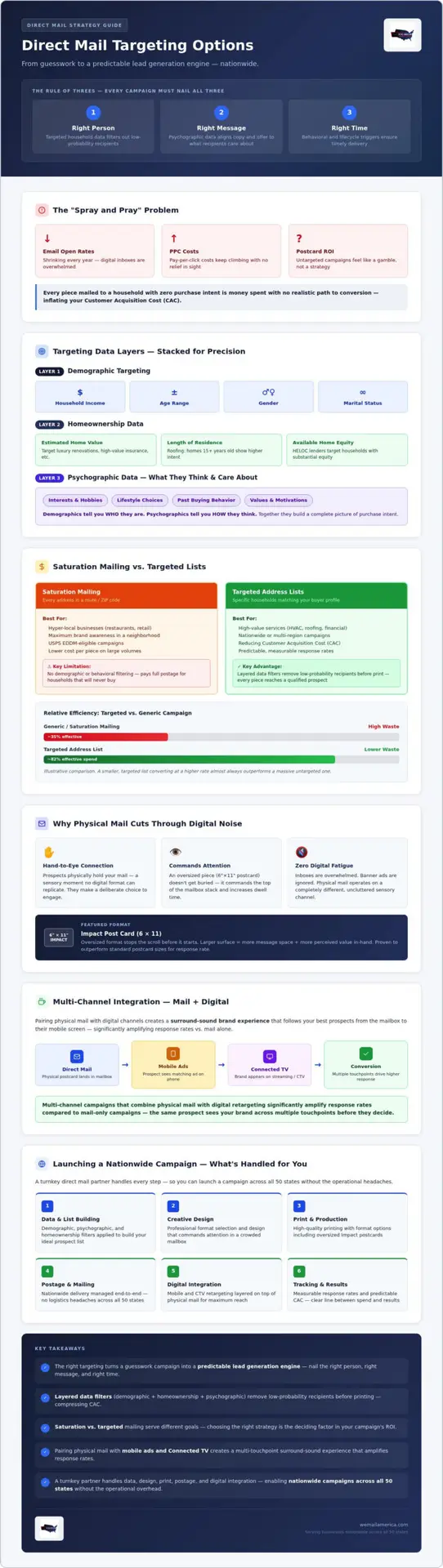
This guide will show you how to reach the right households with surgical precision, choose the physical formats that command attention in a crowded mailbox, and connect your direct mail to digital channels for a surround-sound brand experience that follows your best prospects from the mailbox to their mobile screen. Smarter targeting starts here.
Key Takeaways
- The right direct mail targeting options can transform a guesswork campaign into a predictable lead generation engine — and this guide shows you exactly how to get there.
- Demographic and psychographic filters, including household income, homeownership status, and lifestyle data, allow you to reach the specific households most likely to convert, not just the nearest ones.
- Saturation mailing and targeted address-based lists serve very different goals — knowing which strategy fits your business can be the deciding factor in your campaign’s ROI.
- Pairing physical mail with digital channels like mobile ads and Connected TV creates a multi-touchpoint experience that significantly amplifies response rates compared to mail alone.
- A turnkey direct mail partner handles everything from data and design to print and postage, so you can launch a nationwide campaign without the operational headaches.
Precision Direct Mail Targeting Options for Modern Business Growth
Direct mail didn’t always require precision. For decades, the strategy was simple: print as many pieces as possible, flood a ZIP code, and hope the numbers worked in your favor. That era is over. Today’s most effective campaigns are built on demographic, geographic, and behavioral data that puts your message in front of the exact household most likely to respond. That shift from mass saturation to data-driven selection is the single biggest development in direct mail marketing, and it changes everything about how you calculate return.
Think of it as the Rule of Threes. Every successful direct mail campaign depends on reaching the right person, delivering the right message, and arriving at the right time. Miss any one of those three, and you’re paying full postage for a partial result. Nail all three, and direct mail becomes one of the most predictable lead generation tools in your arsenal. That’s what modern direct mail targeting options are designed to deliver.
Why Physical Tangibility Beats Digital Noise
Digital fatigue is real. Inboxes are overwhelmed, banner ads are ignored, and social feeds move faster than anyone can process. Physical mail operates on a completely different sensory level. When a prospect picks up a piece of mail, there’s a hand-to-eye connection that no digital format can replicate. They hold it, they look at it, and they make a deliberate choice about what to do with it. That moment of attention is extraordinarily valuable.
Format amplifies this effect significantly. An oversized piece like the Impact Post Card (6 X 11) doesn’t get buried under a utility bill. It commands the top of the stack. Larger formats naturally increase dwell time because they feel like something worth reading, not something to discard. When your targeting is precise and your format is built to stop the scroll before it even starts, the combination is hard to beat.
The ROI of Targeted vs. Generic Campaigns
Generic saturation mailing has a hidden cost that rarely shows up in the initial quote: waste. Every piece mailed to a household with zero purchase intent is money spent with no realistic path to conversion. That waste inflates your Customer Acquisition Cost (CAC) and makes your results harder to predict.
Targeted lists solve this by filtering out low-probability recipients before the campaign even goes to print. You’re not mailing less; you’re mailing smarter. In 2026, targeted direct mail is defined by its ability to use layered data filters to ensure every piece in a campaign reaches a qualified prospect, compressing CAC and making response rates more consistent and measurable across every send.
The math is straightforward. A smaller, targeted list that converts at a higher rate will almost always outperform a massive untargeted one. Smarter selection means fewer wasted impressions and a clearer line between your spend and your results. That’s the foundation every effective campaign is built on.
Demographic and Psychographic Targeting: Reaching the Right Mailbox
Knowing who lives at an address is the foundation of every smart campaign. Demographic targeting lets you filter your mailing list by age, gender, household income, and marital status before a single piece goes to print. A luxury home renovation company doesn’t need to reach renters in their twenties. A retirement planning firm doesn’t need to mail to households earning under a certain threshold. Filtering by demographics removes those mismatches entirely, so your postcard lands in the hands of someone who actually fits your buyer profile.
Homeownership data adds another powerful layer. You can refine your list by estimated home value, length of residence, and available home equity. A roofing contractor targeting homes over fifteen years old in a specific region, or a HELOC lender looking for households with substantial equity, can build a list that reflects genuine purchase intent rather than simple proximity. That specificity is what separates modern direct mail targeting options from the ZIP code blasts of the past.
Psychographic data goes deeper still. Where demographics tell you who someone is, psychographics tell you how they think and what they care about. Interests, hobbies, lifestyle choices, and past buying behavior all become filters. A pet supply brand can target confirmed pet owners. A fitness studio can reach households with active lifestyle indicators. This level of nuance is where response rates improve meaningfully, because the message resonates with what the recipient already values.
B2B campaigns have their own targeting toolkit. Decision-makers can be reached by industry classification, company size, annual revenue, and job title. If you sell commercial HVAC services, you don’t need to reach every business in a metro area. You need the facilities managers and operations directors at manufacturing plants, medical offices, and multi-location retailers. That precision is achievable with the right data partner.
Life Event Targeting: Catching Prospects in Transition
Timing is everything. People are most receptive to new vendors and services during major life transitions. New Mover lists target households within their first 30 days at a new address, a window when brand loyalties haven’t formed yet and spending on home services, insurance, and local businesses is at its peak. Similarly, lists built around new parents, recent retirees, and first-time homebuyers capture audiences at the exact moment their needs are changing. For B2B service providers, New Business lists identify recently formed companies that are actively building vendor relationships and making foundational purchasing decisions.
Advanced Data Modeling and Lookalike Audiences
Your existing customer base is one of your most valuable targeting assets. By analyzing the shared characteristics of your best customers, including demographics, geography, and behavioral patterns, you can build a lookalike model that identifies similar households across the country. Predictive modeling takes this further, using historical purchase behavior to score prospects by their likelihood to convert. We Mail America sources verified, high-quality data to support nationwide campaigns built on this kind of modeling, so your list isn’t just large; it’s strategically constructed from the ground up.
- Demographic filters: Age, gender, income, marital status
- Homeownership filters: Home value, equity, length of residence
- Psychographic filters: Interests, hobbies, lifestyle indicators, purchase history
- B2B filters: Industry, company size, revenue, job title
- Life event triggers: New movers, new parents, retirees, new businesses
Layering these filters together is where the real leverage comes from. A single campaign can simultaneously target the right income bracket, the right homeownership profile, and the right lifestyle segment, compressing waste and amplifying conversion potential in one move. If you’re ready to build a list that reflects your actual buyer, start your targeted campaign inquiry and let the data do the heavy lifting.
Saturation vs. Targeted Mailing: Which Strategy Fits Your Goals?
Not every campaign needs a scalpel. Sometimes a sledgehammer is exactly the right tool. The real skill is knowing which one to pick before you spend a dollar on postage. Saturation mailing and targeted address-based mailing are fundamentally different strategies, and choosing the wrong one doesn’t just hurt your ROI; it undermines the entire campaign before the first piece hits a mailbox.
When to Choose EDDM Saturation
Every Door Direct Mail (EDDM) is built for businesses with broad, geographic appeal. The premise is simple: you select specific carrier routes, and your mail piece goes to every active delivery point on those routes. No list purchase, no demographic filtering, no minimum household criteria. You’re blanketing a neighborhood.
That simplicity is a genuine advantage in the right context. Restaurants, retail shops, home services companies, and local gyms often serve anyone within a reasonable radius. When your ideal customer is essentially “anyone who lives nearby,” EDDM’s postage discounts through USPS saturation pricing rules make it one of the most cost-efficient volume strategies available. You’re not filtering because you don’t need to.
Format matters enormously here. In a saturated route, every piece is competing for the same three seconds of mailbox attention. An oversized format like the Impact Post Card (6 X 11) physically rises above standard-sized envelopes and flyers. It commands the top of the stack. When you’re mailing to an entire route, that visual dominance is the differentiator between a piece that gets read and one that goes straight into recycling.
When Targeted Mail is Non-Negotiable
EDDM has a real weakness that rarely gets discussed: it can’t filter. If your product requires a specific income level, homeownership status, or professional role, saturation mailing will put your message in front of hundreds of households that will never convert. For high-ticket services, niche products, or any offer with a defined buyer profile, that waste isn’t just inefficient; it’s expensive.
Targeted, address-based lists solve this directly. A luxury home remodeling company doesn’t need to reach apartment renters. A commercial insurance provider needs facilities directors, not residential homeowners. Nationwide B2B account-based marketing campaigns, in particular, require the kind of job-title and company-size filtering that EDDM simply can’t provide.
Choosing between these two direct mail targeting options comes down to one honest question: does your offer appeal to most people in an area, or does it appeal to a specific type of person regardless of where they live? The answer tells you everything. For a deeper breakdown of how these two strategies compare across budget, format, and campaign goals, the EDDM vs. Targeted Direct Mail guide walks through the decision framework in full detail.
Geographic targeting adds another dimension to both approaches. You can select specific ZIP codes, define a radius around a physical location, or build a nationwide footprint that hits multiple metro markets simultaneously. That flexibility means a local pizza shop and a national franchise can both build effective campaigns using the same strategic framework, scaled to their own goals.
- Choose EDDM when: Your product or service appeals to a broad local audience, postage efficiency is a priority, and geographic density matters more than demographic precision.
- Choose targeted mail when: Your buyer profile is specific, your offer is high-ticket or niche, or you’re running B2B outreach that requires filtering by industry, title, or company size.
- Use geographic targeting to: Define ZIP codes, set radius parameters, or build multi-market national campaigns regardless of which list strategy you choose.
Multi-Channel Integration: Connecting Physical Mail to Digital Screens
A postcard in the mailbox is powerful on its own. A postcard backed by mobile ads, a Connected TV spot, and a follow-up text message is a different animal entirely. This is the Surround Sound effect: when your brand appears across multiple channels in a coordinated sequence, prospects encounter your message at every touchpoint in their day. Physical mail anchors the campaign. Digital layers amplify it. The result is a conversion environment that’s significantly harder to ignore than any single channel could create alone.
The logic is straightforward. A prospect who receives your postcard, sees your mobile ad while scrolling that evening, and catches your commercial during a streaming show isn’t experiencing three separate campaigns. They’re experiencing one coherent brand story told in three places. That repetition builds familiarity, and familiarity drives action. We Mail America’s Mail to Mobile texting service and Connected TV Network are built specifically to create this kind of synchronized, multi-touchpoint presence around your physical mail drop.
Retargeting the Mailbox: Digital to Physical
The channel flow doesn’t have to start with mail. Direct Mail Retargeting flips the sequence: someone visits your website, doesn’t convert, and receives a postcard within days. That physical piece lands at a moment when your brand is already familiar, which changes the entire psychology of the interaction. It’s not a cold introduction; it’s a well-timed follow-up to a conversation the prospect already started.
Mail to Mobile texting keeps that momentum going after the postcard arrives. A timely text reinforces the offer, adds urgency, and gives the prospect an instant path to respond without hunting for a phone number. Connected TV ads complete the loop. When the same household that received your postcard sees your commercial on a streaming platform, the physical piece gains authority. It stops feeling like unsolicited mail and starts feeling like confirmation that your brand is legitimate and everywhere.
Measuring Multi-Channel Attribution
Tracking across channels used to be the hardest part of any integrated campaign. Today, QR codes and personalized URLs (PURLs) on your mail piece create a direct, measurable bridge between the physical and digital worlds. When a prospect scans a QR code or visits a PURL, you know exactly which mail piece drove that action. That data closes the attribution loop and tells you which channel combination is actually producing leads.
USPS Informed Delivery adds another layer. Subscribers receive a daily email preview of their incoming mail, which means your postcard gets a digital impression before it even arrives. That preview functions as an additional touchpoint, extending your campaign’s reach without any additional spend on your part.
Coordinating all of these moving pieces across your direct mail targeting options doesn’t have to be complicated. Ready to map out a multi-channel rollout that connects your mail campaign to mobile and CTV? Submit your campaign details through the advertising inquiry form and get a strategy built around your specific goals.
- Mail to Mobile: Sync text messages with your mail delivery window to reinforce your offer at the right moment
- Connected TV Network: Run commercials to the same households receiving your postcards for maximum brand authority
- QR codes and PURLs: Create measurable, trackable bridges from your physical piece to your digital conversion point
- Informed Delivery: Earn a digital impression before your postcard even reaches the mailbox
- Direct Mail Retargeting: Turn website visitors who didn’t convert into postcard recipients within days
Launching a Nationwide Targeted Campaign with We Mail America
Every direct mail targeting option covered in this guide becomes significantly easier to execute when you have a single partner managing the entire process. That’s the turnkey advantage. From the initial strategy consultation through data selection, creative design, printing, and postage, We Mail America handles every moving part. You don’t coordinate between a list broker, a designer, a printer, and a mail house. You make one call, and a campaign gets built.
That operational simplicity isn’t just convenient. It’s a competitive advantage. Campaigns that fall apart between vendors lose time, lose consistency, and lose money. When one team owns the entire workflow, every element aligns: the targeting informs the design, the design matches the format, and the format ships on schedule to any ZIP code in the United States. Nationwide reach, zero handoff friction.
Custom Design for Targeted Results
Generic design is a silent campaign killer. A postcard built for “everyone” resonates with no one. When you’re targeting a specific demographic, the imagery, headline, and offer need to speak directly to that audience’s situation. A piece targeting new homeowners should feel different from one reaching established homeowners with significant equity. A campaign aimed at facilities managers should look nothing like one aimed at residential consumers. We Mail America builds creative around your specific targeting profile, not a one-size-fits-all template.
Format selection is where physical impact gets locked in. The Mailbox Buster Post Card (12 X 9) and The Giant Post Card (10 X 14) aren’t just large; they’re engineered to dominate the mailbox stack. At those dimensions, your piece physically can’t be buried. It arrives on top, stays visible, and commands attention before anyone makes a single decision about what to read. The Extra Large Card (9 X 11) delivers similar presence at a different scale. Choosing the right format for your audience and offer is part of the design strategy, not an afterthought.
This is the gap most competitors miss when they talk about “full-service” direct mail. Handling logistics is one thing. Aligning your creative to your targeting data so the right message reaches the right person in the most attention-commanding format available is another level entirely. That’s where well-executed direct mail targeting options translate into actual results.
Start Your Targeted Campaign Today
The process is straightforward. Submit your campaign details through the inquiry form, and a specialist will map out your targeting parameters, recommend the right format, and build a custom quote based on your specific geography, audience, and volume. From that first conversation to pieces landing in mailboxes, the timeline moves in weeks, not months.
There’s no guesswork, no juggling multiple vendors, and no staring at a blank spreadsheet trying to figure out which ZIP codes make sense. The strategy, the data, the design, the print, and the postage are all handled. Your job is to define the goal. We Mail America handles everything else.
Get your nationwide direct mail quote today and put precision targeting to work for your next campaign.
Put Precision to Work in Your Next Campaign
Direct mail still works. What’s changed is how precisely you can control who receives it, when it arrives, and what happens next. The right direct mail targeting options transform a postcard from a gamble into a calculated move, whether you’re filtering by homeownership status, catching new movers in their first thirty days, or layering Connected TV ads on top of a physical mail drop.
Three things set a winning campaign apart: data-driven list selection that eliminates wasted impressions, oversized formats like the Impact Post Card that physically command attention in the mailbox, and full-service project management that keeps every element aligned from design through delivery. That’s exactly what We Mail America brings to every campaign, nationwide.
You don’t need to figure this out alone. A specialist will map your targeting parameters, recommend the right format, and build a custom strategy around your goals. Start your nationwide targeted campaign today and let precision do the work your budget deserves.
Frequently Asked Questions About Direct Mail Targeting Options
What are the most common direct mail targeting options available in 2026?
The most widely used direct mail targeting options fall into five categories: demographic filters (age, income, gender), homeownership data (home value, equity, length of residence), psychographic filters (lifestyle, interests, purchase behavior), B2B selects (industry, company size, job title), and life event triggers like new movers or new businesses. Each layer can be combined with others to build a list that reflects your actual buyer profile rather than a broad geographic area.
How do I choose between EDDM and targeted direct mail for my business?
Ask one honest question: does your offer appeal to most people in a given area, or does it require a specific type of buyer? If you’re a restaurant, gym, or local service business where geography is the main qualifier, EDDM’s saturation pricing makes it a cost-efficient choice. If your product requires a specific income level, homeownership status, or professional role, targeted address-based lists are non-negotiable. Sending an untargeted campaign to a highly specific audience is one of the fastest ways to inflate your cost per acquisition.
Can I target specific household income levels with direct mail?
Yes. Household income is one of the most commonly applied demographic filters in direct mail targeting. You can set a minimum income threshold, define a range, or combine income data with other filters like homeownership status or estimated home equity to build a list that matches your buyer’s financial profile. This is particularly valuable for high-ticket services where mailing to households outside your price range produces zero realistic conversion potential.
How does Connected TV (CTV) integration work with a postcard campaign?
We Mail America’s Connected TV Network delivers commercials to the same households receiving your postcards, creating a coordinated brand experience across physical and digital channels. When a prospect receives your mail piece and then sees your ad on a streaming platform, the postcard gains credibility and the commercial gains context. The two channels reinforce each other rather than operating in isolation, which builds the kind of brand familiarity that drives action more reliably than either format alone.
What is the best postcard size for a targeted marketing campaign?
Larger formats consistently outperform standard sizes because they physically can’t be buried in the mailbox stack. The Impact Post Card (6 X 11) is a strong starting point for most targeted campaigns, offering oversized presence at a manageable scale. For maximum mailbox dominance, the Mailbox Buster Post Card (12 X 9) and The Giant Post Card (10 X 14) command immediate attention before anyone makes a single decision about what to read. The right choice depends on your offer, your audience, and your budget, and a campaign specialist can help you match format to targeting strategy.
How accurate are direct mail targeting lists?
List accuracy varies significantly by data source and how recently the file was updated. Reputable data providers regularly process records against the National Change of Address (NCOA) database to remove outdated addresses and reduce undeliverable mail. No list is perfect, but sourcing from a verified, high-quality data partner dramatically reduces waste compared to older or unverified files. Accuracy directly affects your cost per delivered piece, so it’s worth asking any provider how frequently their data is refreshed.
Do I need to provide my own mailing list for a targeted campaign?
No. We Mail America sources verified data to build targeted lists on your behalf based on the demographic, geographic, and behavioral criteria that match your buyer profile. That said, if you already have a customer list, it’s a valuable asset. Your existing customers can be used to build a lookalike model that identifies similar households across the country, giving your prospecting campaign a head start grounded in real purchase behavior rather than assumptions.
How do I track the ROI of my targeted direct mail campaign?
The most reliable tracking methods are QR codes and personalized URLs (PURLs) printed directly on your mail piece. Both create a measurable bridge between physical delivery and digital response, so you can see exactly which campaign drove a website visit, form fill, or call. Unique phone numbers assigned to specific mail drops serve the same purpose for phone-driven businesses. Layering these tools into your design from the start, rather than adding them as an afterthought, gives you clean attribution data from the first piece delivered.