
A postcard earns its keep when you can connect it to a membership. Gym promotion postcards are easier to measure when each campaign has a distinct QR code, promo code, or booking link. Track scans, calls, trial claims, and visits, then count the memberships that result. Divide the campaign cost by new members to calculate cost per acquisition.
It’s easy to focus on how many cards go out, but delivery is only the start of the story. A clear trial offer gives nearby prospects a reason to respond, while simple tracking shows which responses turn into visits and ongoing memberships.
Learn how to shape an offer, target nearby households and plan a mailing schedule. You’ll also see how design choices support response, which costs to include in your campaign budget, and how to follow results from the mailbox through membership conversion.
Key Takeaways
- Build a trial offer around clear details: what’s included, where to visit, any restrictions, and how to claim it.
- Focus household selection on nearby neighborhoods, ZIP codes, and carrier routes that make sense for your gym’s location.
- Use a distinct response path, such as a QR code or promo code, then space repeat mailings to give each campaign room to work.
- Measure the full path from response to visit to membership, and calculate acquisition cost by dividing campaign spend by new members.
- Compare print, postage, offer discounts, and other campaign expenses against the value of the memberships you acquire.
1. Gym postcard promotions and trial offers
Gym promotion postcards can turn a recipient’s curiosity into a first visit when the trial offer is clear. Start with one action, such as claiming a day pass, booking a tour, or registering for a multi-day trial. Make the next step easy to spot.
For U.S. promotions, present the offer truthfully and explain its terms. State what the trial includes, where the facility is, any restrictions, how to claim the offer, and what happens next. Avoid unsupported promises about weight loss, body transformation, guaranteed fitness outcomes, or health results.
Successful examples give prospects a specific way to experience the gym. A postcard might invite a recipient to try a seven-day membership, visit a new location, or attend a group fitness class. A personal training introduction can suit someone seeking coaching, while a referral offer can reward an existing member when a referred friend joins before January 10.
Use a simple template: a compelling headline, the trial or introductory offer, the facility location, claim instructions, and one next step. For example: “Try our seven-day fitness experience. Visit our downtown fitness center to explore the facility, equipment, and classes. Scan to claim your trial.” Ensure all facility details are specific, and make restrictions and redemption instructions easy to find.
Match the offer to the audience and campaign goal. A new gym can promote an opening or build awareness—often pairing direct mail with on-site promotional banners and storefront graphics from Signarama to maximize visibility—while an established facility can highlight personal training, group fitness, referrals, or member reactivation. For acquisition, a trial gives prospects a way to experience the facility before joining. For retention, a member-focused referral offer can encourage current members to bring a friend.
Give the promotion a clear deadline when timing matters. One example sets the offer’s expiry 30 days from the expected delivery window, giving recipients time to act after the postcard arrives. A December campaign could invite people to join by December 24, but the stated deadline must match the actual offer and enrollment process.
Focus the design on one primary offer instead of crowding the card with every service. The headline should identify the fitness benefit or trial, and the response instructions should tell recipients exactly what to do. This makes the offer easier to understand and gives the gym a clear acquisition action to measure.
2. Local household targeting and mailing radius
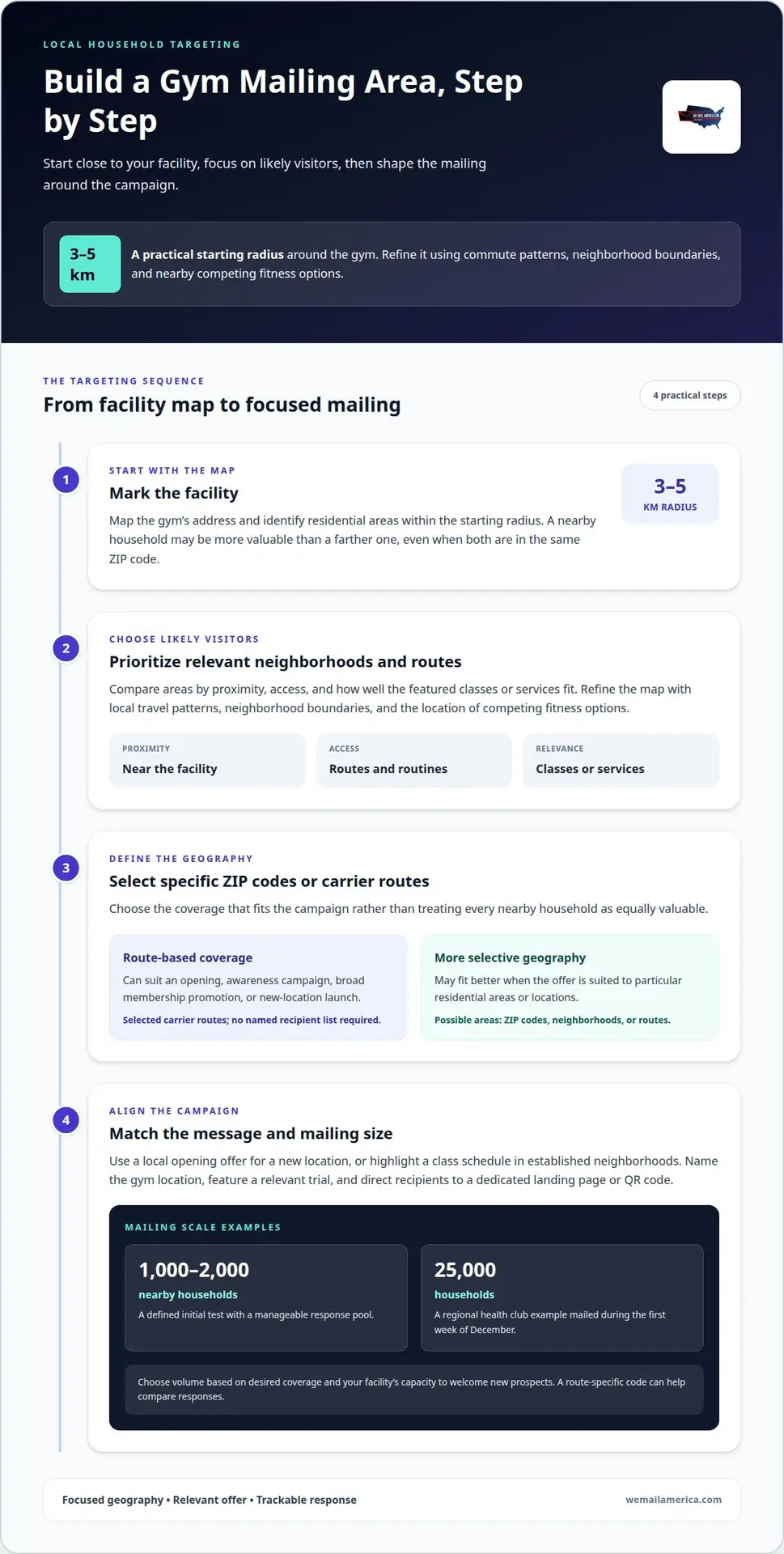
Start with households most likely to visit your facility. A practical starting radius is 3-5 km from the gym, then refine the area using commute patterns, neighborhood boundaries, and the location of competing fitness options. A nearby household may be more valuable than a distant one, even when both sit within the same ZIP code.
Choose the geography that fits your campaign. You can focus on priority ZIP codes, residential neighborhoods, postal carrier routes, or areas around multiple locations. For an initial test, mail 1,000-2,000 nearby households. This gives you a defined audience and a manageable response pool to assess before expanding coverage.
Use a simple targeting sequence to turn a broad map into a clear mailing plan:
- Mark the facility. Map the gym’s address and identify surrounding residential areas within the 3-5 km radius.
- Prioritize likely visitors. Compare routes and neighborhoods by proximity, access, and relevance to the classes or services featured.
- Set the mailing area. Select specific ZIP codes or carrier routes instead of treating every nearby household as equally valuable.
- Match the message. Use a local opening offer for a new location, or highlight a class schedule for established neighborhoods.
Route-based postal programs can suit an opening, an awareness campaign, broad membership promotion, or new-location launch. They reach selected carrier routes without requiring a named list of individual recipients, making them useful when neighborhood coverage is the goal. More selective geographic targeting may work better when the offer fits particular residential areas or locations.
Scale the mailing to your facility and campaign objective. A regional health club example mails 25,000 households during the first week of December. A smaller gym can begin with a focused route, learn which households respond, then adjust the next mailing’s geography. The right volume depends on the coverage you want and the capacity to welcome new prospects.
Targeting also shapes the gym promotion postcards call to action. Name the location, feature a relevant trial, and direct recipients to a dedicated landing page or QR code. A code tied to each route can help compare responses. Include specific location and class information so recipients can quickly judge whether a visit fits their routine.
For a route-based campaign, define the target area and desired action before preparing the mailing. Plan a targeted direct mail campaign around the neighborhoods your gym wants to reach with We Mail America.
3. Postcard design, QR codes, and schedules
Build the design around one offer and one response action. Recipients should quickly see the headline, trial benefit, gym name, location, and next step. For example, pair “Book a facility tour” with a QR code linking directly to tour registration. Keep details such as class options secondary so the main action stays clear.
Choose a QR destination that matches the postcard’s promise. A trial offer should lead to trial registration, while a class promotion can open the class schedule. Other useful destinations include a facility tour, membership information, a location page, or a lead form. A mismatch adds effort for recipients and can interrupt conversion.
Give each mailing a distinct way to identify responses. Use a unique promo code, dedicated landing page, QR code, or campaign-specific booking link. For example, use a different code for a spring trial postcard than for a later class campaign. This helps staff connect scans, calls, bookings, and visits to the right direct mail effort.
Set a measurable scan benchmark before launch. A suggested target is a QR scan rate of 1-3% of mailed postcards. Treat scans as an early signal, not the final result. Track what happens next, including trial claims, booked sessions, visits, and membership conversions. A scan that never becomes a visit tells a different story from a scan followed by a workout and enrollment.
Plan repeat delivery with enough space to compare results. One possible schedule places mailings four to six weeks apart, giving each card time to reach households and generate responses. For example, send the second mailing five weeks after the first. Keep the audience, offer, and response path consistent when testing timing, or change one element at a time to understand what influenced response.
Use the mailing calendar to support the offer’s actual redemption window. If a trial requires booking, allow recipients to choose a session that fits their routine. A confirmation text or email can support attendance; gym studios typically see trial-booking show rates of 70-80% when they send one. Make sure the message confirms the booking details and explains what the prospect should expect during the visit.
Before printing, scan each QR code from the finished design and test its destination on a phone. Confirm the page loads, the form works, and the promised action is available. Record the delivery date, scan activity, bookings, visits, and conversions. These checkpoints make future scheduling and design decisions more practical.
4. Printing and postage costs
Budget for the full campaign, not printing alone. A gym postcard campaign can include printing, postage, offer discounts, and other expenses. Track each component separately to understand the total and compare it with the memberships acquired.
The total depends on mailing quantity, postcard format, production choices, delivery approach, and target area. A targeted campaign and a broad carrier-route mailing have different scopes. The offer also affects campaign economics: include the value of a waived enrollment fee or complimentary session in your calculation, even when no payment changes hands.
Build the estimate in clear categories:
- Printing: Include the selected postcard format and production requirements.
- Postage: Account for the number of recipients and the mailing approach.
- Offer expense: Record the value of discounts, waived enrollment, or a complimentary session.
- Campaign support: Include relevant expenses tied to response tracking and fulfillment.
Calculate cost per acquisition by dividing total campaign cost by new members acquired. For example, if a campaign costs $C and generates M new memberships, divide C by M. Use actual campaign costs and confirmed membership conversions, rather than counting scans, calls, or trial claims as acquired members.
Compare acquisition cost with the financial contribution from memberships. Consider membership revenue and retention, not just the first enrollment payment. A friend who joins through a referral offer may also represent a different acquisition path from a recipient who responds to a trial postcard. Track those sources separately when possible.
Use a break-even view before approving a campaign. Estimate how many new members the gym needs to cover its expenses, then compare that target with actual results. If the mailer generates responses but few trial visits, review the offer and follow-up process. If visits happen without memberships, examine the enrollment experience instead of changing the mailing without evidence.
Connect digital and direct-mail reporting. A QR scan can show interest, but membership conversion determines acquisition performance. Record the response source at booking and enrollment, then compare those records with mailing quantities and expenses. This gives the gym a clearer view of which campaign elements bring in members.
For a useful estimate, define the format, quantity, target area, and response method before requesting a quote. Cost depends on the campaign, including print specifications, mailing quantity, postage, and requirements. Review those factors together, then measure results against membership contribution.
5. What postcard sizes and paper stocks work best for gym promotions?
Choose a postcard size based on what it needs to do. A compact layout can focus attention on one trial offer and response action. A larger format gives more room for a facility photo, class details, location, and redemption instructions. For gym promotions, choose a format that presents the offer clearly without crowding essential information.
Available postcard dimensions include 6 X 11, 9 X 11, 12 X 9, and 10 X 14. Consider each against the campaign’s message, not size alone. A single introductory offer may fit a simpler layout, while a grand opening announcement could need space for several details. Keep the headline and main action prominent in either format.
Use these steps to narrow the format:
- Define the message. Decide whether the card promotes a trial, membership, class, or opening.
- Prioritize content. Put the offer, location, and response instructions first.
- Allow for visual hierarchy. Give the headline and call to action room to stand apart from supporting copy.
- Review the final layout. Check that text, images, and any QR code remain readable at the chosen size.
Choose paper stock with the way recipients will handle the card in mind. Consider whether it needs to make a strong first impression, carry detailed information, or stay easy to keep for later. For a trial starting on a future date, make the instructions clear and readable. For a short-term offer, give the headline and redemption step more emphasis.
There is no single stock choice for every gym campaign. The right selection depends on the design, amount of copy, intended feel, and mailing approach. Keep the offer readable and the response action easy to find. Avoid choosing a material for appearance alone if it makes details harder to read or use.
Before approving production, review a proof at its intended size. Check that the gym name, facility location, offer terms, and QR code are legible. Scan the code and confirm it opens the right destination. This can catch layout issues before the full mailing is produced.
Compare size and stock choices against the campaign’s goal and budget. A larger format can support more content, but extra space only helps when the design uses it purposefully. Request a postcard campaign quote with your preferred format, audience, and mailing plan.
We Mail America: Impact Post Card – 6 X 11
We Mail America’s Impact Post Card – 6 X 11 gives gyms a defined format for presenting a trial offer, facility details, and a response action. If your promotion needs more room for class information or membership details, compare the Extra Large Card – 9 X 11, Mailbox Buster Post Card – 12 X 9, and The Giant Post Card – 10 X 14.
Choose the format that suits the amount of information and the campaign’s priorities. Keep the headline, offer, and next step easy to find, whether you’re promoting a new membership or a gym trial. Contact We Mail America to discuss a postcard format for your campaign.
Turn Your Next Mailing Into a Clear Test
Make your next campaign a learning opportunity, not just another drop in the mailbox. Choose one question to answer, such as whether a different headline or offer brings more qualified prospects through the door. Keep the rest of the campaign consistent so the results can guide your next decision.
Gym promotion postcards can support growth when each mailing has a clear purpose and a response path you can evaluate. Use what you learn to refine the message, audience, or timing of the next campaign. Intentional adjustments help your team build a more informed approach instead of relying on guesswork.
When you’re ready to plan a postcard campaign for your gym, contact We Mail America to discuss the format and mailing approach that fit your goals. Take the next step with a focused plan, and give nearby prospects a reason to discover your gym.
Frequently Asked Questions
How do I track whether my gym postcards are generating memberships?
Connect each response to a specific mailing, then verify membership status at enrollment. Give the campaign its own booking link or promo code, and add a source field to the prospect record. Staff can ask new members how they heard about the gym and compare their answers with recorded responses. This helps capture conversions that happen by phone or in person, not just through online forms.
How many households should I mail my gym membership postcards to?
A focused first campaign can reach 1,000-2,000 nearby households. Before selecting routes, compare the mailing area with your facility’s capacity to handle tours, trial bookings, and new member questions. A gym with limited appointment availability may start with a tighter area; a new location seeking broad awareness may choose wider route coverage. Use the first response pattern to refine the next audience.
How often should a gym send postcards to the surrounding neighbourhood?
Space repeat mailings four to six weeks apart, then adjust based on the offer and response window. A seasonal membership promotion needs time for recipients to consider joining, while a class announcement may need to arrive closer to registration. Avoid changing the message, offer, and timing all at once. Holding some elements steady makes it easier to see what prompted calls, visits, or sign-ups.
What intro offer works best on a gym membership postcard?
A trial offer can work well when prospects want to experience the facility before choosing a membership. Shape the trial around what the gym wants them to discover, such as equipment, a group class, or coaching. State what participation includes and what action comes next. For example, invite prospects to attend a class and book a membership discussion after their visit.
When Should Gyms Mail Slow-Season Promotions?
Schedule a slow-season promotion so the postcard arrives before the period you want to improve, leaving time for responses. Work backward from the offer’s start and end dates, allowing time for booking and follow-up. If the goal is to fill quieter class sessions, feature those sessions rather than a general membership message. Match staff availability to the expected response period.
What should a gym promotion postcard include?
Include the gym’s name, facility location, one clear offer, eligibility details, and a direct response instruction. Add a relevant image or class detail only if it supports the offer. Recipients should understand whether they’re claiming a trial, booking a tour, or asking about membership. Use accurate terms and avoid unsupported promises about health, weight loss, or guaranteed fitness outcomes.
What are effective gym postcard offers and calls to action?
Pair a concrete offer with an action that says exactly what to do. For example, promote an introductory personal training session with “Book your first session,” or feature a group class with “View the schedule and reserve a spot.” A referral promotion can encourage current members to introduce a friend. Focus each card on one offer so recipients aren’t choosing between competing actions.
How much does it cost to design and print gym postcards?
The price depends on the case and is given after a quote request. Key factors include postcard size, print specifications, mailing quantity, postage, target area, and carrier routes. We Mail America’s pricing model is an all-inclusive price per piece for listed campaign components, with final pricing confirmed after reviewing the target area and carrier routes. Share your campaign scope to receive an estimate suited to the mailing.