
Tuesday is a strong starting point when choosing the best day of the week to mail postcards, with Wednesday and Thursday also worth testing. Plan for when recipients are likely to receive the card, not just the day it enters the mail.
Timing matters because a postcard is more useful when it arrives while people have a chance to notice the offer and act. There is no single ideal weekday for every audience or campaign: the offer, delivery window, and recipients’ routines all play a part.
This guide covers why Tuesday through Thursday are common choices, how mailing dates differ from arrival dates, and what to consider around holidays and busy periods. It also explains how to test send dates and compare results, so you can use evidence from your audience rather than guesswork.
Key Takeaways
- Plan around when recipients are likely to see the postcard, not just the day it enters the mail.
- Account for weekends and holidays when setting a campaign’s arrival window.
- Compare mailing-day tests using the same audience, offer, and response measures to get a clearer read on timing.
- Allow time for delivery differences between local and non-local mail when coordinating a campaign.
- Choose a postcard format that gives your offer the space and visibility it needs to stand out.
What’s the Best Day of the Week for Direct Mail?
Tuesday is a useful starting point for postcard delivery, while Wednesday and Thursday are also common targets. Focus on when the card reaches recipients, not only when it enters the mail.
Delivery Timing and Response Rates
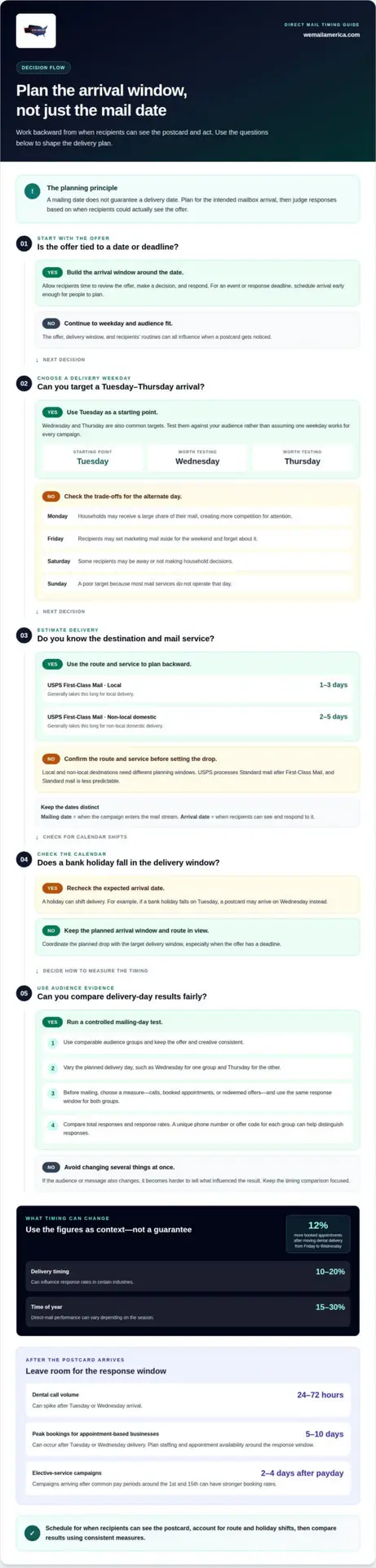
Delivery timing is the weekday a postcard reaches its target audience, and it can shape when recipients notice an offer. Tuesday, Wednesday, and Thursday are common delivery targets, with Tuesday a strong choice. Timing can influence response rates by 10-20% in certain industries. For a campaign, that makes the intended arrival day part of planning, rather than a detail to leave until mailing.
Monday may bring more competition for attention if households receive a large share of their mail that day. On Friday, recipients may set marketing mail aside for the weekend and forget about it. Saturday delivery may reach people who are away or not making household decisions. Sunday is a poor target because most mail services do not operate that day.
Bank holidays can shift the expected arrival date. If a bank holiday falls on Tuesday, for example, a postcard may arrive on Wednesday instead. Account for holidays when setting the schedule, and coordinate the target delivery window with your mailing team. This matters especially when an offer is tied to an event or response deadline.
Postcard Routes and USPS Service Timing
The mail route and service affect how long a postcard takes to arrive, so local and non-local destinations need different planning windows. In the United States, USPS First-Class Mail generally takes one to three days for local delivery and two to five days for non-local domestic delivery. Use the destination and chosen service to plan the intended arrival rather than assuming every postcard follows the same timeline.
The day a postcard is mailed does not guarantee its delivery day. USPS processes Standard mail after First-Class Mail, and Standard mail is less predictable. Coordinate the planned drop with the target arrival window, distinguishing when the campaign enters the mail stream from when recipients can respond.
USPS postcard postage rates and size requirements depend on the postcard’s dimensions and applicable mail category. Plan the format and mailing category together before production, since the chosen size affects which postal requirements apply.
For a U.S. campaign, Tuesday through Thursday is a useful delivery window to test against your audience’s routines. Local and non-local First-Class mail have different typical delivery ranges, and holidays may shift the expected date. Schedule around the intended mailbox arrival, then evaluate responses based on when recipients could actually see the offer.
Why direct-mail arrival timing matters
A campaign’s arrival date connects its offer to the moment a household can act. Planning only around the mailing date overlooks the recipient’s schedule, the season, and the time needed to respond. Direct mail performance can vary by 15-30% depending on the time of year. That makes audience timing part of campaign planning, not a final scheduling detail.
Begin with the action you want recipients to take. Someone considering an appointment needs time to review the offer, contact the business, and find a suitable opening. A postcard promoting a time-sensitive event needs to arrive early enough for people to plan. Match the arrival window to the decision, and make the next step clear on the card.
Dental marketing shows how timing and offer can work together. Early Q1 dental campaigns paired with mid-week delivery and a strong call to action can generate response rates of 3-5%. Some dental practices’ general new-patient campaigns perform 30-40% lower in mid-December than in spring. These figures point to the value of aligning the message with a period when the audience is more receptive.
Appointment bookings also follow a response window after delivery. Dental campaign call volume can spike 24-72 hours after Tuesday or Wednesday arrival. Peak bookings for appointment-based businesses can occur within 5-10 days after Tuesday or Wednesday delivery. Plan staffing and appointment availability around that window, so a response has a practical path forward.
Pay cycles add another planning layer for elective services. Common pay periods in many markets fall around the 1st and 15th of the month. Campaigns arriving 2-4 days after those pay periods can have stronger booking rates for elective services. A postcard for a discretionary treatment, for example, may fit better after payday than during a competing household expense period.
Industry and season matter together. Tax professionals face a crowded decision period in April, while winter-holiday campaigns need early arrival or highly relevant messaging. Real estate postcards promoting an open house can be timed to arrive on Thursday before the weekend, keeping the event close to the recipient’s plans. For a focused campaign plan, use this direct-mail campaign inquiry to connect the audience, offer, and arrival window.
Distinguish the shipping date from receipt, since bulk carriers may distribute mail when convenient, not when preferred. Consider what recipients will be doing and whether they can act. Moving dental delivery from Friday to Wednesday increased booked appointments by 12%.
A/B testing mailing days
A mailing-day test compares similar postcard campaigns to see whether arrival timing affects results. Keep the audience, offer, creative, and response window consistent, then vary the planned delivery day. For example, divide one eligible audience into two comparable groups and schedule one for Wednesday and the other for Thursday. If the message or audience also changes, it becomes harder to identify what influenced the result.
Set the measurement plan before the first postcard goes out. Choose a response to track, such as calls, booked appointments, or redeemed offers, and use the same attribution period for both groups. A unique phone number or offer code for each segment can help distinguish responses. Compare total responses and response rates, since different group sizes can make raw totals misleading.
Mailing schedules do not always produce the arrival days you intend, so record the actual delivery window when available. Test delivery timing, not just the day each batch enters the mail. If Wednesday and Thursday mailings arrive on overlapping days, the comparison may be weak. Coordinate planned drops and note any holiday or processing disruption that affects the schedule.
Allow 90 days for direct mail timing tests, as recommended in the campaign timing guidance. That period gives recipients time to respond and helps capture results beyond the first few days. Don’t stop a comparison as soon as one group appears ahead. Use the same cutoff for both groups, and record late responses consistently so one mailing doesn’t benefit from extra time.
Existing timing results can suggest a hypothesis, but they don’t replace a controlled test for your audience. One timing test reported nearly 18% more response volume over a 30-day tracking period for a mid-week drop than for a late-Friday drop. Treat that as a reason to compare your own mid-week and Friday segments, not as a guaranteed outcome. Saturday delivery can also be examined when it fits the campaign, but avoid changing other variables at the same time.
Interpret the results in context before choosing a winner. If Wednesday brings more calls but Thursday produces more completed bookings, the stronger day depends on your campaign goal. Record the offer, audience, actual arrival window, response measure, and outcome together. This makes the next test more useful and helps separate a repeatable timing pattern from a one-off result.
Coordinating send and receipt dates
The mailing date is when a campaign enters the mail stream; the receipt date is when recipients can see it. Plan around the intended in-home date, since a postcard can lose relevance if it arrives after the offer or event window.
If a postcard needs to arrive by a specific date, work backward using the destination, mail service, holidays, and delivery estimate. Choose a mailing day that allows enough transit time for the route, and build the schedule around the arrival window rather than the drop-off day.
Start with the recipient’s location. In the United States, First-Class Mail generally takes one to three days for local delivery and two to five days for non-local domestic delivery. Non-local domestic Standard Class mail generally takes 10 to 14 days. These are different planning windows, so the same mailing date won’t suit every audience or service.
Next, align the production and mailing schedule with the provider. Share the required in-home date, the destination mix, and the campaign’s response window. Agree on the planned drop date and delivery range together. Poor coordination can cause campaigns to miss their intended timing window by 3-4 days, enough to affect an appointment promotion or a postcard tied to an upcoming event.
Account for holidays before choosing a mailing day. A bank holiday can shift expected delivery, so do not schedule a time-sensitive offer close to a holiday without allowing for the change. If recipients need time to book before an event, set the arrival target early enough for them to respond before the deadline.
Pay particular attention to Friday arrivals. Recipients may set mail aside for the weekend, leaving less time to respond while an offer is fresh. If results depend on a quick call or booking, target a weekday that gives recipients a practical chance to act. Track the actual arrival period and responses within the same campaign window.
Use one shared calendar for the campaign. Record the target in-home date, planned mail date, service, destination areas, holiday impacts, and response deadline. If the delivery window changes, adjust the response tracking period too. This prevents a delayed postcard from being judged against a window that began before recipients could reasonably see it.
How weekday routines affect mail engagement
A postcard is more likely to get attention when it arrives at a time that fits the recipient’s routine. Tuesday through Thursday can put an offer in front of households during the workweek, when people may have time to sort mail and consider what to do next. The best day depends on who makes the decision and when they are likely to act. Someone choosing an appointment, for example, may respond differently from someone planning a weekend visit.
Monday may bring a larger volume of household mail, leaving a promotional card to compete for attention. Friday presents a different challenge: recipients may turn to weekend plans and set mail aside. That makes Friday a weak choice when an offer needs a quick response. The least suitable day depends on the goal, but Sunday is a poor delivery target because most mail services do not operate that day.
Weekend routines can also affect who sees a postcard. Some recipients may be away, while mail that waits until they return can be overlooked. Weekend delivery can reach household members who aren’t the decision-makers. For a local service offer, consider whether the person who handles bookings or purchases is likely to review mail during the planned arrival window.
Seasonal routines matter as well as weekdays. September through November typically shows strong direct-mail performance, while July and December are identified as weaker months for consumer attention. Mail volumes are usually heavier around Christmas, Mother’s Day, Father’s Day, and Easter. During these periods, make the offer and next action easy to understand so the postcard can stand out among other household mail.
USPS collection times and post office hours can affect when a postcard enters processing, but they do not determine its eventual mailbox day on their own. For a business mailing, coordinate the planned drop and target arrival window, including any holiday shift. Keep the schedule focused on recipients’ routines rather than the sender’s handoff time.
Shape the response path around the weekday you choose. If a card arrives before a weekend event, give recipients a clear date, location, or booking action. If the offer requires a phone call during business hours, a mid-week arrival gives people who work weekdays a practical chance to respond. Track responses against the actual arrival period, not just the date the mailing began.
Use audience habits to shape the campaign calendar, then refine timing through measured results. A targeted campaign can align the offer, arrival window, and recipient routine instead of treating every weekday alike. Plan a direct-mail campaign around the audience and timing that fit your offer.
We Mail America: Impact Post Card – 6 X 11
We Mail America’s Impact Post Card – 6 X 11 gives your campaign a tangible format for putting an offer directly in recipients’ hands. Pair the postcard choice with a planned arrival window, a clear call to action, and a response measure that matches your campaign goal.
For a different format, We Mail America also offers the Extra Large Card – 9 X 11, Mailbox Buster Post Card – 12 X 9, and The Giant Post Card – 10 X 14. Select the format that suits the message and the space it needs, then coordinate the mailing schedule around when your audience is most ready to act.
Contact We Mail America to discuss your postcard campaign.
Make your next mailing a deliberate test
Choosing the best day of the week to mail postcards is a useful starting point, but your campaign calendar can do more than set a drop date. Use it as a shared planning tool for marketing and the teams handling calls, bookings, or customer follow-up. When those teams know what an upcoming campaign promotes, they can respond consistently and help turn interest into action.
After each mailing, preserve the context behind the results. Record the audience, offer, timing decision, and response goal together. This gives future campaigns a practical reference and helps your team make informed adjustments instead of starting from scratch. Over time, the calendar becomes a working record of what your business has tested and learned.
Ready to shape your next postcard campaign around your audience and goals? Contact We Mail America today to discuss the right next step. A thoughtful plan can make your next mailing more focused, coordinated, and ready to act on.
Frequently Asked Questions
Does the delivery day really affect response rates?
Yes. The day a postcard arrives can affect whether recipients notice and act on its offer. A promotion for a weekend event, for example, needs to reach people while they still have time to plan. Measure responses against the actual arrival period and compare similar campaigns before drawing conclusions. Audience habits, the offer, and the requested action all help determine whether timing supports engagement.
The Real Question: When Should Your Mail Arrive?
Your mail should arrive when recipients have a practical opportunity to respond. For a booking promotion, allow time to make contact and choose an appointment before the offer ends. For an event, the postcard should reach people while they can still plan to attend. Set the arrival target around the recipient’s decision window, then schedule the mailing to support it.
What day of the week is best to mail postcards in the United States?
Tuesday is a strong starting choice, and Wednesday and Thursday are also common postcard delivery targets. The best day of the week to mail postcards depends on when your audience can act, so treat the mid-week window as a starting point to test. A time-sensitive offer, for instance, may need a different arrival target from a general awareness message.
Is it better to mail postcards early in the week to avoid weekend delivery delays?
Mailing early in the week can give a postcard more time to reach recipients before the weekend, but the send date alone does not determine arrival. Route, mail service, and processing all affect the delivery window. For a Saturday event, plan backward from when recipients need to act and coordinate the intended arrival period rather than assuming an early-week drop guarantees weekday delivery.
How do holidays and federal mail delivery schedules affect postcard delivery?
Holidays can shift the expected arrival date, so leave room in the schedule for changes. If a bank holiday falls on Tuesday, the expected receiving date may move to Wednesday. Plan a postcard tied to a deadline or event with that shift in mind. When timing is critical, set the delivery target outside a holiday-sensitive window and coordinate the schedule before mailing.
Does the best mailing day differ for local, cross-country, or international postcards?
Tuesday through Thursday are useful arrival targets for local and non-local domestic postcards. Allow for different delivery times: First-Class mail generally takes one to three days locally and two to five days for non-local domestic delivery.