

84% of marketers report that direct mail provides the highest ROI of any channel they use, yet many national brands still struggle to prove those results to digital-first stakeholders. It’s frustrating to watch your budget disappear into non-responsive zip codes because you lack the data to show exactly who is visiting your site after receiving a mailer. You deserve a clear, data-driven way to show that your physical outreach is driving digital action. Learning how to track direct mail roi is the key to turning your print campaigns into measurable, high-performance assets.
We Mail America is here to take the complexity out of your nationwide marketing. This 2026 guide provides the exact formulas and digital integration tools you need to prove and improve your return on investment. You’ll master practical tracking methods like QR codes on our Impact Post Card – 6 X 11 and our Mail to Mobile texting service. We’ll also show you how to link your physical mailers with a Connected TV Network for seamless cross-channel attribution. Get ready to transform your mail from a logistics headache into your most reliable source of growth across all 50 states. We handle the technical details so you can focus on the results.
Key Takeaways
- Master the fundamental math of direct mail by calculating total revenue against all campaign costs like design, printing, and postage.
- Discover how to track direct mail roi using digital bridge tools like dynamic QR codes and Personalized URLs (PURLs) that capture individual recipient behavior.
- Maximize your response rates by placing tracking elements within the visual “F-Pattern” of our oversized Impact Post Card – 6 X 11.
- Bridge the attribution gap by integrating Mail to Mobile texting and Connected TV Network tracking for a seamless cross-channel view.
- Streamline your reporting across all 50 states with a turnkey partner that provides a single point of contact for nationwide campaigns.
The ROI Challenge: Why Tracking Direct Mail is Non-Negotiable
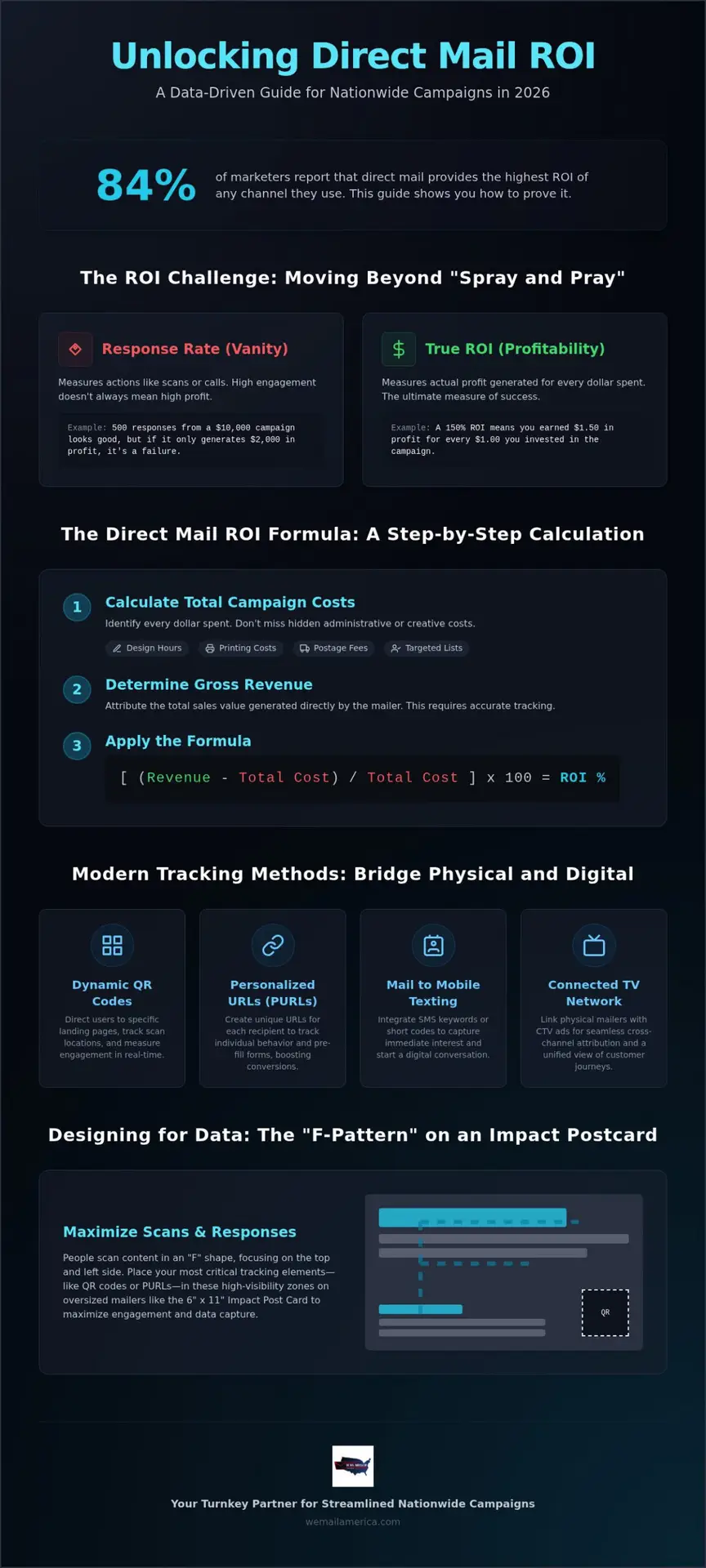
Marketing in 2026 requires absolute precision. You can’t afford to guess which campaigns drive profit and which just waste your budget. While digital ads offer instant clicks, direct mail provides a physical presence that stays in the home. Many national brands struggle with the “attribution gap.” They see a spike in web traffic or social media engagement but can’t prove it came from their last mailing. This lack of clarity makes it hard to explain print value to digital-first stakeholders. Understanding how to track direct mail roi starts with a solid foundation in Return on Marketing Investment (ROMI). The formula is straightforward: subtract your total campaign costs from your gross revenue, then divide that result by those same costs.
Stop using the “spray and pray” method. It’s an expensive relic of the past. You need data to justify every dollar spent across your nationwide campaigns. There is a massive difference between a response rate and true ROI. A response rate measures actions, like a scan or a phone call. ROI measures profit. If you spend $10,000 to get 500 responses but only $2,000 in profit, your campaign failed despite the high engagement. Mastering how to track direct mail roi allows you to scale what works and cut what doesn’t across all 50 states.
The Psychology of the Physical Mailbox
Physical mail has a unique staying power. A postcard sits on a kitchen counter or a desk for days. This tactile engagement is why 84% of consumers open and read their mail the same day it arrives. It also creates a “Halo Effect.” Recipients often see an Impact Post Card – 6 X 11 and later convert on your website or through a social media ad. This physical touchpoint makes your digital ads work harder—for example, a consumer might receive a grooming promotion and later seek styling advice on Reead before converting. National brands use this strategy to capture high-intent leads that digital channels often overlook.
Key Metrics to Monitor Beyond the Sale
Look past the immediate transaction to see the full picture. Track your Cost Per Lead (CPL) and compare it to your Cost Per Acquisition (CPA). These numbers tell you the efficiency of your targeting. You must also focus on Customer Lifetime Value (CLV). A single mailer might trigger a small initial purchase, but the real profit comes from long-term loyalty. ROI should be measured over months, not just the first few days after a drop. Monitor your conversion rate carefully to identify which regions offer the best return. We handle the logistics so you can focus on these high-level results.
The Direct Mail ROI Formula: A Step-by-Step Calculation
To truly understand how to track direct mail roi, you must look at the hard numbers. ROI isn’t a feeling. It’s a calculation of profitability. Start by identifying every single dollar spent on the campaign. This includes design hours, printing costs, postage fees, and the cost of your targeted lists. Next, determine your Gross Revenue. This is the total sales value generated by the mailer. Once you have these figures, use the standard formula: [(Revenue – Total Cost) / Total Cost] x 100. This percentage tells you exactly how much profit you made for every dollar invested. If your result is 150%, you earned $1.50 for every $1.00 spent.
A break-even analysis is your safety net. Before the mail hits the boxes, calculate how many sales you need to cover the initial investment. If your campaign costs $5,000 and your average sale profit is $500, you only need 10 conversions to break even. This keeps your expectations grounded in reality. It also allows you to set clear benchmarks for success across different demographics or regions. When you know your numbers, you can scale your nationwide efforts with total confidence.
Accounting for Production and Postage
Postage is often the largest variable in your budget. The Impact Post Card – 6 X 11 is a high-visibility choice that balances size with postage efficiency. If you need more space to tell your story, the Extra Large Card – 9 X 11 commands attention but requires a different budget approach. Turnkey services eliminate the hidden administrative costs that often plague multi-vendor campaigns. By choosing a single provider for all 50 states, you protect your margins from being eaten away by shipping delays or coordination errors. Using Every Door Direct Mail (EDDM) can offer better margins for saturation campaigns, while Targeted Mail ensures you aren’t wasting money on non-responsive addresses.
Revenue Attribution Models
Attribution models help you decide who gets the credit for a sale. First-touch attribution is simple. If a customer uses a code from your mailer, the mailer gets 100% of the credit. However, modern marketing is rarely that linear. You should also consider multi-touch attribution. This is especially important when integrating your physical mail with digital layers like a Connected TV Network. Seeing an ad on a screen and then holding a postcard in their hand creates a powerful synergy. To accurately measure marketing effectiveness, you must account for these digital assists. Learning how to track direct mail roi across these touchpoints ensures you don’t undercount your success. If you want to see how these numbers apply to your specific industry, you can request a custom ROI assessment to get started.
Modern Tracking Methods: Bridging Physical and Digital
Modern marketers don’t just send mail. They build digital bridges. If you’re wondering how to track direct mail roi in a digital-first world, the answer lies in physical-to-digital integration. Dynamic QR codes are the fastest way to drive traffic from a postcard to a mobile-optimized landing page. Unlike static codes, dynamic versions allow you to change the destination URL and track scan data in real time. Our Impact Post Card – 6 X 11 provides the perfect canvas for these codes. The oversized format ensures the tracking element is visible, accessible, and easy to scan for every recipient.
Personalized URLs, or PURLs, take this a step further. They allow you to track individual recipient behavior on your site. You can see exactly who visited, what they clicked, and where they dropped off. Learning how to track direct mail roi doesn’t have to be a headache when you use these modern tools. For retail and service brands, unique coupon codes remain a classic choice. They provide a direct link between a specific mailer and a transaction. Similarly, unique call tracking numbers using VOIP technology allow you to count phone inquiries generated by each campaign drop across all 50 states.
Integrating Mail to Mobile Texting
Our Mail to Mobile Texting service creates an instant digital trail for every recipient. By including a simple SMS keyword on your postcard, you allow customers to engage with a single text. This triggers an automated follow-up and provides immediate data on who is interested. This integration significantly increases response rates for nationwide campaigns because it meets customers where they already spend their time. It removes the friction from the conversion process and gives you a clear line of sight into campaign performance.
Leveraging Connected TV (CTV) for Attribution
Syncing your mail drops with your Connected TV Network commercials allows you to dominate the household screen. You can track view-through conversions to see if a recipient saw your ad and then visited your site after receiving their mailer. This cross-channel frequency is a powerful driver of ROI. It moves the conversation from a single mailbox to a coordinated multi-screen experience. We handle the technical heavy lifting so you can see exactly how these channels work together to drive sales across the country.
Designing for Data: Maximizing Tracking on Your Postcard
Design is not just about aesthetics. It is your primary tool for data collection. If your tracking elements are buried in a cluttered layout, your response rates will suffer. Most recipients scan mail using the “F-Pattern.” They look across the top and then down the left side. Place your primary tracking element, such as a QR code or a text keyword, along these natural visual paths. Mastering how to track direct mail roi requires a layout that guides the eye toward your tracking tools without distraction. Use high-contrast colors and plenty of white space around your call to action. This makes your offer pop and ensures the recipient knows exactly what to do next.
The Impact Post Card – 6 X 11 offers the best real estate for modern tracking. Its oversized dimensions provide enough room for a large, scannable QR code while still leaving space for a bold headline and compelling imagery. A smaller card often forces you to shrink your tracking elements, which leads to scanning errors and lost data. Always test your tracking before your mail hits the boxes. Scan your own QR codes and call your tracking numbers to verify everything works perfectly. We handle the technical design requirements for all 50 states to ensure your campaign is ready for precision measurement.
The Anatomy of a High-ROI Postcard
Capture attention in two seconds or less with a bold headline. Your message must be clear and immediate. Follow the “One Goal” Rule. Don’t try to track five different actions on a single card. If you want them to visit a landing page, focus entirely on that QR code. Cluttering the card with phone numbers, social media handles, and multiple URLs confuses the recipient and muddies your data. Don’t forget the address side of the card. Turn the back into a secondary tracking hub by repeating your CTA and QR code near the recipient’s name for maximum visibility.
A/B Testing Your Mailers
Use split-testing to optimize your nationwide budget. Test different offers to see what resonates. You might find that “$20 off” outperforms “20% off” even if the value is the same. You can also test physical formats. Compare the Impact Post Card – 6 X 11 vs. Sizeable Trifold – 10 X 17 to see which drives a better return for your specific audience. This data-driven approach allows you to scale your most effective designs across the country while cutting underperforming versions. To start building a campaign designed for maximum data, contact our team for a custom quote today.
Scaling Nationwide: Leveraging We Mail America for ROI
Managing a campaign across 50 states is a massive undertaking. Many brands fail because they juggle too many local vendors. This fragments your data and makes it impossible to see the big picture. We Mail America provides a single point of contact for your entire nationwide strategy. This simplicity is vital when you are learning how to track direct mail roi. You get a clear, unified view of your performance from coast to coast. Our turnkey approach handles everything from geographic targeting to digital integration. We ensure your tracking elements are consistent and functional on every piece of mail we send.
Waste is the enemy of profit. We use high-precision targeting to ensure your Impact Post Card – 6 X 11 reaches only the most relevant households. This reduces your cost per acquisition and boosts your bottom line. Stop paying for mailers that land in non-responsive zip codes. By focusing on high-intent data, we help you master how to track direct mail roi with absolute confidence. Start your nationwide campaign today and see the difference that data-driven precision makes for your brand.
Full-Service Project Management
Our “headache-free” promise means we handle the logistics while you focus on the results. Outsourcing your design and printing to a national specialist ensures your tracking elements meet strict technical standards. A blurry QR code or a broken link can ruin your attribution. We maintain a consistent brand message across every market while ensuring your digital bridges are seamless and scannable. This reliability is why nationwide brands trust us to manage their most important outreach. We take the complexity out of the process so you can scale quickly.
Custom Solutions for Every Industry
Different industries require different physical formats to drive action. A restaurant might need a Massive Menu Trifold to showcase its offerings, while a healthcare provider requires a Medical Appointment Card. We adapt our tracking strategies to fit your specific audience and goals. B2B campaigns often require longer tracking windows and PURLs for individual lead nurturing. B2C campaigns usually rely on high-energy SMS keywords and QR codes for instant engagement. Whatever your sector, we provide Direct Mail Advertising Services for Business Growth that are proven to work across the country. We provide the tools and expertise needed for national success.
Turn Your Physical Mail into a Data-Driven Growth Engine
Direct mail is no longer a guessing game. By mastering the ROI formula and leveraging the visual power of the Impact Post Card – 6 X 11, you can transform your outreach into a measurable profit center. You now have the blueprint for how to track direct mail roi using modern tools like dynamic QR codes, PURLs, and integrated Connected TV ads. These digital bridges ensure every physical touchpoint creates a traceable path to conversion across the entire country. Physical mail is something your customers can hold and keep, and now it’s something you can measure with total precision.
Scaling across all 50 states shouldn’t be a logistical nightmare. We Mail America handles the technical details, from high-precision targeting to seamless digital integration. Our all-in-one nationwide turnkey service removes the stress of multi-vendor coordination. You focus on the high-level strategy while we deliver the tangible results. It’s time to prove the value of your print campaigns with hard data and professional precision. Your brand deserves a partner that values results as much as you do.
Get a Custom Quote for Your Nationwide Campaign and start seeing the impact of data-backed direct mail today.
Frequently Asked Questions
What is a good ROI for a nationwide direct mail campaign?
Industry data shows that direct mail sent to house lists delivers an average ROI of 161%. This is currently reported as the highest return of any paid marketing channel. Prospect lists typically see lower initial returns, but the long-term value remains significant. When calculating how to track direct mail roi, always factor in the lifetime value of the customer rather than just the first transaction.
How do I track direct mail if I don’t have a website?
You can track results effectively using unique call tracking numbers or our Mail to Mobile texting service. These tools allow recipients to engage immediately without needing a computer. You get real-time data on every inquiry and conversion. This is a powerful way to manage nationwide campaigns for service-based businesses or retail brands that prioritize phone calls over digital clicks; you can learn more about identifying the owners of unknown phone numbers to ensure you have accurate contact details for every lead.
Can I use QR codes on Every Door Direct Mail (EDDM) postcards?
Yes, QR codes are a standard feature on EDDM postcards. They bridge the gap between a local saturation mailing and your digital storefront. Using a dynamic QR code on an Impact Post Card – 6 X 11 allows you to track scans by zip code or neighborhood. This provides granular data on which areas are responding best to your message across all 50 states.
How long should I wait to measure the ROI of my mailing?
Wait at least 45 to 90 days to finalize your ROI calculations. Physical mail has a long shelf life and often stays in a household for weeks before a recipient takes action. Measuring too early can lead to undercounting your results. This extended window allows you to capture the full “halo effect” and multi-touch conversions that occur after the initial drop.
Is it better to track phone calls or website visits?
The best approach is to track both touchpoints simultaneously. Website visits are easier to automate through QR codes and PURLs, but phone calls often represent higher-intent leads. By monitoring both, you get a complete picture of how to track direct mail roi across different customer segments. We provide the tools to integrate these metrics into a single, manageable report for your stakeholders.
What is the most effective postcard size for high response rates?
The Impact Post Card – 6 X 11 is the most effective size for maximizing visibility and response. Its oversized dimensions ensure it stands out in a crowded mailbox. This format provides ample room for bold headlines and clear tracking elements without feeling cluttered. Larger sizes like the Mailbox Buster Post Card – 12 X 9 also drive high engagement for premium nationwide brands.
How does Connected TV help me track my direct mail results?
Connected TV allows you to track “view-through” conversions by syncing your mail drops with digital commercials. You can see if a household visited your website after seeing your TV ad and receiving your postcard. This cross-channel data proves the synergy between physical and digital media. It removes the attribution “blind spot” that often plagues standalone print or digital campaigns.
Does personalization really improve direct mail ROI?
Personalization significantly boosts engagement and conversion rates. Using the recipient’s name or tailoring the offer based on their past behavior makes the mailer feel more relevant. This leads to higher response rates and a better bottom line. Our turnkey service handles these data-driven details for you, ensuring every piece of mail sent across the country is optimized for maximum profit.