
The strongest voter outreach mail strategies don’t send every voter the same message. Identify the audiences you want to reach, tailor each message to their concerns, and coordinate mailings with the campaign calendar. A consistent look and a clear next step help every piece support the wider effort.
It’s easy to focus on the postcard or mailer itself, but audience selection matters just as much. A relevant message is more likely to earn attention than a broad appeal that doesn’t speak to the recipient. Allow time to prepare, print, and deliver each piece ahead of important voting milestones.
This guide explains how to segment voter audiences, shape campaign messages, and plan a practical mailing cadence. You’ll also learn what to consider in postage and production planning, how postal requirements fit into the process, and how to schedule outreach around registration, early voting, vote-by-mail deadlines, and Election Day. With a clear plan, direct mail can become a tangible, coordinated part of campaign outreach.
Key Takeaways
- Segment voter audiences by relevant interests and campaign priorities, then shape each message to speak clearly to that group.
- Keep campaign branding consistent across mail pieces and use a clear next step to connect the printed message with digital outreach.
- Plan production and postage together, and build delivery time into the schedule so mail arrives when it can still influence voter attention.
- Work backward from registration, early voting, vote-by-mail, and Election Day milestones to set a practical mailing cadence.
- Measure response with trackable calls to action and compare results across audiences and mail pieces to guide future outreach.
1. Campaign message design and voter personalization
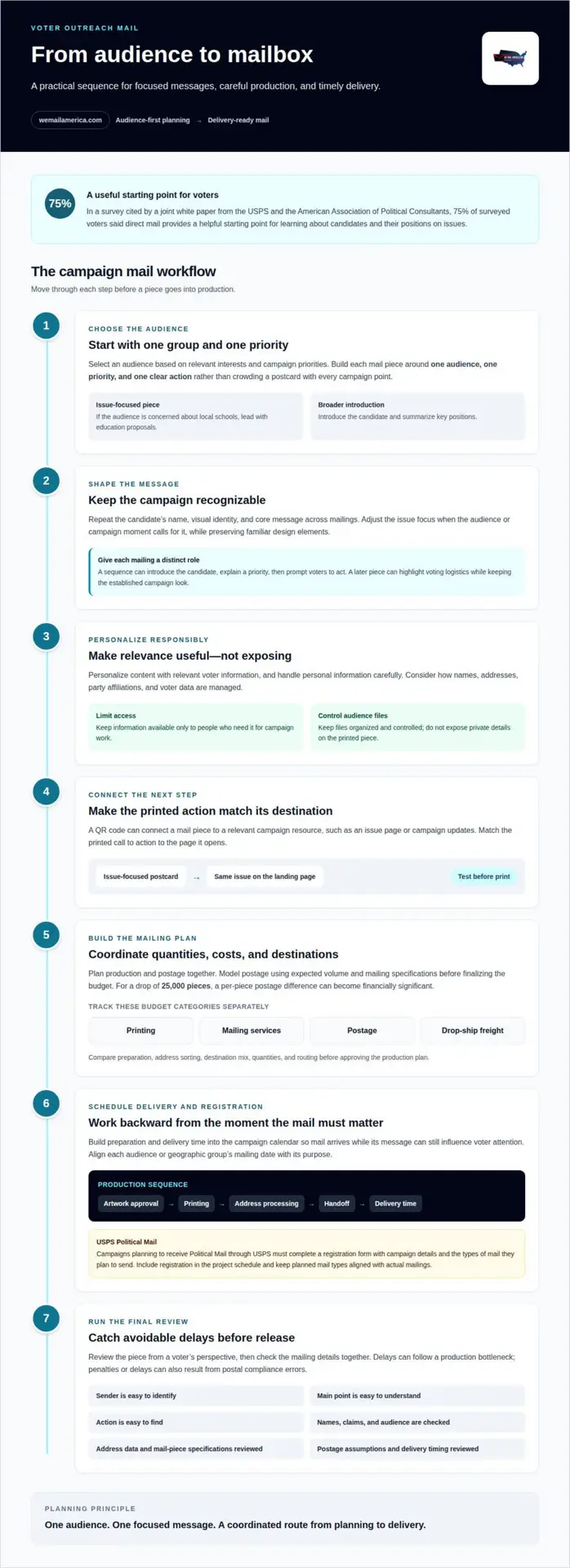
Build each mail piece around one audience, one priority, and one clear action. A campaign addressing concern about local schools can lead with its education proposals. A broader piece can introduce the candidate and summarize key positions. This audience-first approach keeps the message focused instead of crowding one postcard with every campaign point.
Keep campaign branding consistent across direct-mail pieces. Repeat the candidate’s name, visual identity, and core message so voters recognize the campaign across mailings. Adjust the issue focus when the audience or campaign moment calls for it, while preserving familiar design elements. For example, a later piece can highlight voting logistics and retain the campaign’s established look.
Personalize content with relevant voter information, and handle personal information carefully. When selecting a direct-mail partner, consider how names, addresses, party affiliations, and voter data are managed. Limit access to people who need the information for campaign work, and keep audience files organized and controlled. Personalization should make a message relevant, not expose private details on the printed piece.
What makes voter mail useful to recipients? In a survey cited by a joint white paper from the U.S. Postal Service (USPS) and the American Association of Political Consultants, 75% of surveyed voters said direct mail provides a helpful starting point for learning about candidates and their positions on issues. Use that opportunity to explain a position in plain language, connect it to a voter concern, and offer a next step.
Plan multiple mailings throughout the campaign, giving each a distinct role, such as introducing the candidate, explaining a priority, or prompting voters to act. Map the sequence against campaign milestones and budget for design, printing, mailing, and postage. A planning grid can track each audience, message, format, planned drop, and budget category, making gaps and overlapping messages easier to spot before production.
Connect physical mail to campaign resources with a QR code. Send recipients to a relevant destination, such as a page explaining the featured issue or sharing campaign updates. Match the printed call to action to the page it opens, so someone scanning an issue-focused postcard lands on the same topic. Test the code and destination before approving the piece for print.
Before final approval, review the piece from a voter’s perspective: can they identify the sender, understand the main point, and find the action quickly? Check names, issue claims, audience selection, branding, and QR destination together. These practical voter outreach mail strategies help each piece support a coherent campaign message while keeping personalization deliberate and voter information protected.
2. Postage, delivery timelines, and postal compliance
Postage decisions affect both campaign budgets and delivery planning. Compare the mailing’s preparation, address sorting, and destination mix before choosing a mail class or drop plan. For a drop of 25,000 pieces, that per-piece difference can become financially significant. Use the expected volume and mailing specifications to model postage before finalizing the campaign budget.
Budget for more than postage. Account for printing, mailing services, postage, and any drop-ship freight as separate categories. This breakdown helps the campaign see which production and delivery decisions affect the total. Compare the planned drop with its quantities and routing before approving production, and keep the budget tied to the mail plan rather than treating postage as the only delivery expense.
Timing matters as much as the selected rate. Political mail needs to arrive while its message can still influence voters, so build preparation and delivery time into the campaign calendar. Coordinate artwork approval, printing, address processing, and handoff as connected steps. A delay at any stage can push the mailing beyond its intended window. Plan geographic coverage early, grouping addresses by audience or intended area and aligning each group’s mailing date with its purpose.
Common mistakes include underbudgeting freight or mailing services, choosing an unsuitable postage tier, and scheduling a drop without enough time for production and delivery. Postal compliance errors can also cause penalties or delays. Reduce these risks by reviewing address data, mail-piece specifications, postage assumptions, and delivery timing before releasing the job.
Political campaigns planning to receive Political Mail through the United States Postal Service (USPS) must complete a registration form with campaign details and the types of mail they plan to send. Add registration to the project schedule alongside production and postage planning. Keep a record of planned mail types so the registration details align with actual mailings, supporting a clear handoff when pieces are ready.
For nationwide or geographically distributed outreach, map each destination area and mailing group before calculating the postage plan. Different destinations and sorting conditions can affect the appropriate mailing approach, so keep geographic coverage visible in campaign records. A mailing partner with postal expertise can help coordinate these moving parts, from production details to delivery planning. Campaign teams can use the campaign mailing inquiry to discuss their project needs.
3. Election-cycle timing and voting deadlines
Build the mailing calendar around the election milestones voters need to act on. Start with registration deadlines, early voting dates, vote-by-mail application deadlines, ballot deadlines, and Election Day. These dates determine when a reminder or candidate message is most useful. Gather the applicable dates for each target area before setting production and mailing windows. For campaigns reaching multiple areas, track each area’s dates separately instead of relying on one general calendar.
Work backward from each milestone. For a registration reminder, plan delivery early enough for recipients to read the message and act before registration closes. For a vote-by-mail message, distinguish the application deadline from the ballot deadline. These are separate moments, and a piece that addresses only one may leave voters unsure of the next step. Make the relevant date and action easy to find on the mail piece.
Give each mailing a specific role in the sequence. An earlier piece can introduce the candidate and build name recognition. A later one can focus on a priority, explain a voting step, or remind recipients of an approaching deadline. Match the message to the milestone, and don’t ask one piece to cover every campaign issue and voting task. This keeps each contact focused and easier to act on.
Mailing too early involves a tradeoff. Early outreach can build familiarity, but a piece arriving long before the race feels relevant may be discarded before voters pay attention. Set timing by considering what recipients need to know at that point in the cycle. A candidate introduction may suit an earlier stage; a deadline reminder belongs closer to the action, with enough time for delivery and response.
Use a simple planning grid to coordinate the election calendar. Give each row a target area and milestone, then record the message, audience, production status, and planned delivery window. Schedule approval and printing before the mailing window. The grid exposes conflicts, such as two pieces aimed at the same audience in quick succession or production scheduled after the intended drop.
Review the grid whenever campaign dates or plans change. If an early voting date shifts, revisit the related message and delivery window, not just the artwork. Keep separate entries for registration, vote-by-mail applications, ballot deadlines, early voting, and Election Day. This distinction helps prevent a broad “vote soon” message from replacing a timely, specific instruction.
Before releasing each piece, match its call to action to the milestone it addresses. A registration message should direct attention to registration; a vote-by-mail reminder should clarify whether it concerns an application or a ballot. Check every printed date against the current campaign calendar, then confirm the delivery schedule still gives voters time to respond. This final review connects the message, deadline, and mailing window.
4. Identifying and targeting voter audiences
Start with the campaign’s objective, then define who needs the message. A candidate seeking support for a school proposal might prioritize voters for whom education is a central concern. A separate piece could introduce the candidate to residents who have received little campaign communication. Each audience should connect to a clear campaign goal, not just a broad label.
Build practical audience groups using factors that help shape the message. Geography can distinguish areas with different local concerns. Issue interests can guide which policy details to include. Campaign engagement can help separate people who need an introduction from those ready for a specific voting reminder. Tie the criteria to each piece’s purpose, and avoid segments that don’t lead to a meaningful change in content.
Create a simple audience-to-message map before production. Record the group, relevant issue or information, proposed message, and action the piece should encourage. For example, an area-focused piece might explain a local priority, while a candidate introduction gives a concise overview of positions. The map helps identify groups receiving a generic message that doesn’t reflect their needs.
Audience selection also helps campaigns use mailing resources deliberately. Compare the groups the campaign wants to reach with the message schedule and available budget. If several pieces target the same voters, give each a distinct role instead of repeating the same appeal. If an audience has no clear message or action, reconsider its purpose before adding it to the mailing plan. These checks make targeting a campaign decision, not just a list-building task.
Make targeting choices explainable within the campaign. Document why each group was selected and what message it will receive. This record helps staff assess whether a piece matches its intended audience and keeps audience definitions consistent as plans develop. For instance, if a group is defined around a local issue, the finished piece should address it directly rather than rely on unrelated general claims.
Personalization should improve relevance without making a piece feel intrusive. Use the audience definition to choose the topic, examples, and call to action, but don’t expose sensitive details in print. Review the piece from the recipient’s perspective. Voters should understand why the message matters without feeling that the campaign is displaying private information.
For campaigns seeking support aligning mail with a defined audience, Mail Max Pro – The Right Audience / Right Now! is a relevant option. Its name reflects a central planning question: which voters should receive which message, and when? Pair that audience decision with a clear campaign objective and a focused mail piece.
5. How can campaigns measure voter outreach mail effectiveness and response rates?
Measure each mail piece against its intended action, not just its delivery volume. An introductory postcard should build recognition; a voting reminder should prompt a specific next step. Set the objective before printing, then choose a measure that reflects it. For example, track visits to an issue page after mailing an issue-focused piece. This makes results more useful than a single tally of pieces sent.
Use a distinct response path for each audience or mail piece. A QR code can connect recipients to campaign information, and separate destinations can help identify which piece prompted a visit. Keep the destination relevant to the printed message. If a postcard discusses a local issue, direct scanners to the matching issue information rather than a general campaign homepage.
Define the response before mailing. It might be a QR scan, a campaign-page visit, a call, or another action stated on the piece. Compare recorded responses with the number of pieces delivered to the intended audience. Use the same definition and denominator across comparable mailings; otherwise, the results won’t support a reliable comparison.
Keep a tracking record for each drop, including the audience, message, format, mailing date, intended action, delivery count, and responses. This lets campaign staff compare like with like. For example, compare two pieces aimed at similar audiences and promoting the same action. If their response paths differ, account for that before drawing conclusions.
Separate immediate responses from later campaign outcomes. A scan soon after delivery can show prompt engagement, while later interactions may follow other campaign contacts. Note the response window for each mailing and apply it consistently. Don’t attribute every subsequent campaign interaction to one postcard. Instead, consider response records alongside timing and audience details to understand the piece’s role.
Use the findings to improve the next mailing. If a piece draws scans but few visits to its intended action, check whether the destination matches the printed promise. If one audience responds more strongly to an issue message, consider giving that topic a clearer role in later outreach. Change one element at a time, such as the call to action or destination, to keep the next comparison informative.
Protect voter information while evaluating results. Report campaign-level patterns rather than exposing individual names or addresses in routine performance summaries. A concise review can show audience, piece, delivery, response, and next adjustment. Discuss your campaign mailing needs and plan a trackable approach for the next piece.
We Mail America: Impact Post Card – 6 X 11
We Mail America offers the Impact Post Card – 6 X 11 for campaigns planning a direct-mail piece. Turn to it when you’ve defined your audience, message, and delivery schedule and are ready to put the plan into a tangible format. A focused postcard can present a candidate, explain a priority, or direct voters to a relevant campaign resource.
Choose the format to suit the amount of content and the role of the piece. Options include the Extra Large Card – 9 X 11, Mailbox Buster Post Card – 12 X 9, and The Giant Post Card – 10 X 14. With your message and audience plan in hand, contact We Mail America to discuss your mailing.
Turn Your Campaign Plan Into a Mailing
Turn campaign priorities into a working mail plan. Choose one audience, define the action you want recipients to take, and match the message to the moment in the election cycle. Starting with a focused plan makes it easier to coordinate the campaign team and assess what to refine as outreach develops.
Strong voter outreach mail strategies depend on clear decisions before production begins. Bring your audience priorities, message direction, and schedule together, then consider which postcard format suits the piece. We Mail America can help turn those campaign decisions into a direct-mail project tailored to your needs.
Contact We Mail America about your campaign mailing and take the next step with confidence.
Frequently Asked Questions
What voter outreach mail strategies are most effective?
Effective voter outreach mail strategies connect a defined audience with a relevant message and a measurable next step. For example, an introduction for first-time voters can explain who the candidate is, while a later issue-focused piece can direct readers to a detailed policy page. Keep the call to action specific, such as visiting a campaign page or attending an event, and track each action separately.
What should an effective voter outreach mail piece include?
An effective piece makes its sender, main point, and requested action easy to identify. Use a concise headline, one primary message, readable text, and a campaign contact or destination that supports the call to action. For example, a mailer about a transportation proposal can explain the candidate’s position and direct voters to a page with more detail. Review names, claims, and destination links before printing.
How far in advance should voter outreach mail be sent?
Schedule delivery around the action the mail piece asks voters to take. A candidate introduction can arrive early enough to build familiarity, while a reminder needs to reach recipients with time to respond before the relevant deadline. Work backward from the action date, allowing time for production and mailing. If the schedule changes, update the mailing window and printed message together.
What federal and state laws govern political campaign mail in the U.S.?
Requirements can depend on the election, sender, message, and jurisdiction, so there is no universal checklist for every campaign mailer. Distinguish election-related disclosure rules from postal preparation and mailing standards. Identify the jurisdictions covered by the mailing, then review the rules that apply to the campaign and format before approving the piece. Keep the review specific to the sender and content.
What disclaimer and sender identification requirements apply to political mail?
Specific disclaimer and identification requirements depend on the campaign and applicable rules. As a practical starting point, make the campaign or sponsoring organization clear to recipients, and reserve space for any required disclaimer before finalizing the design. Review the finished proof for legibility and placement. Don’t assume a disclaimer used on another campaign or format automatically applies to this piece.
What voter outreach mail deadlines, rules, and costs vary by state or locality?
Registration dates, early voting periods, vote-by-mail application deadlines, ballot deadlines, and local election procedures can differ by jurisdiction. Mailing costs also depend on factors such as piece specifications, volume, sorting eligibility, and destination mix. Build a jurisdiction-by-jurisdiction calendar and estimate mailing costs using the actual piece and audience plan. This helps campaigns avoid treating one area’s timeline or mailing assumptions as nationwide standards.