

Why are you paying a premium for digital ads that your customers simply scroll past or block? In 2026, the noise of the digital world is louder than ever, yet the response rates for physical mail continue to outperform email by a staggering margin. You’ve likely heard the term, but you need to know exactly what is mail saturation and how it can fundamentally change your bottom line. It’s the secret to moving from expensive, scattered marketing to a precise, high-density strategy that commands attention.
We understand the frustration of rising costs and the headache of trying to decode USPS postage categories. You want a marketing partner that handles everything so you can focus on growth. This guide promises to simplify the complexity. You’ll discover how to slash your postage costs to the lowest possible rates by mastering high-density targeting across all 50 states. We make the process simple and effective.
We’ll walk you through the 90/75 USPS rule and show you how to use oversized tools like the 12×9 Mailbox Buster to dominate every neighborhood. From understanding the July 12, 2026 rate updates to executing a turnkey nationwide campaign, this is your roadmap to physical marketing success. It’s time to put your message directly into their hands.
Key Takeaways
- Understand what is mail saturation and how high-density mailing unlocks the lowest possible USPS postage rates for 2026.
- Learn how to meet the 90/75 USPS rule to qualify for significant discounts by reaching a high percentage of households on specific carrier routes.
- Discover why oversized formats like the 12×9 Mailbox Buster Post Card are the ultimate tools for cutting through digital noise and grabbing attention.
- Execute a seamless, turnkey mailing campaign across all 50 states with a single partner handling design, printing, and postage.
- Integrate your physical mail pieces with digital strategies like Connected TV to create a powerful, multichannel brand presence that drives leads.
Understanding Mail Saturation: Definition and Mechanics
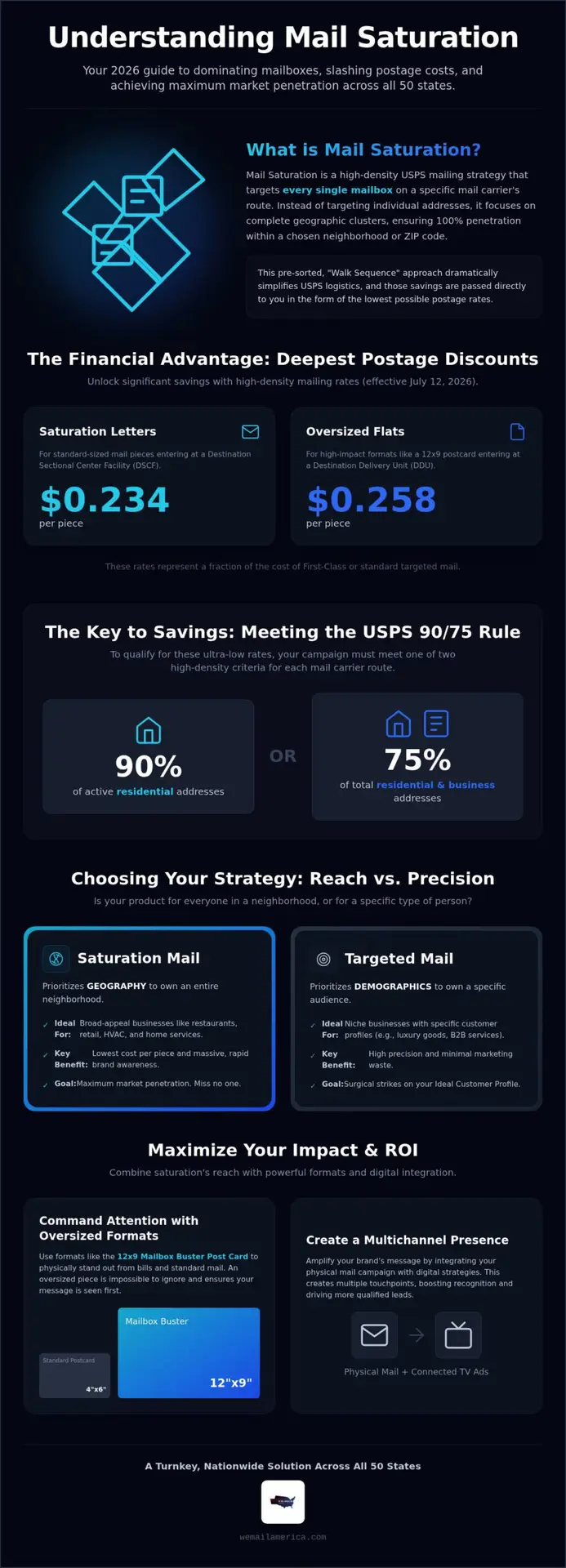
Business owners often ask, what is mail saturation, and why is it the gold standard for high-volume growth? At its core, mail saturation is a specialized USPS postage category designed for high-density mailings that target every mailbox on a specific carrier route. Unlike standard mail that relies on individual addresses, saturation mail focuses on geographic clusters. Mail saturation is the most cost-effective way to achieve 100% market penetration. It’s a powerful tool for brands that need to dominate a neighborhood or an entire zip code without the high cost of individual list rentals.
The Core Concept of High-Density Reach
Density matters far more than total volume when you want to unlock the deepest postage discounts. The USPS organizes every neighborhood into carrier routes, which are the specific paths mail carriers walk or drive daily. To qualify for saturation rates, your campaign must follow a strict “Walk Sequence” order. This means your mailpieces are pre-sorted in the exact order the carrier delivers them. This reduces the labor required by the post office, and they pass those savings directly to you. This strategy is a fundamental part of modern Direct Mail Marketing, allowing businesses to reach every doorstep with surgical precision. While standard bulk mail might target random addresses across a city, saturation ensures you don’t miss a single home on the block.
Postage Discounts and the Bottom Line
The financial incentive for choosing saturation is significant. The USPS rewards high-density mailers because it simplifies their logistics. As of the July 12, 2026 rate update, saturation letters entered at a Destination Sectional Center Facility (DSCF) can cost as little as $0.234 per piece. If you’re sending oversized flats, like our 12×9 Mailbox Buster Post Card, entering them at a Destination Delivery Unit (DDU) brings the rate to $0.258. These rates are a fraction of what you’d pay for targeted or first-class mail. To secure these prices, you must meet the 90/75 rule: your mailing must reach 90% of active residential addresses or 75% of the total residential and business addresses on each route. It’s a high-impact, low-cost model that works perfectly for nationwide brand awareness.
We Mail America handles the technical complexity for you. From mapping out carrier routes to ensuring your 6×11 Impact Post Card meets all automation requirements, we provide a turnkey solution across all 50 states. Our process is seamless and built for speed. If you’re ready to lower your postage costs and maximize your reach, contact us for an advertising inquiry today. We take the stress out of direct mail so you can focus on your ROI.
Saturation vs. Targeted Direct Mail: Which is Right for You?
Deciding between reach and precision is the first step of any successful campaign. To understand the best path, you must first define what is mail saturation in the context of your specific business goals. Saturation mail prioritizes geography. It allows you to own a neighborhood. Targeted mail prioritizes demographics. It allows you to own a specific audience segment. Choosing the right one depends on whether your product has broad appeal or serves a niche utility.
When to Choose Saturation Mail
Saturation is the best choice when your product or service is something almost everyone needs. It’s the ideal strategy for restaurants, HVAC companies, and retail stores. When you want to enter a new national territory quickly, saturation provides the most rapid market entry. It blankets entire neighborhoods to ensure no prospect is missed. This method offers the lowest postage rates available because it simplifies USPS delivery logistics. Using a high-impact tool like our 12×9 Mailbox Buster Post Card ensures your message is the first thing a customer sees. You must follow strict USPS Saturation Mail Requirements to qualify for these discounts, but the resulting brand awareness is massive. It’s about creating a tangible presence that digital ads can’t match.
The Case for Targeted Direct Mail
Targeted direct mail is your surgical strike tool. Use this when your Ideal Customer Profile (ICP) is narrow and specific. You can apply filters like age, gender, or even credit score to refine your list. This approach reduces waste by excluding households that don’t fit your buyer persona. For example, a luxury service provider might only want to reach households with a high net worth. While the cost per piece is higher than saturation rates, the increased relevance can lead to a higher conversion rate for specialized products. If you’re still weighing your options, our detailed guide on EDDM vs. Targeted Direct Mail: The 2026 Guide provides a deeper comparison of ROI and strategy.
We Mail America handles everything from design to delivery across all 50 states. Whether you need to blanket a city or target a specific street, our turnkey process makes it seamless. We take the stress out of marketing so you can focus on running your business. If you’re ready to see which strategy fits your budget, send us an inquiry today. We’ll help you build a campaign that delivers proven results.
USPS Requirements for Saturation Postage Rates
Compliance is the absolute key to unlocking the lowest postage rates available. Understanding what is mail saturation requires a deep dive into the strict regulatory framework set by the United States Postal Service. To qualify for these significant discounts, your campaign must meet specific density and sequence standards that simplify the carrier’s job. It’s a partnership between the mailer and the post office. You provide the efficiency, and they provide the savings.
The “90/75 Rule” is the cornerstone of saturation qualification. According to the USPS Domestic Mail Manual, a mailer must reach at least 90% of all active residential addresses on a specific carrier route. Alternatively, you can reach 75% of the total number of active residential and business addresses combined. If your mailing falls even one house short of these thresholds, you lose the saturation discount and default to higher postage categories. This is why precision in your data is non-negotiable for nationwide campaigns.
Beyond density, your mail must be sorted in a specific “Walk Sequence” to earn the deepest discounts. Walk Sequence means mail is organized exactly as the carrier walks the route. By pre-sorting your Impact Post Card – 6 X 11 in this precise order, you remove the need for the USPS to manually sort the pieces at the local branch. This logistical efficiency is why the post office can offer rates as low as $0.234 for letters and $0.258 for flats as of the July 2026 rate updates.
Meeting the Density Thresholds
Calculating your density requires access to current USPS carrier route data. You must decide whether to target residential-only addresses or the total market, including businesses. Residential saturation is common for consumer services, while total-market saturation is ideal for restaurants or retail grand openings. Maintaining accurate list hygiene is critical. Since the USPS updates route data frequently, using outdated lists can lead to disqualification and unexpected costs at the loading dock. We ensure your data is CASS certified and compliant with the latest standards across all 50 states.
Sorting and Logistics Standards
Preparing a saturation mailing involves complex technical work. Every tray must be labeled correctly, and the paperwork must reflect the exact walk sequence of the carrier. This is where many businesses struggle with the “headache” of direct mail. Working with a full-service partner ensures total compliance with every USPS regulation. We Mail America handles all the technical logistics, from sequencing to the final USPS paperwork. We take the complexity out of the process so you can focus on your ROI. If you want a seamless experience, start your campaign by filling out our advertising inquiry form today. We handle everything from the first design to the final delivery.
Maximizing ROI: Format and Digital Integration
High-density mailing is only half of the equation. To truly understand what is mail saturation in a competitive market, you must look at how your message physically lands. If you’re reaching 100% of a neighborhood, your mailpiece cannot look like a standard utility bill or a flimsy circular. It has to command attention the moment it’s pulled from the box. A saturation strategy works best when the physical piece is impossible to ignore, turning a simple delivery into a brand experience.
The Power of the 12×9 Mailbox Buster
Size is the most effective way to avoid the “junk mail” pile. Our Mailbox Buster Post Card – 12 X 9 is specifically designed to be the largest item in the mail stream. It literally sticks out from the rest of the stack. This oversized format provides massive real estate for complex offers, high-resolution imagery, and bold calls to action. When you use this tool, you aren’t just sending mail; you’re dominating the visual space of the household. For a deep dive into why this format wins, read our Dominating the Mailbox: 12×9 Mailbox Buster Strategy guide. It’s the ultimate weapon for national brands that want to leave a lasting impression across all 50 states.
Integrating CTV and Mobile Texting
Physical mail is powerful, but it’s even stronger when backed by digital touchpoints. We integrate our Connected TV Network to warm up households before the mail even arrives. By running ads on streaming platforms within your target zip codes, you build brand familiarity. When the consumer sees your physical postcard a few days later, they already recognize your name. This multi-touch experience significantly outperforms standalone digital ads that are easily blocked or skipped. It creates a seamless journey from the screen to the mailbox.
Capturing leads should be instantaneous. We use QR codes and our Mail to Mobile Texting service to bridge the gap between physical and digital. A customer scans your card and immediately receives a text with a coupon or a link to your site. This removes all friction from the conversion process. It’s a proven, turnkey system that ensures your saturation campaign drives measurable results. We handle the entire integration, from the digital ad placement to the final mail delivery. If you’re ready to maximize your reach with a high-impact, multichannel approach, fill out our advertising inquiry form. Let’s start your nationwide campaign today.
Launching Your National Saturation Campaign
Launching a campaign shouldn’t be a source of stress. You now understand what is mail saturation and how it drives massive ROI through high-density targeting. The next step is execution. We provide a turnkey solution that covers every detail from the first design concept to the final delivery in a customer’s mailbox. Our process is designed for busy business owners who want results without the logistical headache of managing multiple vendors. We take the complexity out of direct mail marketing. You get a single partner who understands the American market and knows how to reach every doorstep.
Step-by-Step Campaign Execution
Every successful campaign begins with a strategic consultation. We help you determine the best zip codes for your specific business goals based on carrier route data. Once we identify your target areas, our team moves into custom design. We focus on the tangibility of high-quality postcards to ensure your brand feels premium and trustworthy. A customer can hold your message in their hand. That physical connection is something an email cannot replicate. Whether you choose the Impact Post Card – 6 X 11 or one of our massive trifolds, your message will be impossible to ignore. Choosing the right partner is critical for success. You can learn more about Choosing the Best Marketing Companies for Nationwide Direct Mail to see how we stand out from the competition. We focus on impact and speed.
Why a Nationwide Partner Matters
Scaling your message across the entire United States requires a partner with national reach. We serve all 50 states, ensuring your campaign is consistent and impactful from coast to coast. We handle everything. This means you have a single point of contact for design, printing, and postage. You don’t have to worry about USPS paperwork or walk sequence requirements because our specialists manage the entire technical process. We take pride in being a dependable American business that values practical results. Our goal is to move you quickly from curiosity to conversion. We provide the steady hand you need to grow your brand nationwide.
We Mail America is your steady hand in a complex marketing world. We combine modern data precision with the traditional value of physical mail to drive demand in any zip code across the country. It’s time to stop overspending on digital ads that don’t convert. You deserve a marketing strategy that actually lands on the kitchen table. Get started with your saturation campaign today and see the difference a high-density strategy makes. Your nationwide growth starts here. We make the process seamless and impactful for every client.
Take Control of Your Nationwide Growth
You now have the blueprint to stop overspending on digital ads that your customers ignore. Understanding what is mail saturation is the first step toward reclaiming your marketing budget and achieving massive reach. By leveraging high-density sorting and the USPS 90/75 rule, you can send impactful, oversized mailers for a fraction of the cost of traditional targeted lists. Physical mail creates a lasting impression that a fleeting email simply can’t match. It’s about putting your message directly into the hands of your customers.
We Mail America is here to take the complexity out of the process. We provide an all-in-one turnkey service that handles everything from custom design to final delivery across every zip code in all 50 states. Our integrated digital suite, including Connected TV and Mobile advertising, ensures your brand is seen on every screen before it lands on the kitchen table. We’re a dependable partner focused on your return on investment. It’s time to build a campaign that delivers proven results without the logistical headache.
Ready to dominate the mailbox? Get a custom quote for your nationwide campaign. We’re ready to help you drive leads and grow your business with the precision and reliability you deserve. Let’s start your journey toward total market penetration today.
Frequently Asked Questions
What is the difference between mail saturation and EDDM?
Saturation is a specific postage category that requires high-density route coverage. Every Door Direct Mail (EDDM) is a USPS service that uses saturation pricing. While they are related, professional saturation campaigns involve more complex sorting and technical preparation to achieve the lowest possible rates. We Mail America handles this entire process for you across all 50 states. It’s the most efficient way to blanket a neighborhood without the stress of managing postal regulations yourself.
How much can I save on postage with saturation rates?
You can save a substantial amount by qualifying for saturation rates. As of the July 2026 update, postage costs can drop to $0.234 for letters and $0.258 for flats. These are the lowest rates the USPS offers. By meeting density requirements and sorting mail in walk sequence, you remove the labor cost for the post office. They pass those savings directly to you, making nationwide brand awareness much more affordable than digital alternatives.
Do I need to provide my own mailing list for a saturation campaign?
You don’t need to provide a list for a saturation campaign. We use the latest USPS carrier route data to identify every mailbox in your target area. To understand what is mail saturation, you have to realize it’s a geographic tool. We target every doorstep on a route to meet the density requirements. This turnkey approach means we handle the data selection, design, and delivery, so you don’t have to worry about list management.
Can I target specific demographics with saturation mail?
Saturation mail is geographic, but you can still use demographic insights. We select carrier routes based on neighborhood data such as median household income, home ownership status, or average age. While you don’t filter individual households like a targeted list, you can still reach areas where your ideal customers live. This strategy balances broad reach with smart targeting to ensure your Impact Post Card – 6 X 11 lands in the right hands.
What is the USPS 90/75 rule for mail saturation?
The 90/75 rule is the standard for saturation eligibility. You must reach 90% of active residential addresses or 75% of the total addresses on a carrier route. This high density simplifies the carrier’s job, which is why the USPS offers such deep discounts. If you don’t meet these thresholds, your mail defaults to a more expensive postage category. We ensure your campaign meets these requirements across every zip code in the country.
Is there a minimum number of pieces required for saturation rates?
Marketing mail campaigns generally require a minimum of 200 pieces or 50 pounds to qualify for commercial rates. For saturation specifically, the primary requirement is the density on each individual carrier route you select. Whether you’re targeting a few neighborhoods or launching a massive nationwide campaign, we ensure your volume and density meet all USPS standards. This allows you to scale your message while keeping your cost per piece as low as possible.
What mailer sizes work best for saturation campaigns?
Oversized cards are the most effective choice for high-density campaigns. Our Mailbox Buster Post Card – 12 X 9 is a top performer because it’s impossible to ignore. Other effective sizes include the Impact Post Card – 6 X 11 and our various trifold formats. These larger sizes provide more real estate for your offer and imagery. They ensure your brand stands out in the mailbox, which is essential when you’re reaching every household in a neighborhood.
How do I track the results of a saturation mailer?
Tracking is simple with integrated digital tools. We recommend using QR codes, unique tracking phone numbers, or our Mail to Mobile Texting service. These methods provide real-time data on how many people engaged with your physical mailer. You can also use dedicated landing pages to monitor web traffic from specific zip codes. This multichannel approach bridges the gap between the tangibility of a postcard and the data precision of a digital marketing campaign.