

A dental implant mailer has limited space to explain a considered treatment, earn trust, and invite a next step. Effective dental implant marketing mailers need more than a bold headline: they need a well-defined audience, patient-focused information, and a way to track responses.
If you’re unsure which households to reach, how much treatment detail to include, or how to assess whether a mailing worked, those are practical questions to answer before you print. Implant decisions take consideration, so a useful mailer should inform readers without promising a particular outcome or overwhelming them with claims.
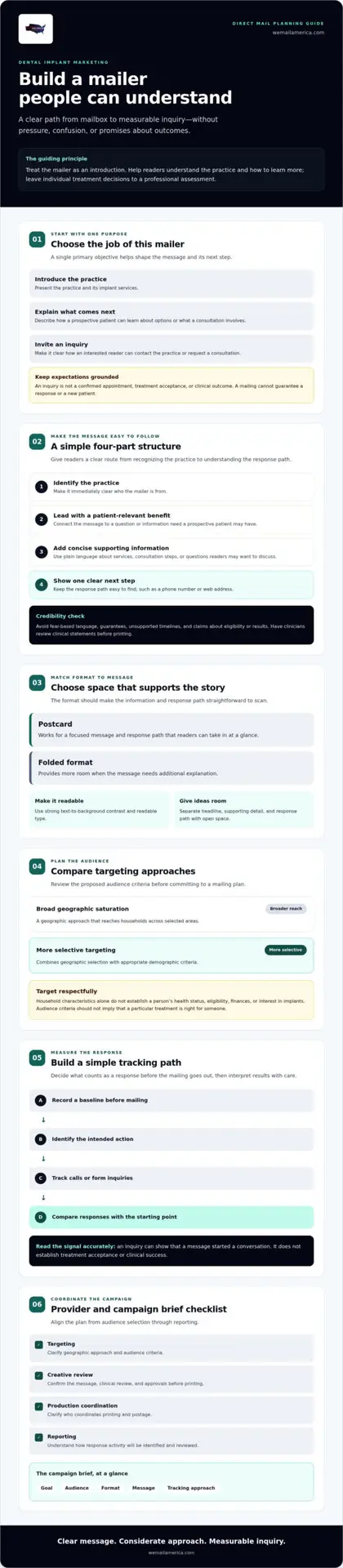
This guide explains how to choose a mail format and targeting approach, present implant care clearly, and plan response tracking. You’ll also learn what to ask a full-service direct mail provider about targeting, design, printing, and postage. The goal is a clear path from mailbox to measurable inquiry.
Key Takeaways
- Give implant mailers one clear purpose, such as introducing the practice, explaining next steps, or inviting readers to learn more.
- Organize the message around the practice, a patient-relevant benefit, concise supporting information, and one clear next action.
- Compare broad geographic saturation with more selective geographic and demographic targeting, and review the proposed audience criteria.
- Use a provider checklist to clarify targeting, creative approvals, print and postage coordination, and reporting.
- Build a brief for dental implant marketing mailers around the campaign goal, audience, format, message, and tracking approach.
Why Dental Implant Marketing Mailers Need a Patient-First Strategy
Dental implants are a significant treatment decision. Prospective patients may want to understand the process, discuss their options, or learn what a consultation involves before contacting a practice. A mailer should make that first step clear and approachable, not pressure someone toward a clinical decision.
Think of the mailer as an introduction. It can present the practice’s implant services, explain how to learn more, or invite readers to request a consultation. As a physical format within direct mail marketing, it offers a tangible way to share a focused message. An inquiry, however, is not a confirmed appointment, treatment acceptance, or clinical outcome. Mail can support a broader patient acquisition plan, but it can’t guarantee that a recipient will respond or become a patient.
Describe the audience broadly and respectfully. A campaign may reach people in selected geographic areas or use appropriate audience criteria, but household characteristics alone don’t establish someone’s health status, eligibility, finances, or interest in implants. Invite readers to explore their options with the practice rather than suggesting that a particular treatment is right for them.
What should a dental implant mailer help a prospective patient understand?
Use plain language to describe the practice’s implant services and the next step. For example, explain that a consultation gives a prospective patient an opportunity to ask questions and learn what options may be appropriate. Have clinicians review clinical statements before printing, and avoid fear-based language or promises about results. The purpose is to make the process easier to understand, not to replace a professional assessment.
Which campaign goal fits your practice right now?
Choose one primary objective before drafting the mailer. An awareness piece introduces the practice and its services. A consultation-focused piece encourages readers to contact the office. Follow-up communication can continue a conversation with an audience the practice can appropriately contact. Each goal calls for a different message and next step. A general introduction might direct readers to learn more, while an inquiry-focused piece can explain how to request a consultation.
Before mailing, record a baseline and decide how you’ll identify and review responses. Track the intended action, such as calls or form inquiries, and compare results with the practice’s starting point. This keeps expectations grounded. A response is a useful signal, but it doesn’t establish treatment acceptance or clinical success.
Well-planned dental implant marketing mailers connect a clear patient question with a relevant next step. That focus helps the practice assess whether the message is starting useful conversations.
How to Build Clear, Credible Dental Implant Marketing Mailers
A strong mailer gives readers a clear path through the message: identify the practice, state a relevant patient benefit, add concise supporting detail, and make the next action easy to find. For example, a headline can introduce implant consultations, followed by a short explanation of what a prospective patient can discuss and a visible phone number or web address. Keep one primary call to action so readers know where to focus.
Persuasive copy should still be responsible. Use everyday language and ask a clinician to review descriptions of treatment and consultation steps. Avoid fear-based pressure, guarantees, unsupported timelines, and claims about who qualifies or what results someone will achieve. The Federal Trade Commission’s guidance is a useful reference for keeping advertising truthful and non-deceptive. Clarity builds reassurance without suggesting certainty about an individual outcome.
Make the design easy to scan. Use strong contrast between text and background, readable type, and enough open space to separate the headline, supporting detail, and response path. Remove copy that doesn’t help readers understand the offer or take the main action. For broader postcard fundamentals, look for the related article, “Postcard Marketing: The Ultimate Guide.”
Which information belongs on an implant mailer?
Prioritize what the practice offers, how an interested reader can learn more, and what they might ask during a consultation. Include clinician names or credentials only when the practice supplies and verifies them. Before printing, review every clinical statement. Remove details about outcomes, treatment duration, or eligibility unless the practice can substantiate them and clinicians approve the wording.
How should the format support the message?
A postcard can present a focused message and response path at a glance. A folded format can provide more room to organize an explanation across panels. Choose based on the campaign objective and how much information readers need, not on an assumed response advantage. We Mail America’s Impact Post Card – 6 X 11 is one format to evaluate alongside its available trifold formats.
Dental implant marketing mailers work best when the format suits the message. If you’re comparing options, use the advertising inquiry form to share your campaign needs.
Targeting and Measuring Dental Implant Mailers: What to Compare
Targeting determines who may receive a mailer; measurement helps show whether the campaign prompted a response. Start with the practice’s objective, then compare distribution approaches based on the audience and reach needed. Neither broad coverage nor selective criteria can identify who has a medical condition or needs implants. They are campaign planning choices, not a substitute for an individual conversation with a clinician.
We Mail America provides geographic and demographic targeting as part of its full-service direct mail campaigns. This differs from standalone mailing-list rental, which the company doesn’t offer. Before choosing an approach, clarify which audience criteria will be used, who supplies them, and whether they fit the campaign brief and the practice’s privacy procedures.
When should a practice compare saturation and targeted mail?
Broad geographic saturation may fit when the goal is to introduce a practice across a wider area and broad household coverage makes sense. More selective geographic or demographic targeting may better fit a brief with defined audience criteria. Compare the tradeoffs in reach and selectivity, then review the criteria for appropriateness. For a deeper look at distribution approaches, consult the related EDDM vs. Targeted Direct Mail article.
How can a practice evaluate campaign response?
Set a response window and record a baseline before the mailing goes out. Choose a method that distinguishes campaign inquiries, such as a campaign-specific phone number, form, or response code. Make sure staff know how to record the source consistently, and follow the practice’s privacy procedures when handling inquiry information.
Look beyond the initial response count. Review whether inquiries are relevant to the campaign and whether they progress to consultation requests. These measures add context to response volume, but they don’t establish treatment acceptance or clinical outcomes. Use the findings to assess whether the audience, message, and response path aligned with the campaign goal.
Clear tracking makes dental implant marketing mailers easier to evaluate and gives the practice a more grounded basis for planning its next campaign.
How to Choose a Dental Implant Mailer Provider and Campaign Plan
A provider should make the campaign easier to coordinate, with responsibilities clearly assigned. Compare the full workflow, from audience planning and creative coordination through printing and postage, and ask what reporting is available. We Mail America supports full-service direct mail campaigns nationwide. For broader context on what service scope can include, see Direct Mail Advertising Services for Business Growth.
Use this checklist when speaking with potential providers:
- 1. Targeting: Ask how geographic or demographic criteria are developed, who supplies them, and how the practice can review them for fit.
- 2. Creative workflow: Confirm who coordinates design, how revisions and approvals work, and who gives final approval before production.
- 3. Print and postage: Request a clear outline of the formats, printing, and mailing deliverables included in the campaign plan.
- 4. Tracking: Ask which response elements, such as a campaign-specific phone number or form, are included and which require setup by the practice.
- 5. Reporting and timing: Clarify what campaign reporting is provided, who reviews it, the expected milestones, and when the practice needs to supply or approve materials.
Get responsibilities in writing. The practice should know who owns the audience criteria, who prepares and reviews the mailer, what deliverables are included, and where approval checkpoints fall. Have appropriate practice-side reviewers, including clinicians for clinical statements, assess the final copy before production. This keeps treatment messaging clear and gives the practice control over claims about its services.
How can the practice assess value without relying on guarantees?
Compare providers by service scope and measurement readiness, not promises of patient volume or revenue. A useful plan explains the work, the practice’s role, and how responses can be assessed. Define success measures in advance, such as relevant inquiries or progression to consultations, and document assumptions so expectations stay realistic.
A short written brief can align the provider and practice team. Include the campaign goal, intended audience, format, core message, response path, timing needs, and tracking approach. This gives reviewers a shared reference and helps surface missing decisions before production begins.
To discuss a campaign plan based on your practice’s requirements, share the details through the direct mail advertising inquiry form.
Launch Dental Implant Marketing Mailers With a Clear Next Step
A clear campaign brief turns planning into practical decisions. Before contacting a provider, write down what the practice wants the mailer to do, whom it hopes to reach, and what response it wants to invite. We Mail America supports full-service direct mail campaigns nationwide, coordinating consultation, targeting, design, printing, and postage.
Use this short template to organize your starting point:
- Goal: Build awareness, invite consultation inquiries, or support appropriate follow-up.
- Audience: Describe the geographic or demographic criteria you want to consider. Avoid assumptions about a recipient’s health or treatment needs.
- Coverage: Identify the service areas or ZIP codes the practice wants to evaluate.
- Format: Note whether a postcard or folded mailer may suit the message. The Impact Post Card – 6 X 11 is one option to discuss, not a guaranteed best fit.
- Message and response: Summarize the patient-focused message, desired action, and how the practice plans to track inquiries.
What information should the practice prepare before requesting campaign details?
Gather approved brand assets and clinician-reviewed messaging before creative development. Include the practice’s preferred response path, such as a phone call or web inquiry, and identify who will review the final piece. If mobile advertising, texting, or connected TV could support the same campaign goal, note that in the brief so the provider can discuss whether coordination is relevant.
What happens after the initial campaign inquiry?
Use the first discussion to review the practice’s goal, audience criteria, format, message, and printing and mailing needs. Confirm who supplies and approves each campaign element, what tracking setup the practice must handle, and where review checkpoints fall. These details help the practice understand the workflow before production begins, without assuming a particular response or treatment outcome.
Dental implant marketing mailers work best when the plan is specific and the next step is easy to measure. Share your campaign brief through the advertising inquiry form to start a conversation about your goals and direct mail needs.
Build a Clear Plan for Your Next Mail Campaign
Strong dental implant marketing mailers start with a patient-focused message, an audience chosen for the campaign’s purpose, and a clear way to respond. Keep clinical explanations accurate and easy to understand, then track inquiries so the practice can evaluate performance. A mailer can support patient education and practice growth, but it can’t guarantee appointments or treatment acceptance.
Planning the campaign doesn’t have to mean coordinating every detail alone. We Mail America provides full-service support from consultation and targeting through custom design, printing, and postage. The Impact Post Card – 6 X 11 is one format to consider as you compare options for your message and goals.
Start with your objective, audience, key message, and response path. Then discuss your dental mail campaign with We Mail America. A focused brief makes it easier to talk through the right next steps and move forward with a clear plan.
Frequently Asked Questions
What should a dental implant marketing mailer include?
A dental implant marketing mailer should identify the practice, explain its implant consultation process in plain language, and make the next step easy to find. Include a clear response path, such as a phone number or web address. Keep clinical statements accurate and have appropriate practice reviewers check them before printing. Avoid unsupported claims about eligibility, treatment timelines, or results. A focused message is easier to understand than a crowded piece trying to answer every possible question.
Do dental implant marketing mailers work?
Dental implant marketing mailers can introduce a practice and encourage prospective patients to ask questions, but results depend on the audience, message, offer, and response process. A mailing can’t guarantee appointments, treatment acceptance, or clinical outcomes. Set a specific campaign goal before launch, such as generating inquiries, then track responses and their progression. This helps the practice judge whether the mailing supported its broader patient acquisition plan and what to adjust next time.
Should a dental practice use EDDM or targeted direct mail for implant marketing?
Choose based on the campaign goal and appropriate audience criteria. EDDM or other saturation approaches can support broad household coverage in selected delivery areas. Targeted direct mail uses defined geographic or demographic criteria to narrow the audience. Neither approach can determine who has a medical condition or needs implants. Compare the reach and selection approach, then confirm who provides and reviews the criteria before the campaign begins.
How can a dental practice track responses from implant mailers?
Give the campaign a response path that can be distinguished from other marketing, such as a dedicated phone number, campaign-specific form, or response code. Record a baseline and decide on a response window before the mail goes out. Ask staff to document inquiry sources consistently, following the practice’s privacy procedures. Review not only the number of inquiries, but also their relevance and whether they progress to consultation requests.
What size postcard is best for dental implant marketing?
There isn’t one best size for every campaign. Choose a format that gives the message enough room while keeping the main benefit and response action easy to notice. A concise introduction may fit a postcard, while a more detailed explanation may call for a folded format. We Mail America offers the Impact Post Card – 6 X 11 as one option to evaluate, not a guaranteed best fit for implant marketing.
Can a direct mail company provide a dental practice mailing list?
We Mail America doesn’t offer standalone mailing-list rental. It provides geographic and demographic targeting as part of full-service direct mail campaigns, including consultation, custom design, printing, and postage. Ask how audience criteria are selected, who supplies them, and what the practice needs to review. Make sure the proposed approach fits the campaign objective and the practice’s procedures for handling audience and response information.
How much do dental implant marketing mailers cost?
Costs depend on the campaign’s scope, including targeting, format, design coordination, printing, postage, and any selected digital options. We Mail America charges project-based fees for full-service direct mail campaigns, so the exact quote depends on the brief. Share the intended audience, format, message, and response plan to discuss the work involved. Avoid evaluating proposals by price alone; compare deliverables, responsibilities, and reporting too.