
A thank-you shouldn’t sound like another ad. Thank you postcards for customers give your appreciation a tangible place in the mailbox, but the message still needs to feel personal, not like a sales pitch. Planning, printing, and mailing a postcard can take coordination, so it helps to make the campaign manageable from the start.
You’re right to want more than a generic note. A thoughtful postcard can recognize a customer and create a deliberate touchpoint within your broader retention strategy, though it can’t guarantee a particular response. The key is to connect the message to a genuine customer moment and keep appreciation at the center.
This guide explains how to choose occasions and audiences, write a concise message that sounds like your business, and select a mailing format. You’ll also learn how to plan and evaluate a campaign, so you can make informed decisions without assuming every postcard will deliver the same result.
Key Takeaways
- Set a relationship goal first, then choose a customer moment that gives your thank-you a clear purpose.
- Make thank you postcards for customers feel genuine by naming the reason for your appreciation and keeping the message focused on them.
- Choose between a postcard and email based on the customer, the message, and the kind of follow-up you need.
- Plan the audience, message, and mail piece in sequence, then review campaign results against the objective you set.
- We Mail America supports nationwide direct mail campaigns, including consultation, targeting, design, printing, and postage.
Why Send Thank-You Postcards to Customers? Start With the Relationship Goal
A thank-you postcard gives your business a simple way to recognize a customer relationship or meaningful interaction in print. Its purpose is appreciation, not an offer dressed up as gratitude.
A customer thank-you postcard is a printed message that recognizes a customer’s relationship with your business or a specific interaction. It can complement a purchase receipt, onboarding email, service follow-up, or loyalty communication. Give each channel a clear role: keep practical details in the relevant service message, and use the postcard to recognize the person behind the transaction.
That distinction matters. “Thank you for choosing us for your first order” centers the customer. A message that quickly pivots to a discount or another purchase may feel like promotion instead. If you include a next step, keep it separate and secondary to the appreciation.
Which customer moments are worth recognizing?
Start with moments when a thank-you would feel natural: a first purchase, repeat order, referral, customer milestone, or helpful service interaction. Match the timing to what happened and the expectations your business has set. A note after a personal service interaction may feel fitting; the same gesture could feel out of place if your brand usually communicates only about transactions.
Use your usual voice. If your business is straightforward and practical, a concise, sincere note may sound more authentic than an elaborate message. There’s no single schedule that works for every customer relationship, so choose moments that make sense for your audience rather than mailing on autopilot.
What can a postcard add to digital follow-up?
A digital message can deliver useful details quickly. A postcard adds a physical touchpoint the customer can hold and revisit. The history of the postcard reflects its role as a compact format for sharing a message, and that directness still suits a brief expression of thanks.
Use each channel for what it does well. Send email or service communication when the customer needs information or a response; consider a postcard when you want to make appreciation tangible. It can complement digital follow-up, not replace it. For broader planning ideas, explore a postcard marketing strategy that fits your customer relationship and purpose.
Before sending thank you postcards for customers, name the relationship goal in one sentence. That simple check helps keep the message relevant, sincere, and distinct from a sales campaign.
How to Write a Customer Thank-You Postcard That Sounds Genuine
A sincere message starts with a real reason to write. Before drafting, name the customer moment you’re recognizing. Then personalize the note with one accurate, appropriate detail, express thanks plainly, and review the final copy before it goes to print. If you can’t explain why this customer is receiving the postcard, the message may need a clearer purpose.
Keep the customer and their action at the center. For example: “Thank you for choosing us for your first order. We appreciate the opportunity to serve you.” If you have a relevant detail, such as the product or service they chose, include it only when it’s accurate and suitable to use. Avoid personal or sensitive information that doesn’t belong in a mailed message.
What should the thank-you message say?
Open with thanks and identify the relationship or interaction. Use plain language that sounds like your business, not generic promotional copy. The message should still feel complete if the customer ignores any offer. Add one only when it fits the relationship, and make sure it doesn’t crowd out your appreciation. The psychology of gratitude offers useful context for thinking about how to express thanks thoughtfully at work.
A genuine thank-you message recognizes a meaningful moment, expresses gratitude, and adds an optional next step only when it belongs.
How do you make a postcard feel personal at scale?
Personalization doesn’t require a completely different message for every recipient. Group customers by a meaningful moment, such as a first purchase or referral, and write copy that speaks to that shared experience. Use only information your business is permitted and prepared to use. If a detail is uncertain, leave it out rather than risk addressing the customer incorrectly.
Before approving the mailing, review the details that can undermine a thoughtful note:
- Check customer names and any personalized message fields.
- Confirm each audience segment receives the right version.
- Review offer terms and response instructions if included.
- Read the postcard aloud to catch wording that feels stiff or overly sales-focused.
That final review helps preserve a consistent, genuine voice across the mailing. We Mail America supports nationwide direct mail campaigns, with project services that can include consultation, targeting, design, printing, and postage. You can share your needs through a direct mail campaign inquiry.
Thank-You Postcards vs. Email: Choose the Right Customer Follow-Up
A postcard and an email can both express appreciation, but they serve different communication needs. A postcard is physical and can be held or revisited, while email suits messages customers need to receive digitally. Neither channel is automatically the better choice. The right fit depends on the relationship, the occasion, and what the customer needs next.
Use these factors to compare the options:
- Tangibility: A postcard creates a physical touchpoint. Email stays in the customer’s digital inbox.
- Message space: A postcard encourages a brief, focused note. Email can carry more detail when the customer needs instructions or supporting information.
- Customer context: A mailed note may suit a meaningful milestone or relationship. Email may feel more natural in a service workflow that already happens online.
- Production: A postcard involves preparing the audience and mail piece, then coordinating printing and mailing. Email requires a message and a digital sending process.
- Follow-up: Use the channel that makes the next step clear. A customer who needs a prompt confirmation may need email, even if you also send a postcard later.
Channel fit depends on the customer’s context, not a universal performance claim. For instance, an email can confirm a completed order or provide service details, while a postcard can offer a separate note of appreciation afterward. The science says about being thankful offers background on gratitude, but it doesn’t mean every expression of thanks needs to use the same channel.
When is a mailed thank-you the better fit?
Consider a postcard when the occasion feels significant and a physical message fits the customer experience. A milestone or thoughtful service interaction may merit a note, especially if your business has accurate mailing information and a workable campaign plan. Don’t send one automatically after every transaction. The gesture should feel relevant, not routine for its own sake.
When should email remain the primary follow-up?
Keep email in the lead for time-sensitive updates, transactional confirmations, or information customers expect through an established digital process. Respect stated communication preferences and avoid adding another touchpoint without a clear reason. If a postcard would add warmth rather than duplicate an update, use it as a complement. Businesses assessing how direct mail fits into a wider plan can review direct mail campaign options with We Mail America, which supports campaigns nationwide.
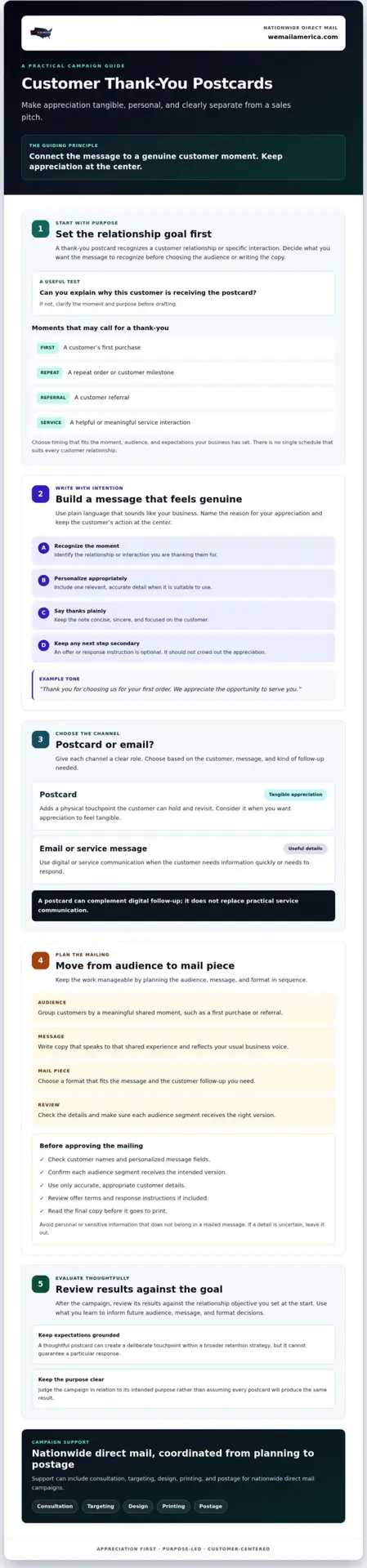
How to Plan and Evaluate a Customer Thank-You Postcard Mailing
A clear plan keeps appreciation at the center and makes the campaign easier to review. Before sending thank you postcards for customers, decide what relationship you want to recognize and what signal would help you understand whether the mailing was relevant. A thank-you campaign can support retention efforts, but no postcard guarantees a particular response.
How should a business define its audience and objective?
Use this sequence to shape the mailing:
- Set one objective. Choose a purpose, such as thanking customers after a first purchase, recognizing a relationship milestone, or reconnecting with customers who haven’t engaged recently.
- Select a relevant audience. Build a segment from appropriate first-party customer records. For example, separate recent first-time buyers from customers reaching a service milestone so each group receives a message that fits.
- Choose the message. Match the wording to the objective. A note focused on appreciation may not need an offer or response request.
- Define a review signal. Decide in advance what you’ll look for, such as replies, use of a clearly identified response option, or a customer-service comment that mentions the postcard. These signals can inform your review, but they don’t prove the postcard alone caused a change.
- Prepare the mail piece. Approve the message and design, confirm recipient information and mailing details, then coordinate production.
Keep the measure aligned with the goal. If the purpose is recognition, customer feedback or a relevant response may be more useful than treating immediate purchases as the only sign of value. For campaigns with trackable responses, decide how those responses will be recorded before mailing. That gives you a practical direct mail attribution approach without overstating what the results can show.
What should the team check before sending?
Run a controlled review. Have the appropriate team members check recipient data, names, message accuracy, readability, mailing details, and any response instructions. Confirm that an offer, if included, is described accurately. Then compare the planned mailing with other customer communications so the postcard doesn’t repeat or conflict with a service email, confirmation, or scheduled follow-up.
Keep one approved version as the reference copy, and confirm campaign-specific production details with your provider before the mailing proceeds. We Mail America supports direct mail campaigns nationwide. To discuss planning and mailing coordination, submit a direct mail campaign inquiry.
How to Get Customer Thank-You Postcards Designed, Printed, and Mailed
Once your message and audience are approved, the next step is turning the plan into a finished mail piece. Confirm the details your provider needs, including recipient information, postcard format, final copy, and any response instructions. Then review the design proof and mailing plan before approving production. A clear handoff helps keep the appreciation message consistent from the first draft through mailing.
What does full-service campaign support involve?
Depending on the campaign, support can include consultation, geographic and demographic targeting, custom design, printing, and postage. Coordinating these steps with one campaign provider can reduce the work of managing separate handoffs. We Mail America supports direct mail campaigns nationwide. Confirm the current scope and production details for your specific mailing before proceeding.
The company also offers digital advertising options, including mobile ads, texting services, and connected TV. These may complement a direct mail effort, but the right fit depends on your audience and objective. Discuss any desired integration with the provider rather than assuming a particular setup or measurement option is available.
How can a business take the next step?
Prepare a short campaign brief before making an inquiry. Include the relationship goal, intended audience, approved or draft message, preferred postcard format, and the response or customer signal you plan to review. If you’re still deciding on those details, note the questions you need answered. This gives the campaign conversation a practical starting point without committing you to an unverified schedule, specification, or result.
With the plan in hand, request a direct mail campaign consultation to discuss your requirements for thank you postcards for customers. A provider can help clarify which campaign components fit your needs and what information is needed to coordinate design, printing, and mailing.
Turn Customer Appreciation Into a Thoughtful Touchpoint
Strong thank you postcards for customers start with a real reason to write. Choose a meaningful customer moment, keep the message focused on appreciation, and use a postcard when a physical note suits the relationship. Email can still handle timely confirmations and service details, while a mailed thank-you adds a separate, tangible touchpoint.
Plan with purpose. Define your audience, decide what customer response or relationship signal you’ll review, and check the message and mailing details before production. A clear process helps you assess the campaign without assuming every postcard will produce the same result.
We Mail America supports nationwide campaigns, with project services that can include consultation, targeting, design, printing, and postage. Bring your objective, audience, and draft message to the conversation. Request a direct mail campaign consultation to discuss your needs. A sincere note can be a practical next step in building stronger customer relationships.
Frequently Asked Questions
What should you write in a thank-you postcard to a customer?
Write a direct thank-you, name the reason, and keep the customer, not a promotion, at the center. For example: “Thank you for choosing us for your first order. We appreciate the opportunity to serve you.” Add one accurate, appropriate detail if it makes the note more personal. Close with your name or business name. If you include an offer or next step, make sure it supports rather than replaces the expression of gratitude.
When should a business send a thank-you postcard to a customer?
Send one when there’s a meaningful customer moment worth recognizing, such as a first purchase, repeat order, referral, milestone, or helpful service interaction. Match timing to the event and your relationship with the customer. A postcard can feel natural after a notable interaction, but not every purchase needs one. Check that the message won’t conflict with another planned service communication or arrive after the moment has lost relevance.
Are thank-you postcards effective for customer retention?
Thank-you postcards can support a retention strategy by recognizing customers in a tangible, personal way, but they can’t guarantee repeat purchases or loyalty. Set a clear objective before mailing, then review an appropriate signal, such as customer replies, feedback, or engagement with a stated next step. Consider the results alongside other customer communications and service experiences. This gives you context without attributing every change in customer behavior to the postcard.
Should I send a thank-you postcard or an email?
Choose based on the customer’s needs, the occasion, and your existing communication practices. Email is often a practical fit for timely confirmations, service details, or information customers expect digitally. A postcard can add a physical expression of appreciation when the moment merits it. The two channels can complement each other: send essential information through the appropriate digital workflow, then use a postcard for a separate thank-you if it feels relevant.
What size should a customer thank-you postcard be?
Choose a format that gives your message room to breathe while fitting the campaign’s design and mailing requirements. We Mail America offers options including the Impact Post Card – 6 X 11 and Extra Large Card – 9 X 11. These are product formats, not a universal recommendation. Confirm the suitable format, layout, and mailing details with your provider before approving production, since the right choice depends on your campaign needs.
How much does it cost to send thank-you postcards to customers?
The total depends on campaign details, including the selected format, quantity, targeting, design, printing, and postage. We Mail America charges on a project basis for full-service direct mail campaigns, with campaign components determined by the project. There isn’t enough information to give a reliable price here. To understand your campaign’s costs, prepare your audience, preferred format, and mailing needs, then request a project-specific estimate from the provider.
Can thank-you postcards include an offer or call to action?
Yes, a postcard can include an offer or next step if it fits the customer relationship, but appreciation should remain the main message. Keep any offer accurate, easy to understand, and secondary to the thank-you. For example, you might invite a customer to share feedback after recognizing a recent interaction. Before mailing, review all offer terms and response instructions, and consider whether the call to action could make the note feel overly promotional.