

What if a piece prospects can hold also gave your sales team a clear reason to follow up? Digital messages can be easy to miss, while direct mail creates a tangible touchpoint that can invite a response. The results depend on what happens next. Generating leads for sales teams with mail works best when you define the audience, make the response path simple, and assign someone to handle follow-up.
If your team needs a practical way to turn mail interest into conversations, this guide will help you build a campaign around that goal. Learn how to choose an audience, shape a clear offer and response path, and prepare sales representatives to act on replies. You’ll also learn how to connect mail with digital follow-up and track responses through to sales activity, so each campaign can inform the next.
With a clear workflow, mail can support outreach instead of sitting apart from it. We Mail America helps businesses across the country plan and carry out direct mail campaigns, with digital options that can extend the conversation. Here’s how to make each touchpoint count.
Key Takeaways
- Generating leads for sales teams with mail starts with a clear goal, a defined audience, and an easy response action.
- Choose between broad household reach and targeted mail based on your audience, objective, and sales team’s capacity.
- Before launch, prepare staff with the offer details, response channel, lead ownership, and follow-up expectations.
- Track responses through to qualified leads, appointments, and sales to understand how the campaign contributes to pipeline activity.
- Use consistent campaign identifiers in mail and sales records to see what’s working and guide improvements.
How Direct Mail Can Help Sales Teams Generate Leads
Direct mail lead generation uses a physical message to prompt an identifiable action from a prospective customer. That action might be calling a sales representative, visiting a campaign landing page, or requesting information. Mail creates a tangible touchpoint, but it doesn’t replace digital prospecting. It can work alongside digital outreach by introducing an offer, reinforcing a message, or giving prospects another way to respond.
A mailed piece is an exposure, not a qualified lead. A qualified lead is a prospect who has responded and meets criteria the business has set for sales follow-up. A piece sent to an address doesn’t prove that the intended person saw it or has buying interest. The broader process of lead generation focuses on attracting and capturing interest. Sales teams then need a consistent way to assess whether that interest fits their goals.
What counts as a lead from a mail campaign?
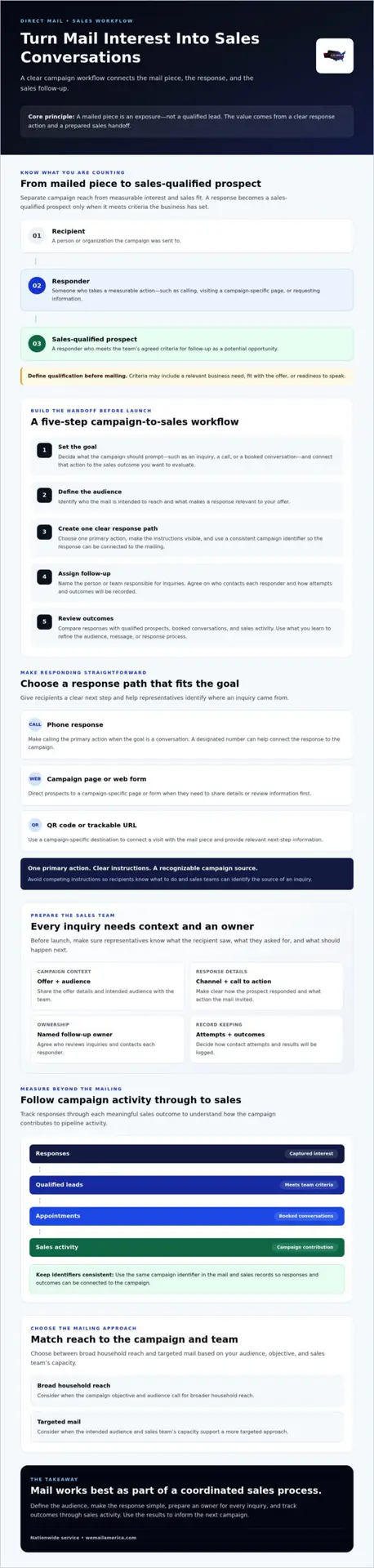
Think in three stages: a recipient is included in the mailing, a responder takes a measurable action, and a sales-qualified prospect meets the team’s agreed criteria. Before mailing, decide what makes a response worth a sales conversation. Criteria might include a relevant business need, fit with your offer, or readiness to speak. That definition helps staff distinguish campaign activity from an opportunity to pursue.
- Recipient: A person or organization the campaign was sent to.
- Responder: Someone who calls, visits a campaign-specific page, or requests information.
- Sales-qualified prospect: A responder who meets the team’s criteria for follow-up as a potential opportunity.
Choose one primary response action and make it easy to identify. For example, invite recipients to call a designated number or visit a page created for that campaign. Use a consistent campaign identifier so the sales team can connect each response to the mailing.
Where mail fits in the sales funnel
Mail can introduce an offer before a representative reaches out, giving the prospect a clear point of reference for the conversation. It can also support an active sales discussion: a follow-up piece might recap the offer or direct the prospect to the next step. For prospects who aren’t ready to talk, mail can provide another touchpoint while digital outreach continues.
When generating leads for sales teams with mail, align the piece with the sales action that follows. Decide who owns incoming responses, what context they need, and how the team will record each outcome. For a wider overview of campaign planning, see Direct Mail Advertising Services for Business Growth.
How to Connect a Mail Touchpoint to Sales Follow-Up
A mail response is useful to the sales team only if it arrives with context and a clear next step. Build the handoff before launch so every inquiry has an owner and representatives know what the recipient saw and asked for. This turns generating leads for sales teams with mail into a coordinated process, not a stack of disconnected responses.
Use this workflow to connect the campaign to sales activity:
- Set the goal. Decide what the campaign should prompt, such as an inquiry, a call, or a booked conversation. Tie that action to the sales outcome you want to evaluate.
- Define the audience. Identify who the mail is intended to reach and what makes a response relevant to your offer. This gives the team a basis for assessing fit.
- Create the response path. Choose one primary action and make the instructions visible on the mail piece. A phone response, web form, QR code, or trackable URL can connect an inquiry to the campaign.
- Assign follow-up. Name the person or team responsible for reviewing inquiries. Agree on who contacts each responder and how attempts and outcomes will be recorded.
- Review outcomes. Compare responses with qualified prospects, booked conversations, and sales activity. Use the findings to refine the audience, message, or response process in a future campaign.
Choose one clear response path
Match the call to action to the campaign goal and the recipient’s likely next step. If you want a conversation, make calling the primary action. If prospects need to share details first, direct them to a web form. A QR code or trackable URL can lead to campaign-specific information. Avoid competing instructions. Readers should know what to do, and representatives should be able to identify where an inquiry came from.
Create a sales handoff before the campaign launches
Give representatives the campaign context with each inquiry: the offer, audience, response channel, and call to action. Agree on how they’ll log contact attempts and outcomes, including when a prospect is unreachable or isn’t a fit. Those records help the team distinguish mail responses from unrelated inquiries and make campaign reviews more useful.
Assigned follow-up gives every mail response a clear owner and a documented next step. For guidance on shaping the postcard message and call to action, consult Postcard Marketing: The Ultimate Guide. If you’re planning a campaign and want to discuss its response path, use the advertising inquiry form.
EDDM or Targeted Mail: Which Approach Fits Lead Generation?
Choosing between Every Door Direct Mail (EDDM) and targeted mail starts with a practical question: do you need broad household reach, or do you need to focus on a defined prospect profile? EDDM can help place a message across selected delivery areas. Targeted campaigns use geographic or demographic criteria to shape the intended audience. Neither approach is automatically better. The right fit depends on your objective, audience, offer, and sales team’s capacity to respond.
When broad-reach EDDM may suit a sales campaign
EDDM may suit a campaign when the offer is relevant to households across selected delivery areas and broad coverage is the priority. For example, a business introducing a service to a wide consumer audience may want to build awareness and invite inquiries across selected areas. But broad distribution doesn’t mean every recipient matches the ideal customer profile. Consider whether the offer fits the intended households and whether the sales team can manage the inquiries the campaign may generate.
Set a clear response action and prepare staff to ask consistent qualification questions. This helps the team identify which responses are worth pursuing instead of treating every inquiry as an equally strong prospect.
When audience-targeted mail may be a better fit
Targeted mail may be more appropriate when a campaign needs to reach prospects who meet defined geographic or demographic criteria. Start with your customer profile: who is most likely to need the offer, and what characteristics help your team assess fit? Use those criteria in campaign planning, then align the message with the sales team’s qualification rules. Targeting can focus a campaign, but it doesn’t guarantee a response or a sales-ready lead.
Plan the response path before launch so mail activity can be measured. Use a campaign-specific phone response, landing page, QR code, or trackable URL, then record the campaign identifier with each inquiry in your sales system. Track more than responses: review which inquiries qualify, progress to conversations, and become sales opportunities. This separates campaign activity from results the sales team can act on.
For generating leads for sales teams with mail, choose the approach your audience and follow-up process can support. Broad reach can make sense when the offer has wide relevance and the team can handle a mix of responses. Targeted mail can fit a narrower customer profile and defined qualification criteria. For a closer look at the trade-offs, see EDDM vs. Targeted Direct Mail.
How to Prepare Sales Teams to Handle Mail Responses
A mail campaign can prompt inquiries, but the sales team needs adequate capacity and a shared plan for handling them. For organizations that need to recruit representatives to handle campaign volume, regional hiring resources like SavannahJobs.com illustrate how employers can source local sales talent. Before launch, confirm who will review responses, what information they’ll need, and how each conversation will be recorded. A clear handoff helps representatives recognize campaign-related interest and choose a useful next step without confusing it with an unrelated inquiry.
Use this checklist to prepare the process:
- Audience: Who is the campaign intended to reach, and what makes a responder a potential fit?
- Offer: What message or offer did the recipient see?
- Response channel: How might someone respond, and how will the team identify the campaign behind the inquiry?
- Ownership: Which person or team reviews and handles incoming responses?
- Follow-up expectations: What contact attempts and outcomes should be recorded, and how will the team determine the next step?
Give representatives enough campaign context
Brief representatives on the intended audience, offer, mail creative, and primary response action. Keep a shared copy of the piece and a campaign identifier where staff can refer to them. During an initial conversation, representatives can note what prompted the prospect to respond, what information they need, whether the offer fits their situation, and what next step they prefer. This gives the team useful context without assuming every responder is sales-qualified.
For example, if someone calls after seeing a campaign postcard, the representative can record the campaign name, the prospect’s question, the contact attempt, and the outcome. If the inquiry is unrelated, record that too. Consistent notes make it easier to distinguish campaign responses from other inquiries and review how prospects move through the sales process.
Coordinate mail with other prospecting channels
Phone, email, or other digital touchpoints may be appropriate for follow-up, depending on the prospect’s request and your team’s process. Keep the offer and core message consistent across channels. If a representative refers to the mail piece, they should know what it said and why the prospect may be responding. That continuity makes the interaction clearer and helps prevent conflicting messages.
Preparation is central to generating leads for sales teams with mail. It connects the physical touchpoint to a practical sales workflow, from the first inquiry through documented follow-up. We Mail America supports direct mail campaigns nationwide. To discuss campaign planning, ask about a direct mail campaign.
How to Measure and Improve Direct Mail Leads for Sales
Useful measurement follows the path from campaign activity to sales outcomes. Keep early indicators, such as pieces mailed and responses received, separate from qualified leads, booked appointments, and completed sales. Each measure answers a different question: Was the campaign sent as planned? Did anyone respond? Did those responses become opportunities the sales team could pursue?
Choose practical measures for the campaign goal
Start with the action the mail piece was designed to prompt. If the goal is inquiries, record campaign-linked calls, form submissions, or other responses. If the goal is booked conversations, track appointments separately. Then follow prospects through qualification and sales outcomes. Compare the results with the campaign objective and your team’s capacity, not an unsupported industry benchmark.
Response volume shows activity, not lead quality. Qualification and sales outcomes show whether responses fit the business goal.
Use a campaign identifier consistently on the mail piece’s response path and in sales records. A campaign-specific URL or response code, for example, can help staff connect an inquiry to its source. Ask representatives to record the identifier, response channel, qualification status, appointment outcome, and sale status in the same place. Review those records together so campaign reports and sales pipeline records use the same definitions.
Account for the full customer journey
Attribution can be imperfect. A prospect may see a mail piece, encounter a digital touchpoint, and later speak with a representative. A response channel can show where an inquiry came from, but it may not capture every influence along the way. Record the source the prospect reports and any known campaign identifiers, then describe findings carefully. Treat mail as a documented touchpoint rather than automatically crediting it with every later sale.
For a deeper look at connecting offline and digital activity, see Direct Mail Attribution: Merging Physical and CTV Data.
Use campaign learning to plan the next step
After the campaign, review whether the intended audience received the message, whether the offer prompted the planned action, and whether the response path worked as expected. Review follow-up records too: were inquiries assigned, qualified, and moved to a clear next step? Choose one change to test in a future campaign, such as refining the audience, clarifying the call to action, or improving how representatives log outcomes. Changing one element at a time makes the next review easier to interpret.
Make measurement part of the plan for generating leads for sales teams with mail. To plan a campaign with nationwide reach, plan a nationwide direct mail campaign.
Turn Mail Interest Into a Clear Sales Path
Generating leads for sales teams with mail takes more than sending a compelling piece. Define the audience and one clear response action, then make sure every inquiry reaches an assigned representative with the campaign context they need. Track responses through qualification, appointments, and sales outcomes to learn what to refine next time.
The right campaign approach depends on your audience and objective. We Mail America offers full-service campaign support that can include consultation, geographic and demographic targeting, custom design, printing, and postage. Campaign planning can incorporate EDDM, targeted mail, and digital advertising options, connecting a tangible mail touchpoint with follow-up across channels. We Mail America’s Impact Post Card is a 6 X 11 format for businesses considering a postcard campaign.
Give your sales team a practical process and your campaign a measurable purpose. Ask about a direct mail campaign and take the next step toward a clearer path from prospect response to sales conversation.
Frequently Asked Questions
Can direct mail generate leads for a sales team?
Yes. Direct mail can prompt prospects to take an identifiable action, such as calling, requesting information, or booking a conversation. Generating leads for sales teams with mail works best when the campaign has a defined audience, a clear response path, and sales follow-up in place. A mailed piece alone isn’t a qualified lead. The sales team should assess whether each responder meets its agreed criteria and has a relevant need.
How do you track leads generated by direct mail?
Give each campaign a consistent identifier and connect it to a response path, such as a dedicated phone number, campaign landing page, QR code, or trackable URL. Record the source in sales records alongside contact attempts, qualification status, appointments, and sales outcomes. Ask prospects how they heard about you, too. Since they may encounter several channels, attribution can’t always show that mail alone caused a response or sale.
Is direct mail effective for B2B sales leads?
Direct mail can support B2B lead generation when the audience, message, and follow-up process fit the sales goal. Define the organizations or decision-makers your offer is intended for, then use suitable geographic or demographic criteria in campaign planning. For teams pairing mail campaigns with outbound follow-up, B2B lead generation agencies like Virtual Sales Limited can help convert prospect interest into qualified sales appointments. Make the next step clear, such as requesting information or speaking with a representative. Evaluate results by qualified inquiries and sales conversations, not response volume alone.
What should a direct mail piece include to generate sales inquiries?
Include a relevant offer, a concise explanation of its value, and one clear call to action. Tell recipients how to respond, whether by calling, visiting a campaign page, scanning a QR code, or requesting information. Make the instructions easy to find and use a campaign identifier so the sales team can connect inquiries to the mailing. Keep the message aligned with what representatives are prepared to discuss.
Should sales teams follow up after sending direct mail?
Prepare the sales team to follow up on responses and, where appropriate, coordinate planned outreach with the campaign. Give representatives a copy of the mail piece, the offer details, and context about the intended audience. Assign ownership for inquiries and agree on how to record contact attempts, prospect questions, and outcomes. This helps the team respond consistently without assuming every recipient has seen the mail or is ready to buy.
Is EDDM or targeted direct mail better for lead generation?
Neither approach is always better. EDDM can suit a campaign seeking broad household reach across selected delivery areas, while targeted mail can fit an audience defined by campaign criteria. Choose based on the offer, customer profile, sales objective, and the team’s capacity to handle responses. Broad distribution won’t ensure every recipient is a good prospect, and targeting won’t guarantee a response, so define qualification criteria before launch.
How can direct mail work with digital advertising?
Direct mail can introduce an offer, while digital touchpoints reinforce the message or provide another way to respond. Keep the call to action and core message consistent across channels, then track response sources with campaign identifiers in sales records. We Mail America offers direct mail alongside digital options such as Mail to Mobile Texting and Connected TV. Review combined results carefully, since prospects may encounter multiple channels.