
A mailer can reach the right mailbox and still leave your store quiet. To learn how to increase foot traffic with mailers, connect three essentials: the households most likely to visit, a timely offer that gives them a reason to come in, and a way to track responses.
If store visits remain low despite ongoing marketing, you may be unsure which audience to reach or how to connect a mailed offer to an in-person visit. A clear campaign plan makes those decisions easier. Targeting focuses your message, while a specific offer gives recipients a next step they can act on.
This guide explains how to choose an audience, create a compelling reason to visit, and measure responses using tools such as unique offer codes and QR codes. You’ll also learn how to use campaign observations to refine future mailers. We Mail America offers direct mail campaign support to businesses nationwide, helping make mail a practical part of a broader marketing plan.
Key Takeaways
- Learn how to increase foot traffic with mailers by aligning your audience, offer, and measurement around one clear store-visit objective.
- Compare broad-area EDDM with targeted direct mail to choose an approach that fits your campaign goals.
- Assess in-store responses and understand what each tracking method can and can’t tell you.
- Follow a practical workflow, from defining the audience to reviewing results after delivery.
- Use campaign insights to refine future mailers and build a more informed foot-traffic strategy.
How Mailers Can Increase Foot Traffic: From Mailbox to Store Visit
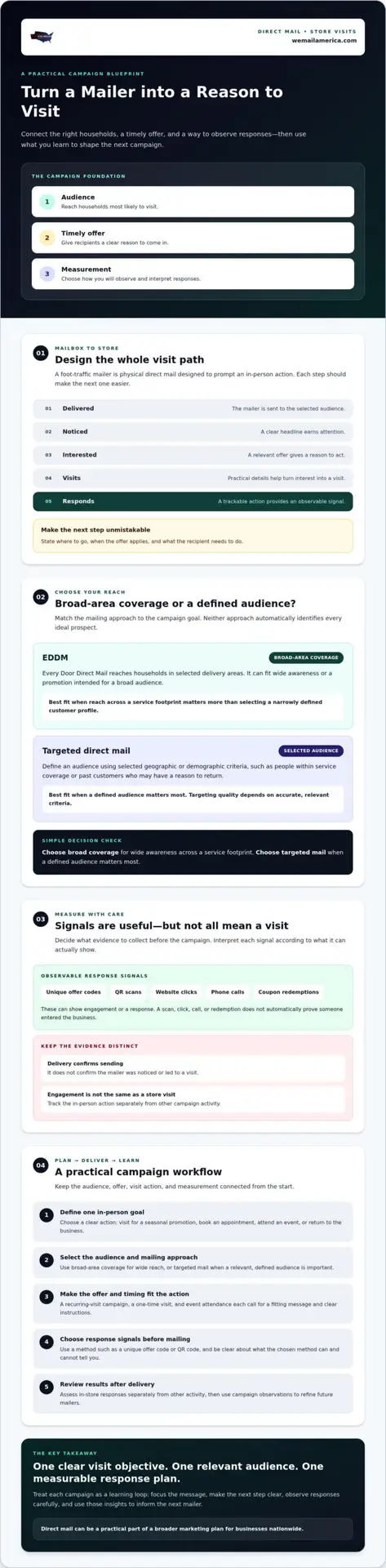
A foot-traffic mailer is a physical piece of direct mail marketing designed to prompt an in-person action, such as visiting a store, booking a service, or attending an event. To understand how to increase foot traffic with mailers, plan the full path from delivery to visit, not just the piece that goes into the mailbox.
That path includes several steps: the mailer is delivered, the recipient notices it, considers the offer, visits, and responds in a way you can observe. A clear headline earns attention, a relevant offer gives the recipient a reason to act, and practical details help turn interest into a visit. Include where to go, when the offer applies, and what the recipient needs to do.
What makes a mailer a foot-traffic campaign?
Start with one specific in-person goal. A retailer might invite customers to visit for a seasonal promotion. A service business could encourage recipients to book an appointment, while an event venue might promote attendance on a particular date. Make the message and offer support that action, then state the next step plainly.
Keep engagement and visits distinct. A website click, phone call, QR scan, or coupon redemption can show engagement, but none automatically proves that someone entered the business. Delivery confirms that a mailer was sent, not that it was noticed or led to a visit. Decide what evidence you’ll collect before the campaign so you can interpret results carefully.
Which businesses can use mailers to encourage visits?
Mailers can support a range of in-person goals. Retailers and restaurants may promote a visit tied to a timely offer. Service businesses can invite people to schedule an appointment or come in for an initial consultation. Event venues can encourage attendance at a specific event.
The visit pattern shapes the campaign. A business seeking recurring visits may emphasize a reason to return or a series of timely offers. A one-time visit campaign needs a clear, immediate incentive and simple directions. Event attendance is different: recipients need to know what the event is, when it takes place, and how to attend. In every case, match the offer and timing to the action you want, then track the response separately from other campaign activity.
Choose Between EDDM and Targeted Mail for Store Visits
The right mailing approach depends on who you want to reach and how broadly you need to reach them. Every Door Direct Mail (EDDM) supports broad-area coverage, while targeted direct mail lets you define an audience using selected geographic or demographic criteria. Neither approach automatically identifies every ideal prospect. Match the coverage and audience selection to your store-visit objective.
The U.S. Postal Service describes Every Door Direct Mail as an option for reaching households in selected delivery areas. Targeted mail, by contrast, focuses on a chosen segment rather than distributing a campaign broadly across an area. For a closer look at the differences, consult a guide such as “EDDM vs. Targeted Direct Mail.”
When does broad-area saturation make sense?
Broad coverage can suit businesses whose potential customers are spread across a defined service footprint, especially when the goal is awareness or a promotion intended for a wide audience. It may also support a grand opening or another broad promotional push—where pairing delivery with on-site promotional displays from Banner 4 Sale helps welcome arriving visitors. EDDM can introduce an offer to a wider pool, including households that may not have considered the business before.
Choose this approach when reach matters more than selecting a narrowly defined customer profile. Before mailing, check that the offer is relevant to the households receiving it and that the visit instructions are clear.
When should a business use targeted direct mail?
Targeted mail can make sense when you can describe the intended audience using useful, appropriate criteria. A business might focus on people within its service coverage, households that fit a relevant demographic profile, or past customers who may have a reason to return. Audience quality depends on accurate selection criteria. Narrow targeting is not automatically better if the criteria don’t reflect who can use the offer or visit the business.
For example, a return-visit offer for past customers needs a different audience and message from an introduction aimed at potential customers. Match the selection criteria, offer, and visit action. For more on postcard formats and campaign planning, see “Postcard Marketing: The Ultimate Guide.”
Use this simple decision check: choose broad-area coverage when your goal calls for wide awareness across a service footprint; choose targeted mail when a defined audience matters most. Either way, evaluate success by the in-person action you’re trying to encourage, not just by how many pieces were delivered. If you’re planning a campaign, explore direct-mail campaign support for businesses nationwide.
Can You Measure Whether Mailers Bring People into Your Store?
Yes, but measurement has limits. A mailer can include response paths that help connect an offer to a visit, yet no single signal captures everyone who saw the piece and came in. Someone may visit without mentioning the mailer, while another person may scan a QR code but never make it to the store. Separate engagement from confirmed visits, and decide what evidence you’ll record before the campaign begins.
Which response methods connect mail to an in-person visit?
Choose a tracking method that fits the offer and is easy for customers and staff to use. You can combine methods, but keep the process simple:
- Unique offer code: Print a campaign-specific code or redemption instruction on the mailer. Record each in-store redemption as a direct response.
- Dedicated landing page or QR code: Send recipients to a page created for the campaign. Page visits and scans show engagement, but don’t confirm a store visit unless the person completes a trackable in-store action.
- Staff inquiry prompt: Ask each visitor the same neutral question, such as “How did you hear about us?” Train staff to record the answer consistently and avoid suggesting one.
These methods provide different kinds of evidence. Scans and landing-page visits show that someone interacted with the mailer. A redeemed code or a visitor who identifies the mailer provides a stronger link to an in-person response, though self-reported answers can still be incomplete. A small business marketing guide can offer broader context for planning and tracking marketing activity.
How should you interpret campaign results?
Set a baseline before mailing. Choose a consistent period that reflects typical visits or redemptions, then define the campaign window and keep recording the same measures. Compare like with like, such as campaign-period code redemptions against the same type of redemptions during your baseline. Keep total visits, code use, scans, and staff-reported referrals in separate categories.
Interpret changes with care. Seasonality, other promotions, and concurrent advertising can influence visits during the same period, so don’t attribute every increase to the mailer. Note those factors and compare results across campaigns where practical. For additional context, consult “Performance Benchmarks: 6×11 Impact Postcard Case Study,” treating benchmarks as reference points rather than a promise of your own results.
For businesses learning how to increase foot traffic with mailers, a consistent measurement process is more useful than a single headline number. It shows which response paths recipients used and gives you clearer evidence to guide the next campaign.
Plan a Mailer Campaign That Gives People a Reason to Visit
A store-visit campaign needs more than an attractive mail piece. It needs a clear goal, a relevant audience, one compelling offer, and a way to see whether people responded. Use this workflow to connect each decision, from planning through measurement.
- Step 1: Set the objective. Choose one primary in-person action, such as visiting to redeem an offer, booking an appointment, or attending an event. Decide what response you’ll track before the mailer is produced.
- Step 2: Define the audience. Select households or customer segments that make sense for the offer and your business’s service coverage. Geographic or demographic targeting can focus the campaign, while broader coverage may suit an offer intended for a wider audience.
- Step 3: Build a visit-worthy offer. Match the offer to the audience’s likely reason to act. A restaurant might invite recipients to try a featured menu item; a service business could encourage them to book an appointment. State eligibility, redemption steps, and any deadline clearly. Avoid promising how many people will visit.
- Step 4: Create focused mailer copy. Lead with the customer benefit, then make the business identity and in-person call to action easy to find. Use concise copy, visible branding, and readable instructions. Include relevant location information, how to redeem the offer, and one next step, such as bringing the mailer in or scanning a code.
- Step 5: Coordinate delivery and measurement. Choose a delivery period that gives recipients time to act before the offer expires. Confirm the campaign calendar and production timing for your business. Use the response method selected during planning, then review results after the campaign window.
Make the offer and instructions easy to act on
One clear offer is easier to understand than several competing promotions. Set a deadline only when the timing fits your business, and make any conditions readable rather than burying them in fine print. Recipients should be able to tell at a glance what they’ll get, where to go, and what to do next. Clear instructions support a stronger campaign, but they can’t guarantee a visit.
For broader planning context, the guide “Direct Mail Advertising Services for Business Growth” can complement these steps. We Mail America supports campaign planning, audience targeting, custom design, printing, and mailing for businesses nationwide. To discuss a campaign built around an in-person goal, submit a direct-mail campaign inquiry.
Turn Mailer Results into a Smarter Nationwide Foot-Traffic Strategy
Each campaign gives you evidence to shape the next one. Review more than redemptions: consider whether the audience fit the offer, which response paths people used, whether visits were recorded, and what staff observed. If recipients engaged but few came in, the offer or visit instructions may need attention. If the offer was used but staff struggled to record it, improve the tracking process before changing the audience.
When practical, change one major variable at a time, such as the audience, offer, or mailer message. Keep the measurement method and campaign window consistent, then compare outcomes. This makes it easier to assess what may have influenced results. Note outside factors, including seasonal demand and other promotions, so you don’t treat every change in visits as proof that one campaign element caused it.
How can direct mail work alongside digital advertising?
Digital channels can reinforce a mail message, but give each one a distinct role. A mailer can introduce the offer and prompt an in-person visit. Mobile ads or connected TV can provide another opportunity to see the message; texting or email can share a reminder or supporting details when those channels fit the campaign. Track responses separately where possible. Don’t assume that adding channels creates more visits without evidence from your own results.
What does a full-service campaign partner handle?
Campaign support can include consultation, geographic and demographic targeting, custom design, printing, and mailing. Coordinating these steps can simplify execution, especially when a campaign needs consistent audience criteria, creative, and delivery planning. We Mail America serves businesses nationwide. Available postcard formats include the Impact Post Card – 6 X 11.
Use your campaign review to guide the next discussion: identify the audience you want to reach, the in-person action you want to encourage, the format that fits the message, and how you’ll measure responses. If connected TV is part of the plan, ask how it can be coordinated with the mail campaign and how each channel’s results will be assessed.
Ready to plan the next step? Discuss a nationwide mail campaign and bring your goals, audience, format, and measurement approach into one focused conversation.
Make Your Next Mailer Campaign Count
Knowing how to increase foot traffic with mailers starts with a focused goal: reach an appropriate audience, give people a clear reason to visit, and track the response. Review what happened after each campaign, then use those observations to refine the next one. Deliberate adjustments can help you learn which audience, offer, and message best support your business.
Planning and execution don’t have to feel disconnected. We Mail America serves businesses nationwide, with campaign support that can include consultation, targeting, design, printing, and mailing. Direct mail can also be coordinated with mobile ads, texting, email campaigns, or connected TV when those channels suit your plan.
Bring your goals, audience, preferred format, and measurement ideas to the conversation. Discuss your direct-mail campaign and take a practical next step toward more informed store-visit marketing.
Frequently Asked Questions
How do mailers increase foot traffic to a business?
Mailers encourage visits by putting a tangible offer and clear invitation directly in a recipient’s hands. To understand how to increase foot traffic with mailers, connect the audience, offer, and in-person action. For example, a restaurant can invite recipients to visit and redeem a mailer-specific promotion. Delivery alone doesn’t prove a visit occurred, so include a response method and record in-store actions separately from scans, calls, or website activity.
Is direct mail effective for bringing customers into a store?
Direct mail can support store visits when the message gives recipients a relevant reason to come in and makes the next step clear. Results depend on factors such as audience fit, offer appeal, timing, and execution, so no mailer can guarantee visits. Measure responses with a campaign-specific code, staff inquiry prompt, or another consistent method. Compare those signals with a baseline, and account for other promotions or advertising that may affect visits.
What should a mailer include to attract more customers?
A visit-focused mailer should make the benefit, business identity, and next action easy to understand. Include one clear offer, eligibility details, a deadline if relevant, and practical instructions for visiting or redeeming it. Use concise copy and readable response directions. A unique offer code can help identify in-store redemptions tied to the campaign. Keep the design focused so recipients can quickly see what’s offered and how to act.
Should I use EDDM or targeted direct mail for foot traffic?
Choose based on the campaign’s coverage and audience needs. EDDM can suit broad-area awareness or promotions intended for a wide pool of households across a defined service footprint. Targeted direct mail can focus on selected geographic or demographic criteria, or relevant past-customer segments. Targeting is only as useful as its selection criteria. Consider whether broad reach or a defined audience better fits your offer and store-visit goal.
How can I track store visits from a direct mail campaign?
Use a campaign-specific response method and distinguish engagement from confirmed visits. A QR scan or dedicated landing-page visit records interaction, but doesn’t establish that the person visited your store. A redeemed offer code or a visitor’s response to a neutral staff question provides a clearer visit signal. Record visits or redemptions during a defined campaign window, then compare them with a consistent pre-campaign baseline and note other factors that could affect results.
How often should a business send mailers to increase foot traffic?
There’s no universal mailing frequency that fits every business. Set the cadence around your offer, customer buying patterns, business capacity, and the time recipients need to respond. Avoid repeating a message without reviewing its performance. Track visits or redemptions for each campaign, then adjust timing or messaging based on observed results. When practical, change one major variable at a time so you can better understand what may have influenced the outcome.