
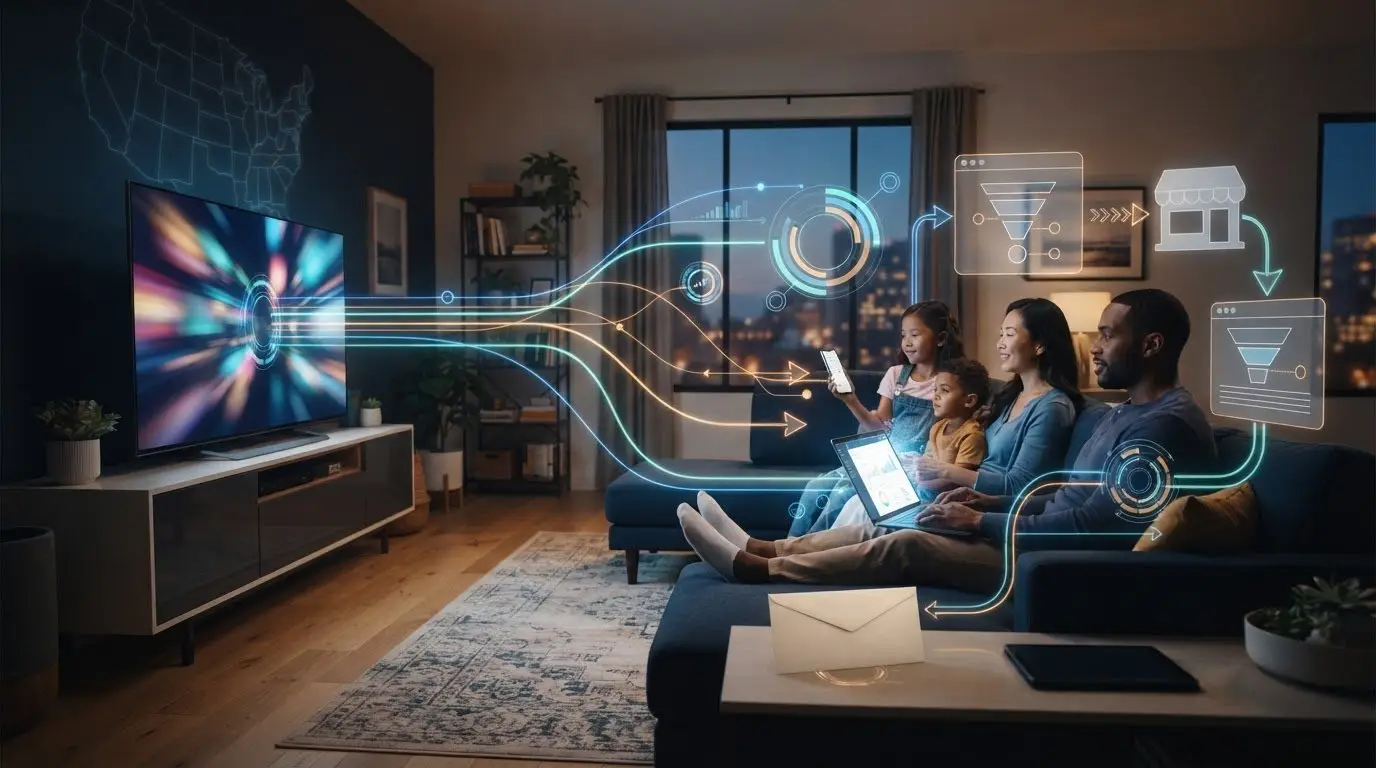
Over 53% of marketing decision-makers say they would increase their streaming ad investment tomorrow if they had reliable ROI tracking. Living room screens now capture the lion’s share of American television watch-time, yet measuring connected TV ad performance remains a persistent headache for growth-focused brands nationwide. Disjointed platform dashboards, walled gardens, and unverified impressions often leave marketing teams wondering whether their spend generated revenue or vanished into thin air.
You already know the frustration of pouring ad dollars into digital channels when cross-device attribution feels like guesswork. The good news is that streaming measurement succeeds when you evaluate verified household identity rather than isolated platform metrics. In this guide, you’ll master the core metrics, cookie-free attribution models, and cross-channel frameworks needed to accurately evaluate campaigns across all 50 states. We’ll walk you through how to connect living room screen impressions directly to tangible web visits, offline foot traffic, and bottom-line conversions.
Key Takeaways
- Move beyond outdated broadcast estimates by using household-level identity graphs to track verified cross-screen engagement.
- Master the three tiers of measuring connected TV ad performance to connect video completion rates directly to site visits and offline foot traffic.
- Implement cookieless attribution models and calibrated lookback windows to accurately credit streaming ads without guesswork.
- Multiply commercial impact across all 50 states by pairing digital living room impressions with synchronized physical direct mail touchpoints.
- Build a dependable national measurement blueprint that establishes clear baseline metrics and uses robust cross-device tracking tags.
What Is Connected TV Ad Performance Measurement in 2026?
Television advertising is no longer a guessing game built on broad estimates. Modern performance tracking ties high-impact living room commercials directly to verified consumer actions, from website visits to physical retail foot traffic. While the fundamental question of What Is a Connected TV began with internet-enabled hardware, today’s focus centers entirely on commercial accountability. Brands no longer settle for passive viewership. They demand verifiable revenue impact across every screen in the home.
Effective execution means moving past vanity metrics like gross impressions. When measuring connected TV ad performance, modern advertisers track full-funnel business outcomes across all 50 states. Rather than relying on outdated web browser cookies, modern platforms leverage persistent household identity frameworks. These systems deliver unified national reporting across fragmented streaming providers without compromising user privacy.
Linear TV Ratings vs. Modern Streaming CTV Analytics
Linear TV relied on legacy panel diaries and sampled households to project gross rating points. It was an educated guess at scale. Modern streaming analytics replace those statistical estimates with deterministic digital ad server logs. Every completed commercial generates a verified impression tied to a specific streaming device. This deterministic logging confirms delivery in real time, giving brands verifiable proof of exposure nationwide rather than an extrapolated projection.
The Role of Household Graph Resolution
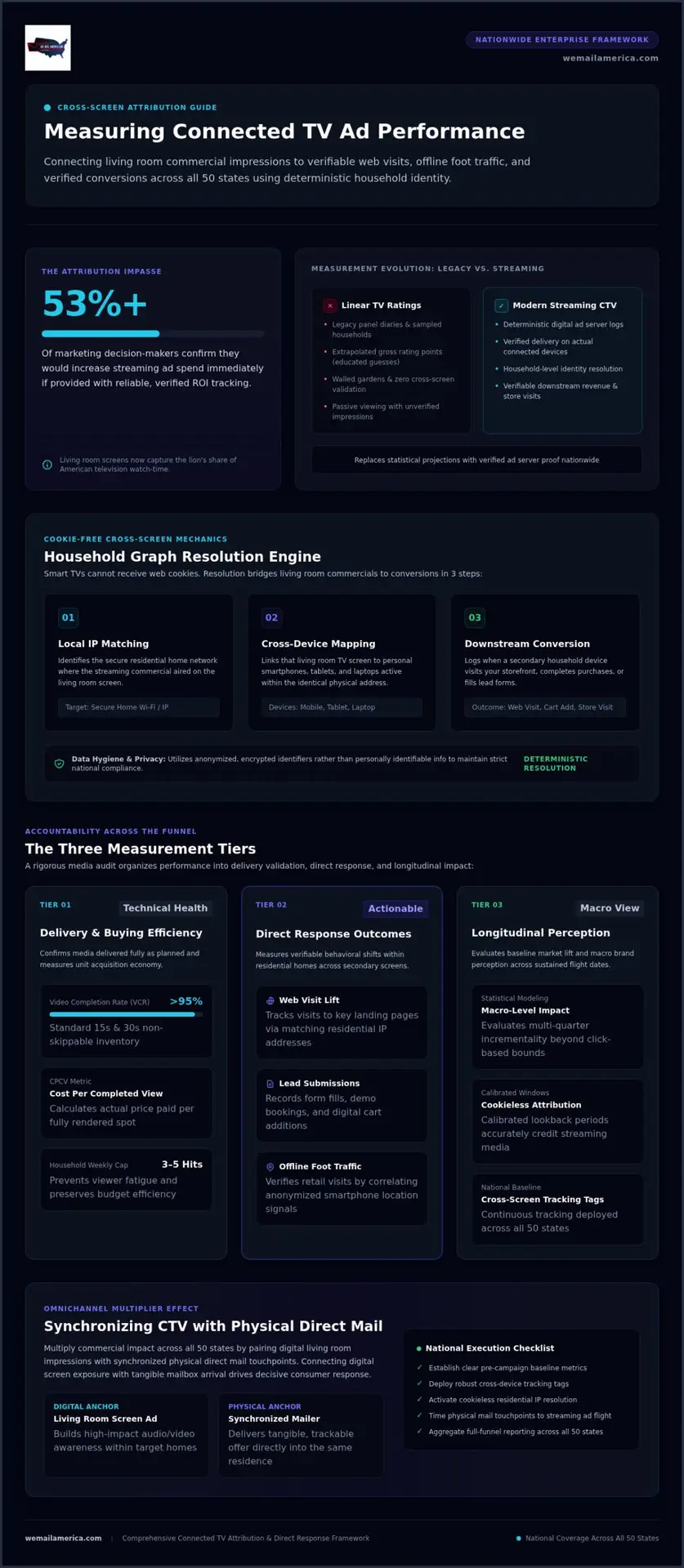
Connected televisions do not accept traditional web cookies, and viewers rarely click a TV screen with a remote control. Household graph resolution bridges this physical gap through compliant cross-device matching:
- Local IP matching: Identifies the secure home network where the streaming commercial aired.
- Cross-device mapping: Links that living room screen to smartphones, tablets, and laptops operating within the same physical address.
- Downstream conversion tracking: Logs when a secondary personal device visits your storefront or completes a purchase after viewing the TV ad.
Privacy regulations require rigorous data hygiene. Modern household graphs utilize anonymized, encrypted identifiers rather than personally identifiable information. This approach ensures consumer privacy compliance while providing businesses with exact cross-screen attribution. Master the technical mechanics of measuring connected TV ad performance, and your business transforms top-of-funnel streaming awareness into predictable, measurable revenue.
The Core Metrics for Measuring Connected TV Ad Performance
Every serious media audit begins by establishing accountability across your entire sales funnel. When measuring connected TV ad performance, you cannot evaluate technical delivery and revenue generation with the exact same yardstick. Top-tier campaigns organize their metrics into three distinct categories: delivery validation, direct response outcomes, and longitudinal brand perception.
Delivery and Engagement KPIs
Delivery metrics confirm your media ran as planned. The Video Completion Rate (VCR) serves as the primary benchmark for streaming delivery health. Because connected television placements are predominantly non-skippable, standard 15-second and 30-second units consistently generate completion rates exceeding 95%. Cost Per Completed View (CPCV) measures media buying efficiency by calculating the real price paid per fully rendered spot. Capping weekly ad frequency at 3 to 5 impressions per household avoids viewer fatigue while preserving budget across national audiences.
Direct Response and Outcome KPIs
Streaming spots actively motivate commercial transactions when paired with modern device graphs. Outcome tracking focuses on measurable behavioral shifts within target residential homes:
- Web Visit Lift: Tracks visits to key landing pages via matching residential IP addresses after a household views a commercial spot.
- Lead Submissions: Records form fills, demo bookings, or digital cart additions triggered across personal secondary screens.
- Offline Foot Traffic: Verifies actual store visits by correlating anonymized smartphone location signals with homes exposed to your TV spots.
Analyzing cross-channel lift helps you understand true business growth. Research highlighted in Harvard Business Review on Modern Attribution Methodologies demonstrates how pairing macro-level statistical modeling with deterministic tracking establishes verified conversion lift. If you want a proven partner to coordinate these complex touchpoints nationwide, you can connect with our media team to align cross-device streaming campaigns with real commercial metrics.
Brand Lift and Perception Studies
Longer sales cycles demand clean verification of brand equity. Lift studies rely on randomized control groups, comparing survey responses between households served your commercial and identical unexposed audiences. These controlled evaluations measure aided brand recall, perceived authority, and actual purchase intent. Tracking these lifts confirms your living room ad dollars build genuine market presence that outlasts fleeting digital clicks.
Modern Attribution Methodologies: Proving CTV Business Impact
Establishing true commercial accountability requires selecting the right attribution framework. Without transparent cross-device validation, advertisers risk double-counting conversions across paid search, social platforms, and streaming video channels. Aligning with verified standards, such as the CTV Measurement Framework and Transparency Principles, ensures that your campaigns rely on clean data lineage rather than platform guesswork. Clean attribution clarifies exactly how living room impressions drive bottom-line revenue.
Deterministic vs. Probabilistic Attribution Models
Deterministic attribution uses verified household identifiers, pairing residential IP addresses and device graphs to connect a TV ad directly to secondary screens. It provides exact, verifiable proof of viewer action. Probabilistic modeling, on the other hand, relies on statistical likelihood, grouping actions by timestamps, location clusters, and web browsing patterns. While probabilistic models work well for broad demographic awareness, deterministic matching is essential when measuring connected TV ad performance against concrete commercial sales across all 50 states.
Incrementality Testing and Holdout Groups
Incrementality testing separates baseline organic demand from sales directly generated by your streaming campaigns. To run an effective test, segment your target audience into exposed and unexposed control groups across comparable national markets. The unexposed holdout group establishes your organic conversion baseline. Any conversion lift observed in the exposed group represents net-new revenue. This scientific structure proves true return on ad spend and prevents wasted media budget.
Managing Attribution Windows and Decay
Living room viewers rarely buy products immediately while watching a program. Multi-touch attribution models must account for this natural behavioral delay by establishing calibrated post-view lookback windows:
- 7-Day Post-View: Best suited for direct-to-consumer goods, quick promotions, and impulse retail purchases.
- 14-Day to 30-Day Post-View: Recommended for considered purchases, appointment scheduling, and complex services requiring household consideration.
Calibrating these timeframes accurately prevents last-click channels from stealing credit for pipeline built on the living room screen.
Integrating Connected TV with Direct Mail for Verifiable ROI
Digital attribution becomes crystal clear the moment you introduce a physical touchpoint. Purely digital campaigns often vanish into background noise, leaving marketing teams to puzzle over complex match rates. Pairing your streaming commercials with physical mailbox delivery anchors your message in the real world. Research shows that combining direct mail with digital advertising delivers a 63% lift in response rates and a 49% lift in sales.
Household Synchronization Across Mailbox and Screen
Timing makes all the difference. When measuring connected TV ad performance alongside physical mail, strategic sequence creates momentum. Our turnkey Connected TV Network aligns digital video spots with physical mail arrival across all 50 states. We match verified physical addresses directly to living room screens. Your target customer watches your television spot on Tuesday evening, and your physical mailer lands in their hands by Thursday afternoon.
Deploying Verifiable Response Mechanisms
Direct response tools transform passive living room screen impressions into verified conversion data:
- Dedicated QR Codes: Route prospects instantly to customized, campaign-specific mobile checkouts from their phones.
- Custom Vanity URLs: Master our step-by-step framework for setting up trackable URLs for mailers to isolate direct web traffic.
- Targeted Matchback Audits: Compare post-campaign customer purchase lists against your mailed and streaming distribution lists to verify net-new buyers.
Amplifying Response with Impactful Formats
Tangible mail delivers a lasting household presence that digital video cannot match on its own. Reinforce your streaming commercial with the high-visibility Impact Post Card – 6 X 11, giving consumers a durable physical piece to keep on the counter. You can also trigger immediate digital follow-ups using coordinated Mail to Mobile Texting to close the sale. Ready to build a high-converting, fully measured campaign? Get a turnkey campaign quote and take control of your nationwide marketing performance today.
Building a National CTV Measurement Blueprint: Step-by-Step
Executing an effective streaming campaign requires operational discipline before the first commercial airs. Enterprise platforms often overcomplicate this process with dense data jargon, but establishing reliable verification comes down to a clear, repeatable workflow. When measuring connected TV ad performance across all 50 states, a systematic launch framework eliminates blind spots and protects your marketing budget.
Pre-Campaign Setup and Technical Tracking
Technical verification must precede media distribution. Follow this pre-launch checklist to ensure clean data capture across your digital properties:
- Deploy Conversion Pixels: Install universal tracking scripts across primary lead capture pages, demo forms, and post-purchase confirmation screens.
- Lock Attribution Parameters: Standardize post-view lookback windows inside your core analytics platform so every stakeholder reviews identical data windows.
- Test Server Pass-Through: Trigger test conversions to verify that residential IP addresses correctly map back to active ad server delivery logs.
Ongoing Campaign Optimization and Analysis
Campaign management doesn’t end once ads go live. Review performance reports weekly to optimize budget allocation across premium streaming networks and publisher apps. If specific creative variations yield high completion rates but sluggish site visit lift, swap messaging immediately. For direct-to-consumer and eCommerce businesses refining their acquisition channels, partnering with a dedicated growth team like WeBrandLab can help translate cross-screen creative performance into scalable revenue. Enforce frequency caps strictly across households to prevent audience burnout, shifting media investment into top-performing regional zip codes and high-converting audience segments nationwide.
Scale Your Multi-Touch Strategy Nationwide
True commercial efficiency happens when living room screens work hand in hand with physical mail delivery. Rather than juggling multiple disconnected vendors, successful brands rely on an integrated partner that executes both digital streaming and physical mail drops simultaneously. We take the complexity out of multi-touch marketing by handling household targeting, digital distribution, print production, and downstream verification under one roof. When you are ready to remove the guesswork, submit an advertising inquiry form to launch your verified, turnkey campaign across America.
Master Your Cross-Screen Measurement Strategy Today
Accurate tracking transforms streaming television from an unverified branding expense into a dependable revenue engine. Real commercial clarity in measuring connected TV ad performance comes from unified household identity, calibrated attribution windows, and scientific incrementality testing. When you connect living room screen impressions directly to tangible consumer actions, you eliminate attribution guesswork and protect your ad spend.
We Mail America delivers turnkey campaign execution that removes the stress of multi-channel marketing. Our proprietary targeting reaches verified households across all 50 states, creating seamless multi-touch integration between living room screens and physical mailboxes. From precise household targeting and creative delivery to comprehensive response reporting, we handle everything under one roof. Take the next step toward predictable, scalable growth. Request a quote on your integrated CTV and direct mail campaign today and build a measurable, high-performing presence across America.
Frequently Asked Questions
What is the difference between measuring CTV advertising and traditional linear TV?
Linear TV measurement relies on sampled panel diaries and broad statistical projections like gross rating points. In contrast, measuring connected TV ad performance is deterministic and device-specific. Digital ad servers log each completed streaming view in real time. Advertisers can tie verified living room impressions directly to secondary devices within that same household, replacing legacy demographic estimates with verifiable conversion tracking across all 50 states.
Can you track direct sales and website conversions from connected TV ads?
Yes, you can track direct sales and online conversions using household graph resolution. While viewers rarely click a television screen directly, tracking pixels on your website match incoming residential IP addresses with the households that viewed your streaming commercial. This allows you to monitor post-view web traffic, digital lead forms, online purchases, and even physical store visits without relying on direct remote control clicks.
What is a good Video Completion Rate (VCR) benchmark for connected TV campaigns?
A healthy Video Completion Rate for connected TV campaigns should consistently exceed 95%. Unlike web video or social media feeds where users can skip or scroll past ads, streaming TV placements are predominantly non-skippable full-screen environments. If your campaign completion rate dips below 90%, inspect your publisher mix, review app-level placement reports, or verify whether non-standard ad units are running on unvetted streaming apps.
How do cross-device household graphs work without third-party cookies?
Household graphs connect living room televisions to mobile phones, laptops, and tablets using privacy-compliant residential network data. By analyzing persistent IP addresses, device operating systems, and opt-in location signals, identity providers map out devices operating under the same roof. This deterministic and probabilistic network structure maps consumer journeys across devices without depending on third-party web browser cookies or tracking invasive personal identity data.
What attribution window should I use for measuring connected TV ad performance?
Your attribution window depends heavily on your sales cycle and product price point. For lower-cost retail or impulse consumer goods, a 7-day post-view attribution window prevents inflated numbers. For higher-ticket services, home improvements, or medical consultations requiring household discussion, a 14-day to 30-day window is standard. Calibrating this timeframe ensures you credit the living room commercial properly without claiming credit for unrelated organic traffic.
How does pairing connected TV with direct mail improve overall campaign measurement?
Direct mail provides a tangible, trackable response trigger that complements streaming ads. When you reinforce a television commercial with an Impact Post Card – 6 X 11 delivered to the same address, you introduce physical response mechanisms like personalized QR codes and custom vanity URLs. This multi-touch strategy bridges offline and online actions, establishing an undeniable link between your streaming spend and customer response.
How do incrementality tests prove the real business lift of streaming TV ads?
Incrementality tests measure true business lift by comparing conversion rates between an exposed audience and a randomized holdout group. By keeping a control group of target households unexposed to your streaming commercials across identical markets, you establish an organic baseline of sales. Any statistical increase in conversions or revenue observed in the exposed group proves the campaign’s net-new impact, eliminating attribution double-counting.