A birthday date can turn a standard mailer into a timely personal offer. Birthday mailer campaigns can match a recipient’s birth day and month, then send an offer at the start of the birthday month or around the birthday itself. Local prospect filters and a half-birthday trigger can extend the approach beyond one annual mailing.
It makes sense to want more than a festive design: the audience, timing, offer, and format all shape how relevant a mailer feels. This guide walks through practical examples, from filtering recipients by birth date and location to choosing birthday or half-birthday timing and matching the message to a service. You’ll see how to make the campaign feel personal while keeping the targeting and mailing plan clear.
Key Takeaways
- Use birth day and month data to time an offer for the birthday month, and plan how to handle leap-day birthdays.
- Refine local prospect segments by age, income, and location so the message fits the audience and service area.
- Match the mailer format and offer to the campaign, then coordinate the message, printing, and mailing steps.
- Consider birthday, pre-birthday, and half-birthday triggers to create more than one timely reason to engage.
- Measure response alongside mail volume, then adjust targeting, timing, or creative to improve the next campaign.
Filtering recipients by birth day and month
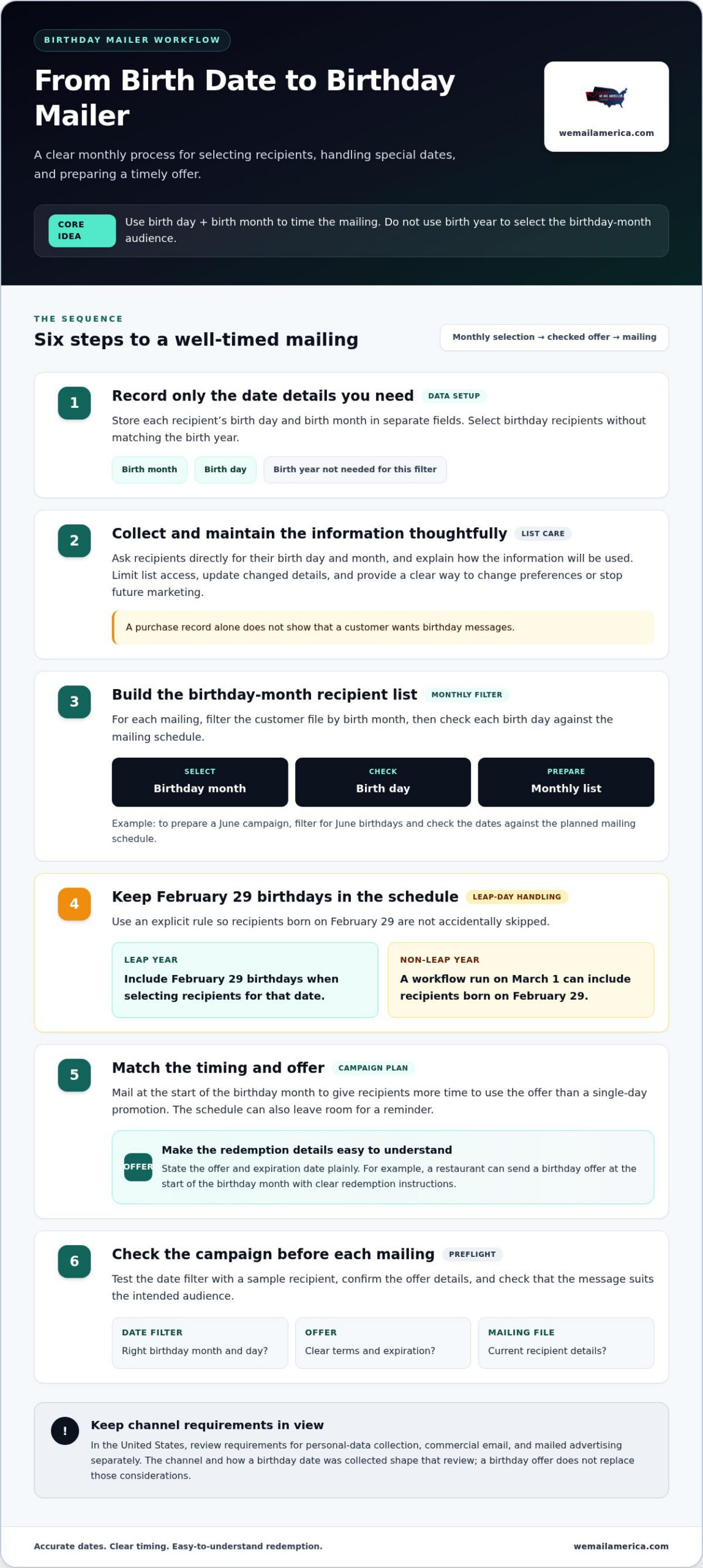
A useful birthday mailing list needs an accurate birth day and month for each recipient. Store them in separate fields, then use those fields to select recipients for a particular month without matching birth year. Limit access to the list and update records when customers change their details.
Situation: A business wants to thank customers whose birthdays fall in June. Action: It filters its customer file by birth month and checks each day against the mailing schedule. Result: Staff can prepare a monthly list and send an offer early enough for recipients to use during their birthday month.
A birthday-month campaign gives recipients more time to redeem an offer than a single-day promotion. For example, a restaurant can mail a birthday offer at the start of the recipient’s birthday month, with clear redemption instructions. The timing also leaves room for a reminder. State the expiration date plainly so customers know when the offer ends.
Situation: A customer database contains a recipient born on February 29. Action: In a leap year, include February 29 birthdays when selecting recipients for that date. In a non-leap year, a workflow run on March 1 can include recipients born on February 29. Result: The recipient remains part of the annual birthday schedule instead of being accidentally skipped.
Birthday mailers add a personal, date-based touch to loyalty efforts such as points, purchase rewards, or seasonal offers. A birthday coupon ties the message to a specific occasion, while loyalty points reward ongoing purchases. A business can combine the approaches, provided it explains the offer and redemption steps clearly.
For birthday marketing, collect the recipient’s birth day and month directly and explain how you’ll use the information. Ask only for the detail needed to time the message, and give recipients a clear way to change preferences or stop future marketing. A purchase record alone doesn’t show that a customer wants birthday messages.
In the United States, review requirements for personal-data collection, commercial email, and mailed advertising separately. The channel and how a birthday date was collected shape that review. A birthday offer doesn’t replace those considerations.
Common mistakes include sending the wrong month’s offer, using outdated addresses, and setting an unclear redemption period. Before each monthly mailing, test the date filter with a sample recipient, confirm the offer details, and check that the message suits the intended audience.
Targeting local birthday prospects by age, income, and location
A local birthday mailing works best when the audience and offer fit the business’s actual service area. Start by choosing a geographic boundary, such as selected ZIP codes or neighborhoods, then combine it with relevant prospect details. For example, a children’s activity center might focus on nearby households with children, while a salon could target adult customers within its regular travel area. These are audience examples, not assumptions about every resident.
Age can guide the message when it relates to the service. A restaurant promoting a birthday meal might create one version for adults and another for families celebrating a child. A retailer could tailor an offer around products relevant to an age group, then use a postcard with a clear greeting and redemption instructions. Keep the language welcoming: age is a planning filter, not a reason to assume someone’s preferences.
Income can help shape an offer and its creative, but it shouldn’t stand in for individual interests. If reliable audience data supports household income segments, make sure the message fits the service and likely purchase decision. A premium spa, for example, could feature a higher-end birthday experience, while a family entertainment venue could emphasize a group celebration. Don’t imply that every household in an income band wants the same gift.
Choose geographic targeting based on where your business can serve customers. A campaign can use selected ZIP codes and carrier routes, then combine geography with relevant audience details. We Mail America offers EDDM® route-based targeting and targeted mail using filters such as home value, income, and owner-occupancy.
Situation: A local bookstore wants to attract birthday shoppers. Action: It selects nearby prospects, separates family-oriented messaging from adult-gift messaging, and promotes a store visit with a special birthday offer. Result: Each recipient sees a message suited to the audience segment and location, rather than one generic postcard sent across the region.
Useful targeting options include geography, age range, household characteristics, and customer status. Choose only filters that support a clear campaign decision. Then compare responses by segment or offer version and use the findings to refine the next mailing. Automation can organize recurring selections, but records still need accurate addresses and consistent segment definitions.
Planning a local mailing around these filters? Use the advertising inquiry form to outline your audience, location, and campaign goals.
Birthday mailer services for design, lists, printing, and postage
A birthday direct mail project brings together four tasks: prepare the message, select recipients, produce the mailpiece, and send it. Define each task before the first mailing. For example, decide whether the offer runs throughout the birthday month or invites customers to a specific appointment. That choice shapes the copy, recipient data, and production schedule.
Design should make the birthday offer clear at a glance. Present the greeting, gift or discount details, redemption instructions, and response method in an easy-to-follow order. For example, “Celebrate your birthday with a complimentary dessert” explains the offer more clearly than “Something special for you.” Keep the recipient’s name and offer terms consistent across the design and mailing data.
Recipient lists can come from a business’s customer records or prospect information collected for a clear purpose. Organize fields for name, mailing address, birthday month, and any audience segment relevant to the offer. Before production, remove duplicates and correct incomplete addresses. A clean list helps prevent duplicate mailings and messages sent to outdated addresses.
- Design: Confirm the greeting, offer, expiration wording, and response method.
- List: Match each recipient record to the intended audience and address.
- Printing: Review a proof for text, layout, and personalization before approval.
- Postage: Prepare the finished pieces for mailing and coordinate the mailing schedule.
Printing and postage decisions affect how the campaign reaches the mailbox. Select a format that gives the offer enough room without crowding the message. Then set a mailing schedule that allows production and delivery before the offer’s useful date. Track the campaign’s mailed quantity, responses, and purchases. Comparing those results with the average from earlier mailings can show whether the audience, offer, or creative needs adjustment.
Illustrative situation: A bakery wants to mail birthday offers to existing customers. Action: It prepares a birthday greeting, checks customer addresses, reviews a print proof, and schedules the mailing ahead of the offer period. Result: The bakery has a clear process for delivering the offer and measuring redemptions without assuming customers will act.
Some businesses manage each step themselves; others coordinate design, list preparation, printing, and postage through a direct-mail provider. The right approach depends on internal capacity and campaign complexity. A business with a small customer file may handle the list internally, while recurring birthday mailings can benefit from a consistent production workflow. We Mail America provides full-service direct mail, including consultation, targeting, design, printing, and postage.
Birthday and half-birthday triggers
Birthday email and direct mail campaigns use a recorded birth date to time a personal message and offer. Email can deliver a quick reminder, while a birthday card or mailer gives the recipient a physical message to keep.
Timing can vary by audience and offer. More than half of birthday emails are sent on the recipient’s exact birthdate, while about 38% arrive one to three weeks beforehand. A pre-birthday message gives someone time to plan; a birthday-day greeting can make the offer feel timely.
A practical automated workflow starts with a valid birthday field and a clear audience rule. Next, choose the send date, write the message, and set a follow-up condition. One recommended email sequence starts 7 days before the birthday, then sends a reminder 7 days after if the subscriber hasn’t purchased or converted in the previous 14 days. A sequence can contain two or three messages.
- Set the trigger: Match the recipient’s birth date to the campaign schedule.
- Prepare the offer: State what the recipient receives and how to redeem it.
- Set the follow-up: Send a reminder only to recipients who haven’t converted under the selected rule.
- Review the results: Compare response and revenue across message timing and audience segments.
A half-birthday message offers another occasion to reconnect between annual celebrations. A retailer could send a midyear note with a relevant product suggestion, while a service business might invite the recipient to book again. A pre-birthday wish-list message can also prompt recipients to share preferences before friends or family choose a gift. These are scheduling options, not a reason to message every customer more often automatically.
Situation: Olive Grove Restaurant used a recurring birthday-card program. Action: It mailed 5,000 birthday cards a month with a $25 gift certificate offer. Result: The program placed a celebratory offer in recipients’ mailboxes on a continuing monthly schedule; no redemption outcome is implied by those details.
For a small test, a café could start with one birthday email and one matching mailer. It could compare redemptions by send timing before adding a half-birthday message. This helps distinguish the effect of the offer from the effect of the channel.
Keep each message focused: say happy birthday, explain the offer, and make the next step easy to find. A birthday card should feel personal, not like a routine promotion with a greeting pasted on. Track purchases and revenue alongside mailing volume, then refine the timing or creative when results point to a clear opportunity.
Birthday campaign engagement results
Measure birthday campaigns by response, not mailing volume alone. Track how many pieces were sent, how many recipients redeemed the offer, and the resulting purchases or revenue. Compare results with other campaigns using the same measurement period and audience definition. This gives a clearer view of performance than counting impressions or assuming every birthday message generated a sale.
Birthday emails have recorded higher engagement than general promotions: one market finding reports a 481% higher transaction rate and 342% higher revenue per email. Another reports unique click rates 179% higher than promotional emails. These email findings show why timely, personal messages can merit testing, but they aren’t a forecast for postcard results.
For direct mail, keep the offer easy to understand and redeem. A clear “happy birthday” greeting can introduce a relevant gift, service, or discount, followed by a simple next step. A QR code can connect the postcard to a booking or offer page, while a printed redemption code can help staff track purchases. Choose one response method and make it prominent.
Situation: A regional grocery campaign sought to increase sales at participating locations. Action: It mailed 3,000 postcards per location with an offer and a two-week redemption window. Result: The campaign reported a 37% gain in sales, a 62% return on investment, and a $224,000 return. The results describe that campaign, not a typical outcome for every mailing.
Situation: A men’s retail clothing campaign wanted to drive store purchases through postcards. Action: It mailed 5,000 pieces with a purchase-based offer. Result: The campaign reported an 18% redemption rate and more than $90,000 in additional sales revenue, from an investment of less than $4,000. Those results show the value of tracking both redemptions and sales.
No single birthday offer is right for every audience. A relevant gift, service perk, or discount can make the message feel special; clear eligibility and redemption instructions make it easier to act on.
To evaluate birthday mailer campaigns, record the audience segment, creative version, send date, redemptions, and purchases. Compare results across versions before changing several elements at once. This makes it easier to see whether the offer, timing, or message needs refinement.
Plan a birthday mailing campaign with a clear response goal and trackable offer.
For triggered campaigns, marketers can compare send volume and revenue per email, then investigate campaigns with unusual results. Birthday campaigns have a click-through rate of at least 13% that results in a purchase. Birthday emails have open rates over three times higher than mass-promotion emails and transaction rates nearly five times higher than standard bulk emails.
Birthday reminder emails generate rate increases of at least 20% in opens, click-to-delivered, average order value, and revenue per email. Insurance agents who sent Hallmark birthday cards retained 16% more customers than agents who did not. Keep these measures distinct: clicks and opens indicate engagement, while purchases, order value, revenue, and retention capture different outcomes. Reviewing the relevant measure alongside the audience and offer can help assess whether a birthday touchpoint is serving its intended purpose.
We Mail America: Impact Post Card – 6 X 11
We Mail America’s Impact Post Card – 6 X 11 gives a birthday offer a tangible format recipients can hold. It’s a practical next step when you’ve defined your audience, offer, and mailing schedule and want to bring them together in a printed piece.
Choose a format that suits the amount of message and creative your campaign needs. Options include the Extra Large Card – 9 X 11, Mailbox Buster Post Card – 12 X 9, and The Giant Post Card – 10 X 14. Each gives your birthday greeting and offer a physical place in the mailbox.
Contact We Mail America to discuss a postcard format for your birthday mailing.
Turn a Birthday Idea Into Your Next Mailing
The next step is to turn your birthday concept into a campaign plan your team can use. Choose one audience, one offer, and one response goal. Then make sure the greeting, redemption details, and mailing schedule all support that goal. A focused first rollout can help your team learn what to refine before expanding the approach to more customers or locations.
Birthday mailer campaigns work best as part of an intentional customer experience, not as a greeting without a clear reason to respond. Give recipients a useful next step and make the offer easy to understand. Use responses to shape future creative and timing.
We Mail America offers postcard formats including the Impact Post Card – 6 X 11, Extra Large Card – 9 X 11, and Mailbox Buster Post Card – 12 X 9. Contact We Mail America to discuss your birthday mailing and take the next step with confidence.
Frequently Asked Questions
What is a birthday mailer campaign?
A birthday mailer campaign is a direct-mail promotion triggered by a customer’s birthday, usually pairing a greeting with an offer. Unlike a broad seasonal postcard, it gives the business a timely reason to reconnect with a recipient. For example, a fitness studio might send a birthday note inviting a customer to book a session, with the offer terms and response method clearly stated.
When should birthday mailers be sent before or on a customer’s birthday?
Send a physical birthday mailer early enough for recipients to choose an appointment or plan a visit. If the offer is for the birthday itself, schedule the mailpiece to arrive beforehand. Email can arrive on the birthday. Make the expiration date visible and align the mailing schedule with the offer period so recipients have a practical chance to respond.
What metrics measure birthday campaign performance and ROI?
Track redemption rate, attributable sales, average order value, and campaign cost. Use a unique code or dedicated landing page to connect responses to the mailpiece, then compare results with a similar audience or period. Review attributable revenue alongside campaign cost to assess the campaign’s performance. Review total returns alongside cost per redeemed offer before adjusting the next test.
What birthday offers and incentives get the best response?
Examples in this article include a birthday-month coupon, a complimentary dessert, and clear discount or gift offers with simple redemption instructions. No single offer is identified as producing the best response.
What U.S. laws and regulations apply to birthday marketing emails and mail?
Review requirements for personal-data collection, commercial email, and mailed advertising separately. The channel and how the birthday date was collected shape that review. Explain how you’ll use the date and provide a way for recipients to change preferences or stop future marketing.