

Lead timing depends on audience fit, offer clarity, mailing cadence, and homeowners’ readiness to remodel. Home renovation contractor mailers begin generating responses when the right homeowners receive a clear message and an easy next step. A relevant offer and straightforward response path help turn attention into inquiries.
Homeowners may need repeated exposure before they’re ready to plan a project. A single postcard can introduce your services, while a consistent campaign keeps your business visible as renovation needs take shape. Reach likely prospects with a useful message and give them a simple way to respond.
This guide covers how to select homeowner audiences, design postcards and offers, plan mailing schedules, and tailor your message. It also explains how these choices shape a campaign’s lead timeline, helping you set practical expectations and build a focused plan.
Key Takeaways
- Use home age and neighborhood fit to focus your mailing audience, rather than treating every homeowner as an equally likely prospect.
- A starting test of 2,500-5,000 postcards per mailing can help you evaluate reach and response before refining your campaign.
- Build recognition with a steady mailing schedule; a single postcard may arrive before a homeowner is ready to plan a project.
- Pair strong before-and-after imagery with a specific offer and a clear response step so recipients know what to do next.
- Personalize the message to the audience and track responses by mailing to learn which choices support a stronger lead pipeline.
Targeting homeowners with mailing lists
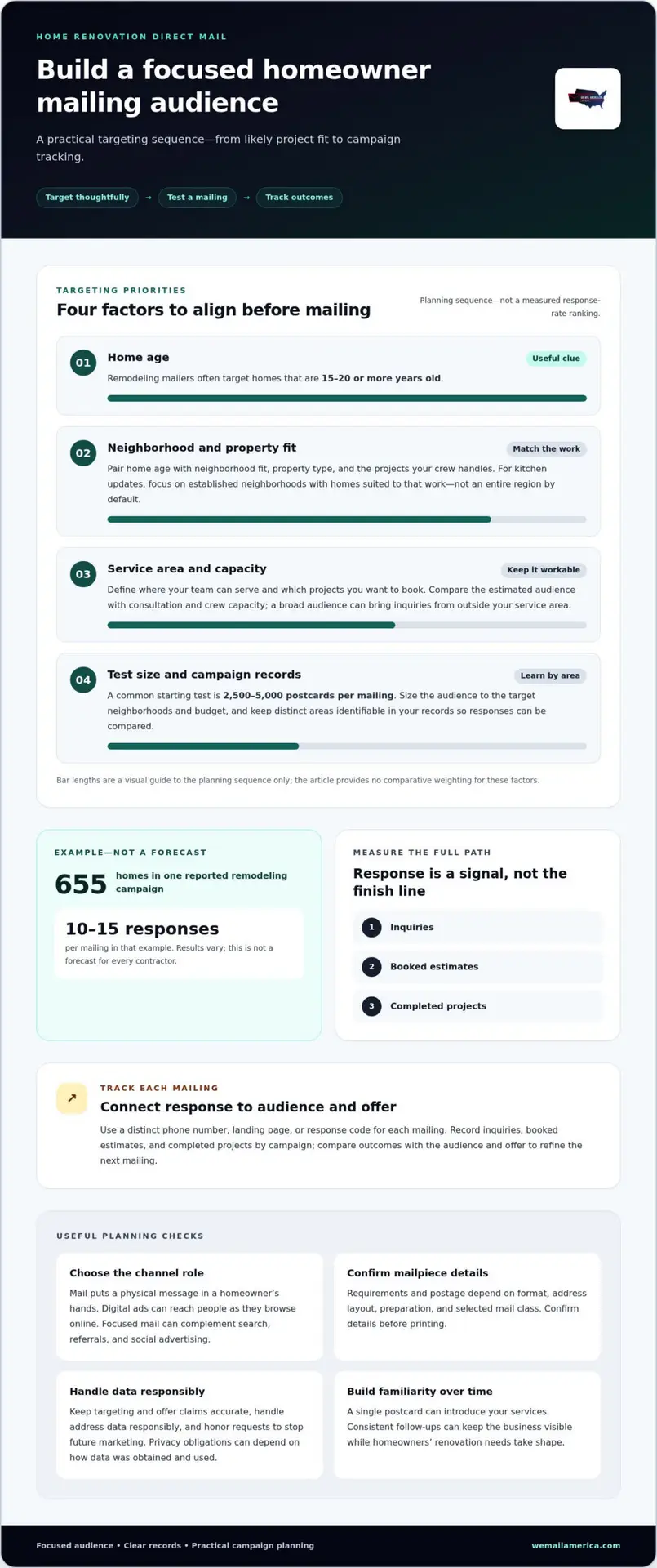
Start with the homes most likely to need the remodeling work you perform. Age is one useful clue: remodeling mailers often target homes that are 15-20 or more years old. Pair that filter with neighborhood fit, property type, and the projects your crew handles. A contractor focused on kitchen updates, for example, can prioritize established neighborhoods with homes suited to that work instead of mailing across an entire region.
Build the audience around service capacity, not just reach. Define the areas your team can serve, identify the projects you want to book, and choose an audience that fits those priorities. Then compare the estimated reach with your consultation and crew capacity. A broad audience may bring inquiries from outside your service area; focused targeting gives the message a clearer purpose.
For a first test, remodeling companies commonly start with 2,500-5,000 postcards per mailing. Use that range as a planning reference, then size the audience to your target neighborhoods and campaign budget. If you serve several distinct areas, keep each area identifiable in your records. That makes it easier to compare responses and adjust the next mailing based on where interest came from.
How do contractor mailers compare with digital ads and other lead-generation channels? Mail puts a physical message in a homeowner’s hands, while digital ads can reach people as they browse online. For construction and remodeling firms looking to synchronize direct mail with targeted online efforts, agencies like H&A Marketing help align digital campaigns with offline outreach. A focused campaign can complement search, referrals, and social advertising by keeping your remodeling offer visible among selected households.
What are the USPS requirements and postage options for contractor mailers? Requirements and postage depend on the mailpiece format, address layout, preparation, and selected mail class. Confirm these details before printing so the design and mailing plan are suited to the postal service you intend to use.
What legal and privacy rules apply to marketing mailers in the United States? Keep targeting and offer claims accurate, handle address data responsibly, and honor requests to stop receiving future marketing. Privacy obligations can depend on how data was obtained and used, so make responsible data handling part of your process.
What response and conversion rates can contractors expect from mailers? Results vary with audience fit, offer, design, timing, and follow-up. One reported remodeling campaign mailed to 655 homes and received 10-15 responses per mailing, but that example isn’t a forecast for every contractor.
How can contractors track and measure mailer campaign results? Give each mailing a distinct phone number, landing page, or response code. Record inquiries, booked estimates, and completed projects by campaign, then compare outcomes with the audience and offer.
Track the full path from mailbox to signed project. An initial response is a useful signal, but it isn’t the final measure of campaign value. Recording each inquiry’s source helps you refine audience selection, offer language, and follow-up for the next mailing.
Turnkey design, printing, and mailing services
A coordinated workflow connects the campaign message, artwork, printing, and mailing preparation. Start with a brief that identifies the remodeling projects to promote, the audience, and the response you want. For example, a contractor seeking bathroom renovation inquiries can focus the copy, photos, and call to action on that service instead of listing unrelated projects.
Design begins with a clear visual hierarchy. Put the main benefit where homeowners can spot it quickly, support it with a relevant project photo, and make the response step easy to find. A kitchen contractor might feature a finished kitchen, briefly explain the work offered, and invite readers to request an estimate. Keep contact details readable and avoid crowding the design with competing offers.
Review the proof from a recipient’s perspective before printing. Check the business name, phone number, website address, offer terms, and image quality. Read the message aloud to catch awkward wording. If the postcard promotes a renovation consultation, make sure that promise reflects the actual process. Careful proofing can catch an incorrect phone digit or mismatched photo before it reaches a mailbox.
Choose printing that supports the design and intended audience. A bright image of a completed deck may suit an exterior remodeling campaign, while a close-up of cabinet finishes may better communicate a kitchen project. Keep colors, images, and wording consistent with the contractor’s brand. Make the piece easy to scan and presentable when it arrives.
Mailing preparation turns finished pieces into an organized campaign. Confirm the audience file, address formatting, delivery area, and schedule before release. Keep the approved artwork and campaign details together so a repeat mailing can reuse the core message or feature a revised offer. If audiences receive different versions, label each version in your records to connect responses with the right message.
One coordinated workflow can reduce handoffs between planning, design, print production, and mail preparation. It also gives the contractor a single campaign plan to review, from the initial offer through the finished mailpiece. To outline a direct-mail campaign, gather the project focus, target area, approved images, and preferred response method before discussing the production plan.
Mailing frequency and quantities
Match the mailing schedule to your sales cycle and your team’s ability to respond. A homeowner planning a kitchen remodel may save a postcard, compare options, and reach out later. The first mailing introduces the contractor; follow-ups can build familiarity as the project moves forward. Plan the cadence before the first piece goes to print.
One documented remodeling campaign mailed a 6×11 postcard twice a month. That schedule is an example, not a universal formula. A contractor can use it as a starting point for discussing frequency, then weigh service-area size, available staff, project demand, and how quickly inquiries receive follow-up. A steady rhythm can keep the message visible, but the campaign needs enough time to track each mailing’s responses.
Set a clear test before choosing quantities. Select a defined neighborhood, promote one project type, and record the mailing date and version. For example, a kitchen-focused card can go to one area while a bathroom message goes to another. Keep the audience and creative distinct in campaign records. This makes it easier to see whether response differences relate to the message or the selected area.
Use these steps to shape a practical mailing plan:
- Choose a campaign goal. Decide whether the mailing should generate estimate requests, promote a seasonal project, or build awareness for a specific service.
- Set a manageable cadence. Schedule mailings at a pace your team can support, including prompt call handling and estimate follow-up.
- Separate campaign versions. Record the area, project focus, creative, and drop date for each version.
- Review results before repeating. Compare inquiries and booked estimates, then adjust the audience, offer, or timing.
Quantity and frequency work together. A larger mailing can broaden exposure, while repeated drops can reinforce recognition among the same households. Choose a plan that fits the campaign goal and your ability to serve incoming demand. If a contractor promotes kitchen projects but has limited consultation availability, a measured rollout can help keep responses manageable.
Allow enough time to evaluate a mailing. Record the first inquiry date, each lead’s source, and whether it became an estimate or project. Compare results across mailing dates instead of judging success from one early call. This helps distinguish a slow response from a poor audience match and informs the next campaign decision.
Keep the schedule flexible enough to reflect business conditions. A busy project calendar, slower follow-up, or a change in the promoted service may call for a revised plan. Use response records from each drop to decide whether to repeat the cadence, adjust the audience, or give the next message a different focus.
Offers and before-and-after imagery
Effective renovation mailers combine one clear offer, a relevant project image, and a direct response step. Show homeowners the transformation you deliver, explain what the offer covers, and make the next action easy to understand.
Before-and-after photos make remodeling work tangible. Use images from the same project, taken from similar angles, so the change is easy to compare. For a finished basement, show the original unfinished space beside the completed room. Keep the photos accurate, well lit, and large enough to see at a glance. A dramatic crop that hides the project’s real scope can undermine trust.
Choose images that match the service featured in the offer. A mailer promoting exterior updates should show completed exterior work, not an unrelated interior. Add a short caption identifying the project type, such as “entry and facade renovation.” If the photos show different properties, label them as separate examples rather than suggesting they show one home before and after.
Give recipients a specific reason to respond without crowding the design. Invite homeowners to discuss a defined project, request an estimate, or schedule a renovation consultation. Explain what happens next and what information to provide. Avoid broad promises like “best results” that don’t explain the service or offer a practical next step.
Build the message in a simple order:
- Lead with the project. Name the renovation service in the headline.
- Show the result. Use a clear before-and-after pair tied to that service.
- Explain the offer. Describe the consultation, estimate request, or project discussion.
- Give one response path. Direct readers to call, visit a landing page, or use a response code.
Keep the design focused. One prominent headline, one image pair, and one call to action give readers a clear path through the message. Supporting copy should answer practical questions, such as which projects the contractor handles and what details to share when responding. A concise message is easier to scan than a crowded list of every service.
Before approving the mailer, check that each photo supports the offer. Confirm captions, contact details, and response instructions. If the offer names a specific project type, make sure the images and headline reinforce it. This consistency helps homeowners understand the offer and gives you a useful basis for measuring responses.
Personalized home improvement postcards
Personalization works best when it makes a remodeling message more relevant, not intrusive. Start with campaign details you can use reliably, such as the recipient’s neighborhood, the project being promoted, and the services available there. A postcard about kitchen updates can speak directly to that project, while a message about exterior improvements can feature siding, entryways, or outdoor living spaces.
Segment the mailing audience using clear business criteria. For example, group households by service area or organize a campaign by project type. Then tailor the headline, image, and response prompt to each group. Someone receiving a bathroom-remodeling message should see relevant examples and an invitation to discuss that project, not a generic list of every service.
What are common mistakes and risks in home renovation contractor mail campaigns? Common mistakes include sending an irrelevant offer, using outdated address data, and personalizing with details that feel intrusive. A mismatch between the headline, project photos, and response offer can also confuse homeowners.
Keep personalization accurate and restrained. Use a neighborhood name only when the mailing genuinely targets that area. Avoid wording that implies you know a recipient’s renovation plans or the condition of their home. Instead of “Your kitchen needs an update,” try “Planning a kitchen improvement?” It invites interest without making assumptions about a household.
Before printing, review each version against a short checklist:
- Audience: Does the selected group match the project and service area?
- Message: Does the headline name the same improvement shown in the photos?
- Offer: Can a homeowner understand what the offer includes?
- Response: Does the call to action provide one clear next step?
- Data: Are names and mailing addresses accurate and handled carefully?
Use personalization to improve clarity, not to fill space. A recipient’s name may help a greeting feel direct, but the core message still needs a useful reason to respond. For example, pair a neighborhood-specific opening with a relevant project photo and an invitation to discuss a remodeling estimate. Keep the greeting, offer, and contact details consistent across every version.
Track each variation separately. Label the audience, project focus, and creative version in campaign records, then connect incoming calls or form submissions to that mailing. If a kitchen-focused version draws relevant inquiries while a broad message produces confusion, use that learning to sharpen the next campaign. Plan a personalized mail campaign around your target audience, project focus, and response goal.
We Mail America: Impact Post Card – 6 X 11
The Impact Post Card – 6 X 11 from We Mail America gives remodeling contractors a postcard format for presenting a focused project offer. Use it to feature a renovation service, a relevant project image, and a clear response step in one tangible mailpiece.
For a different format, We Mail America also offers the Extra Large Card – 9 X 11, Mailbox Buster Post Card – 12 X 9, and The Giant Post Card – 10 X 14. Choose the option that fits your campaign’s creative and message. A concise kitchen-remodeling offer, for example, can direct homeowners toward one next step instead of competing with unrelated promotions.
When your audience, message, and mailing plan are ready, contact We Mail America to discuss your campaign.
Put your next campaign in motion
Turn your campaign plan into a repeatable process. Choose one remodeling goal, align the audience and message, and decide how you’ll record inquiries. This gives your team a clear way to learn from each mailing and make practical adjustments over time.
Home renovation contractor mailers can support a steady pipeline when each campaign has a defined purpose and a simple response path. Start by gathering your project focus, intended audience, creative direction, and response method. A clear brief helps shape a campaign around the homeowners you want to reach.
We Mail America can help you plan the mailpiece that fits your campaign. Contact We Mail America to plan your mailers and take the next step with a focused plan. Build carefully, track what matters, and keep moving toward the homeowners your remodeling business is ready to serve.
Frequently Asked Questions
How long before remodeling postcards start generating leads?
Lead timing depends on when homeowners receive the postcard and decide to act. Some may respond soon after seeing a relevant project offer; others may keep it until they begin planning a renovation. Record inquiry dates alongside mailing dates, then review responses over the full tracking period. This helps distinguish delayed interest from a message that isn’t generating qualified inquiries.
How many postcards should a remodeling company mail each month?
Plan quantities by mailing drop rather than using one fixed monthly quota. Remodeling campaigns commonly start with 2,500-5,000 postcards per mailing. Your monthly total depends on how many drops you schedule and how much of your service area each drop covers. Match volume to your team’s ability to answer calls, follow up, and manage estimate requests.
What kind of mailing list works best for remodeling companies?
A useful list focuses on households that fit the contractor’s service area and promoted project. Homes that are 15-20 or more years old can be a relevant audience for remodeling offers. Filter further by the work you want to book: a contractor seeking kitchen projects should prioritize households in areas suited to that service, not an unrelated broad audience.
What are home renovation contractor mailers and how do they work?
Home renovation contractor mailers are printed marketing pieces sent to selected households to introduce remodeling services and invite a response. A contractor chooses an audience, prepares a project-focused message, and mails it to that group. Recipients can respond using the contact method provided. Tracking inquiries by campaign helps connect responses with the audience and message that prompted them.
How should contractors target neighborhoods and homeowner mailing lists?
Start by defining the households your team can serve, then group audiences according to housing fit and the renovation projects you promote. For example, create separate segments for exterior upgrades and interior remodeling. Keep each segment identifiable in your campaign records. This makes it easier to compare inquiry quality and decide whether to expand, narrow, or change the next audience.
What should a renovation contractor mailer include to generate leads?
Give homeowners a clear project focus, a credible reason to respond, and one simple contact path. Add a trackable phone number, campaign-specific landing page, or response code so inquiries can be attributed to the mailing. Make the offer terms and contact details easy to understand. Consistent tracking helps you assess qualified estimates and booked work, not just initial responses.