

You can reduce unsolicited mail by opting out of prescreened credit and insurance offers online or by calling 1-888-567-8688; choose an opt-out for five years or permanently. For catalogs, promotions, and other mail, contact the sender directly and ask to have your address removed. These steps are a practical start to avoiding the junk mail pile.
It’s frustrating to sort through offers you never requested, especially when your mailbox keeps filling up. A few targeted requests can reduce the flow, but you may need to contact different senders separately.
This guide explains how to opt out of prescreened offers, ask a company to stop mailing you, and handle catalogs and other promotional mail. You’ll also learn what to expect after submitting requests and how to make the process easier to repeat. With a clear plan, you can spend less time sorting unwanted mail and make room for the pieces you actually want to receive.
Key Takeaways
- Opt out of prescreened credit and insurance offers online or by phone, choosing a temporary or permanent option.
- For catalogs, coupon mailers, and fundraising requests, contact the sender and ask to have your address removed or your mail reduced.
- Keep track of unwanted mail and make opt-out requests directly to the organizations sending it.
- After moving, review the mail arriving at your new address and contact senders whose pieces you don’t want.
- When your business needs to reach households through direct mail, We Mail America offers postcard formats including the Impact Post Card – 6 X 11.
How can I reduce unsolicited postal mail in the United States?
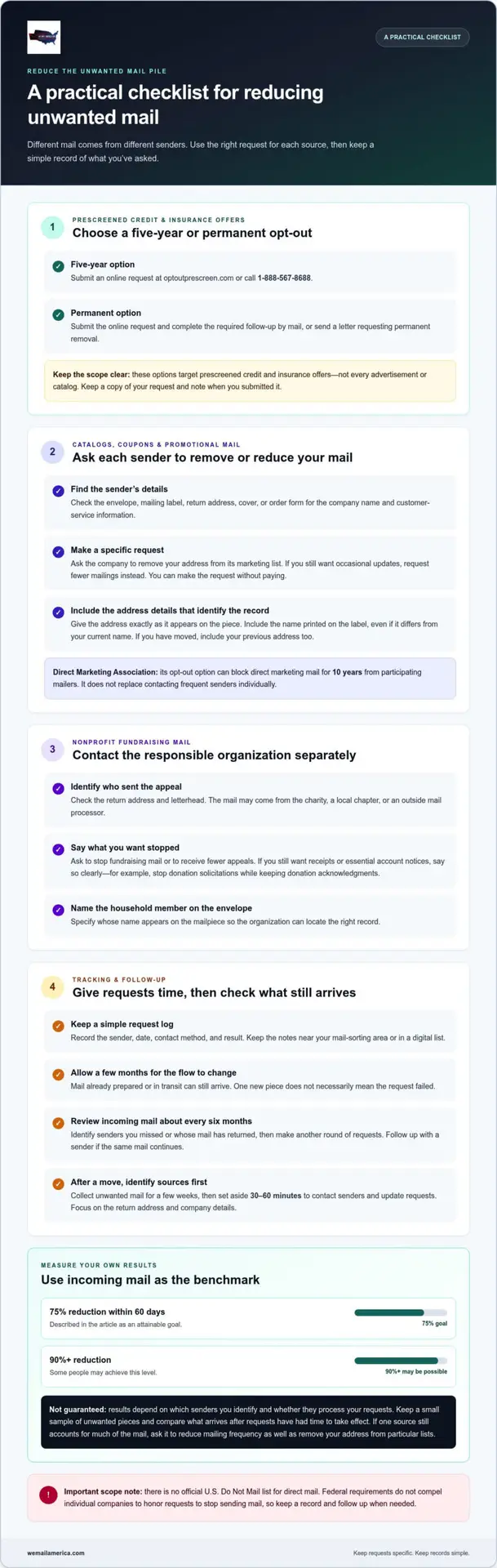
- Opt out of prescreened credit and insurance offers. Choose an online request or call 1-888-567-8688. The phone service and optoutprescreen.com let you request a five-year opt-out. For a permanent opt-out, submit the online request and complete the required follow-up by mail. You can also send a letter requesting permanent removal. Keep a copy of your request and note when you submitted it. These options target prescreened credit and insurance offers, not every advertisement or catalog. Credit card customers can ask their card companies not to share their information through affiliate marketing for up to 5 years, according to the Federal Trade Commission. Make that request directly to your card company. Review account privacy choices, too, because a request about affiliate sharing addresses a different source of offers than a prescreened-offer opt-out.
- Ask each sender to stop mailing you. Check the envelope and mailpiece for the company name, return address, customer-service number, or instructions for managing mail. Contact the company directly and ask it to remove your address from its marketing list. You can also request fewer mailings if you still want occasional updates. Calling customer service is one option, and you can make the request without paying. Give the sender the address exactly as it appears on the piece. If you have moved, include your previous address so the company can identify the record. USPS advises contacting the sender directly or direct-mail associations to request removal from mailing lists. There is no official U.S. Do Not Mail list for direct mail. Federal requirements also do not compel individual companies to honor requests to stop sending mail, so keep a record and follow up if the same sender continues.
- Track requests and repeat the process. Write down the sender, date, contact method, and result of each opt-out request. Keep the notes near your mail-sorting area or in a simple digital list. The full effects of mail-reduction steps may take a few months, since mail already prepared or in transit can still arrive. Allow time before treating one new piece as proof that a request failed. Review incoming mail and make another round of requests about every six months. That check helps catch companies you missed and senders whose mail has returned. After moving, collect unwanted mail for a few weeks to identify its sources. Then set aside 30-60 minutes to call senders and update your requests. Focus on the return address and company details, not just the offer printed on the front. A clear record makes each follow-up faster and helps you distinguish repeat mail from unrelated promotions.
Set a practical target and use your own incoming mail as the measure. The page describes a 75% reduction in incoming mail within 60 days as an attainable goal, while some people may achieve a 90%+ reduction. These are goals, not guaranteed results; the amount you can cut depends on which senders you identify and whether they process your requests. Keep a small sample of unwanted pieces, note the senders, and compare what arrives after your requests have had time to take effect. If one source still accounts for much of the mail, contact that organization again and ask whether it can reduce the frequency as well as remove your address from particular lists.
Treat this as a complement to direct requests, rather than assuming one opt-out will cover every sender. Keep the address details and any responses in your notes so you can track which requests have been handled and which may need follow-up. When contacting an organization, specify whether you want all marketing materials stopped or simply want fewer of them. That can help you retain wanted updates while cutting mail you don’t need. As new pieces arrive, reassess your list and focus further requests on the senders that are still reaching you.
How can I opt out of catalogs, coupon mailers, and nonprofit fundraising mail?
- Start with the catalog or coupon sender. Find the publisher’s name and customer-service details on the cover, order form, or mailing label. Contact the company and ask it to stop catalogs, coupon mailers, or both. Be specific: “Please remove this address from your promotional mailing list.” If you still want some offers, ask for mailings less often instead. Include the name printed on the address label, especially if it differs from your current name, and provide the exact address receiving the mail. Matching the label details helps the sender locate the right record.
- Use the Direct Marketing Association’s opt-out option. Consumers can block direct marketing mail through the Direct Marketing Association for 10 years. This route can help reduce catalogs and other promotional pieces from participating mailers. It won’t replace a direct request to a particular company, so contact frequent senders individually too. Take two minutes to submit an opt-out request when you spot a recurring mailer. The aim is to save time sorting repeated offers over the following years. Treat that as a useful task, not a promise that every sender will stop. Keep the name of the organization and the date of your request for later reference.
- Contact nonprofit organizations separately. A fundraising letter may come from the charity itself, a local chapter, or an outside mail processor. Check the return address and letterhead to identify the organization responsible. Ask to stop fundraising mail or request fewer appeals. If you support the nonprofit and want to keep receiving receipts or essential account notices, say so clearly. For example, ask to end donation solicitations while keeping donation acknowledgments. Specify which household member’s name appears on the envelope. If appeals continue, contact the nonprofit again and describe the exact mailpiece. A clear request helps distinguish fundraising promotions from correspondence related to your giving.
- Check every name and address variation. Mailers may send separate pieces to household members or use initials, nicknames, and former names. Compare the label on each catalog or appeal before making a request. Include each version of the recipient’s name and any previous address associated with the unwanted mail. If a coupon booklet arrives for a former resident, mark it as addressed to someone who no longer lives there and return it through the mailbox. Don’t assume one request covers other names or addresses. Ask the sender to remove each version shown on the mail. Matching the details carefully helps prevent missed records from generating another round of offers.
- Make your request clear and keep the mailpiece details. State whether you want no promotional mail or fewer pieces. Provide only the information needed to identify the mailing, and avoid sharing unrelated personal details. Keep a note of the organization, the request, and the date. Promotional mail already prepared or in transit may still arrive after you ask. If another catalog or appeal appears, compare its sender and recipient information with your note before following up. Organizations sending their own direct mail can also make communication more useful and respectful. For a planned campaign, consider We Mail America’s Mailer – 8.5 X 11 as one mailing format.
Unwanted mail
- Measure what arrives before changing your routine. Collect unwanted postal mail for 30 days, then review the stack. Separate catalogs, coupon pieces, fundraising letters, credit offers, and unfamiliar promotions. Note the sender and the name printed on each address label. This simple inventory shows which categories take up the most space and which senders recur. A 30-day audit makes avoiding the junk mail pile more systematic. For example, several envelopes from one organization suggest a different pattern from unrelated, one-time offers. Keep the notes brief. A list of names and mail types gives you a practical starting point for deciding what to address next.
- Read the whole piece before discarding it. Check the sender, return address, mailing label, and any instructions inside. A dramatic headline may describe a promotion rather than an account notice. One reported example involved a car-warranty mailer arriving two months after a new-car purchase. It suggested the factory warranty had expired or might soon expire. The person noted that the message implied the car could have driven 36,000 miles in two months. Treat this as an example of why details matter, not proof that every warranty offer is misleading. Separate urgent-looking claims from verified information about your own accounts.
- Use your 30-day tally to see the broader pattern. More than 4 million tons of junk mail are produced each year in the United States. Unsolicited mail amounts to more than 60 pounds per U.S. household. Those national estimates cannot tell you what arrives at your address. Your own collection can. Compare the categories you recorded, and look for repeated organizations, similar offers, or multiple names in your household. That breakdown can help you choose which mail to address first. If fundraising letters dominate, focus on those senders. If catalogs fill the stack, identify their publishers instead.
- Handle misaddressed mail carefully. Check whether a piece names you, another household member, or someone who no longer lives there. Don’t open mail addressed to another person. The U.S. Postal Service says it must deliver mail that is properly addressed and has paid postage, except mail that is illegal, contraband, or violates postal mailing standards. For an unwanted solicitation addressed to you, use the sender’s contact details to make a request. A piece addressed to a former resident is different. Keep the addressee visible and follow the postal instructions relevant to that mailpiece.
- Sort recyclable paper from items needing special handling. Junk mail is recyclable, so place suitable paper pieces with your household recycling. Check each envelope for inserts, plastic coverings, or other materials that your local recycling program may handle differently. Remove personal details before recycling a piece, especially account or offer information printed with your name. Keep unwanted mail in one designated tray until sorting day. Your 30-day review can reveal how often that tray fills and which categories dominate. These records help make avoiding the junk mail pile a more manageable household routine.
After a move, wait a few weeks to see which unwanted pieces still arrive before contacting senders to opt out. This gives you time to distinguish recurring mail from one-off offers while checking sender and label details. Note repeat senders, then make focused requests instead of reacting to every envelope separately.
The average American is estimated to spend about eight months of their life opening junk mail, making a manageable approach worthwhile. Turn that broad burden into a concrete task: identify a repeat sender, use the contact details on its piece, and note whether the same type of mail continues to arrive. If unwanted mail persists after a move, revisit your notes after a few weeks and decide which senders still merit an opt-out request.
Your mailbox
- Use your mailbox visits to spot patterns. Homeowners go to their mailbox an average of 6 times a week. Sort each delivery into wanted mail, bills, and unwanted offers. Note which days bring the most promotional pieces, and record repeat senders. A coupon mailer arriving alongside a catalog may come from separate organizations, so sort by sender rather than appearance. This quick routine reveals which mail deserves an opt-out request and which pieces are isolated. If you check less often, set aside mail when you collect it. A dedicated tray keeps the growing stack visible and makes sorting easier.
- Make your own mailbox tally before changing habits. One person reported collecting 20-30 pieces of mail by checking a mailbox about once every two weeks. That example isn’t a prediction for your address. Use it as a prompt to track your actual delivery. For each piece, mark whether it’s useful, required, or unwanted. Count repeat offers from the same sender separately from new ones. After a few collections, compare the categories and identify the biggest source of clutter. This record turns a general frustration into a specific action list, such as contacting a catalog publisher or reviewing recurring insurance offers.
- Protect a small part of your week from mail sorting. Spending 10 minutes per week dealing with junk mail adds up to nearly 87 hours over the next decade. Even five minutes per month amounts to an hour per year and 10 hours over the next decade. Choose a regular time to sort and make opt-out requests together. Keep envelopes until you’ve captured the sender’s name and contact details. Then recycle suitable paper and discard other materials according to your household routine. Batching the task helps prevent each delivery from interrupting your day. It also gives you a consistent time to notice new senders.
- Give wanted mail a better chance to stand out. A direct-mail piece has about 6 seconds to get its audience’s attention. On a delivery day, a recipient may also have 3 to 5 other messages and offers to consider. If you receive mail from a business or organization you value, set it apart from unwanted promotions before sorting. For senders, this is a reminder to make the purpose clear at a glance. Use a direct headline and an obvious next step. For your own household, a quick first look helps distinguish a relevant notice from a promotion without reading every piece in detail.
- Keep expectations realistic while reviewing the results. One estimate describes a PO box receiving about 65% spam in a recent month. Another estimates that a PO box kept for a few years can receive mail that is 95% spam. These figures describe individual examples, not every mailbox. Your own records matter more. Review them after you’ve sorted several deliveries, then target the senders responsible for repeated unwanted pieces. Keep track of requests and incoming mail so you can see whether the mix changes. A focused review helps you spend effort on recurring clutter, rather than treating every envelope as the same problem.
We Mail America: Impact Post Card – 6 X 11
For businesses that want to reach customers through physical mail, We Mail America offers the Impact Post Card – 6 X 11. It’s a practical next step when your message needs a clear presence in the mailbox, rather than another digital impression. Choose from other postcard formats, including the Extra Large Card – 9 X 11, Mailbox Buster Post Card – 12 X 9, and The Giant Post Card – 10 X 14. Match the format to your campaign message and audience, then focus on making the offer relevant to the people receiving it. A direct-mail campaign works best when each piece has a clear purpose for its recipient. Contact We Mail America to discuss your mailing needs.
Make Every Mailpiece More Intentional
Reducing unwanted mail is one part of a better mailbox experience. For organizations, the other part is making each message relevant, clear, and worth a recipient’s attention. That starts with a focused offer and a format suited to the campaign, rather than sending mail without a clear purpose. A deliberate approach can help businesses communicate with customers while readers work toward avoiding the junk mail pile.
We Mail America offers postcard formats including the Extra Large Card – 9 X 11 and Mailbox Buster Post Card – 12 X 9. Choose a format that supports the message you want to put in customers’ hands, then make the next step easy to understand.
If you’re planning a direct-mail campaign, contact We Mail America about your mailing. A thoughtful message can make physical mail feel more useful and purposeful.