

A listing gets attention. A closing shows follow-through. The smarter move is to make just listed just sold postcards two parts of one repeatable campaign, so homeowners see both your activity and your track record. Rather than treating each announcement as a one-time update, connect them to build recognition and create more opportunities for seller inquiries.
Plan how the announcements will work together, who should receive them, and how you’ll record responses. This article explains how to build a consistent campaign around listings and closings, select relevant recipients and carrier routes in ZIP codes across the country, and capture responses with tools such as custom QR codes. It also covers how route research, audience filters, and digital advertising can support a coordinated approach. We Mail America brings design, printing, mailing, and tracking together to help businesses manage repeat campaigns nationwide.
Key Takeaways
- Use just listed just sold postcards to connect a new listing and its closing in a sequence that keeps your real estate activity visible.
- Give each card one clear job: feature the property, state the announcement, identify yourself, and make the next step easy to find.
- Match distribution to your goal: broad carrier-route coverage supports wider outreach, while audience filters can help focus a targeted mailing.
- Track the response paths your campaign uses, such as calls, form submissions, or QR scans, then apply what you learn to the next mailing.
- Coordinate route research, design support, printing, mailing preparation, and delivery tracking to manage repeat campaigns across the country.
Why pair Just Listed and Just Sold postcards in a real estate campaign?
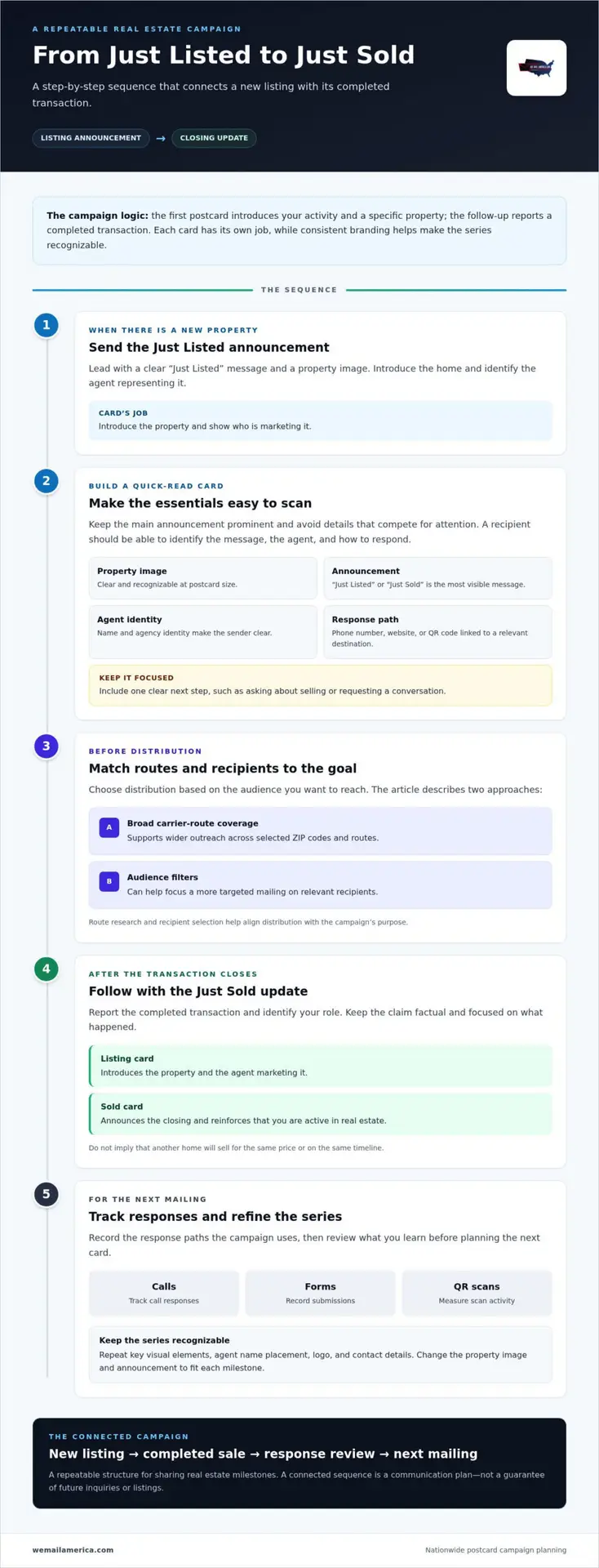
A new listing gives you a timely, specific reason to reach homeowners. A completed sale gives you a natural follow-up: an opportunity to share that you guided a transaction from listing to closing. Used together, just listed just sold postcards create a more coherent campaign than either announcement sent on its own. The first introduces your activity; the second provides a factual update.
Each card has a distinct job. A Just Listed postcard introduces a property and the agent marketing it. A Just Sold postcard reports a completed transaction and reinforces that you’re active in real estate. Keep the message accurate and focused on the specific property or transaction. You can communicate your role without implying that another home will sell for the same price or on the same timeline.
Postcards are a physical format for sharing promotional messages. For broader context on the channel, see Advertising Mail on Wikipedia. In real estate, the value of pairing announcements lies in connecting each mailing to a recognizable business milestone, not in promising a particular response.
What does each postcard communicate to homeowners?
The listing card can lead with a clear “Just Listed” message, a property image, and your name or agency identity. Its purpose is to introduce the home and show who is representing it. The sold card shifts the focus to the completed transaction. It can announce the closing and identify your role, keeping the claim grounded in what happened.
Give the reader one relevant next step. A homeowner considering a move might be invited to request a property valuation or contact you to discuss selling. Make the action specific and provide a clear way to respond. A direct next step turns an announcement into an invitation without suggesting that every recipient is ready to act.
Why make the two announcements a repeatable series?
Consistent visual choices, such as the same agent name placement, logo, colors, and contact details, help recipients connect one card with the next. The property image and main announcement can change while recognizable elements stay steady. That balance keeps each mailing relevant to its milestone while giving the campaign a familiar identity.
A sequence also gives you a practical structure: send a listing announcement when there’s a new property to share, then follow with a sold announcement after the transaction closes. These business milestones provide a reason to communicate and a framework for planning future mailings. Keep each message focused, use a clear call to action, and review how recipients respond before shaping the next card.
A Just Listed card introduces the opportunity; a Just Sold card reports the completed transaction. Together, they make each announcement part of a connected communication plan, not a guarantee of future inquiries or listings.
What to include on Just Listed and Just Sold postcards
A strong postcard gives homeowners the essential information at a glance, then makes it clear how to learn more or get in touch. Keep the main announcement prominent and avoid crowding the design with details that compete for attention. For broader planning ideas, explore Postcard Marketing: The Ultimate Guide.
Use this checklist for both cards:
- Property image: Choose a clear image that supports the announcement and is easy to recognize at postcard size.
- Announcement: Make “Just Listed” or “Just Sold” the most visible message.
- Agent identification: Include your name and agency identity so recipients know who is communicating.
- Contact path: Provide a phone number, website, or QR code that leads to a relevant destination.
- Next step: Invite one clear action, such as asking about selling or requesting a conversation.
Think of the postcard as a quick read. A recipient should understand the announcement, identify the agent, and spot the response option without searching through blocks of copy. Keep supporting details selective, and make contact information easy to find.
How should a Just Listed postcard present a property?
Lead with the listing announcement and a clear property image. Follow with a short line about the home or its marketing, then identify yourself as the agent. Avoid letting descriptive copy overpower the news. Give recipients a specific response path, such as a phone number, website, or QR code, and connect it to a clear action. For digital-response details, the USPS Every Door Direct Mail page provides information about this route-based mailing option.
How should a Just Sold postcard turn a closing into proof?
State the sold announcement clearly, then connect the transaction to your role in the process. Keep the claim factual. Don’t add sale-speed, price, or performance statements unless they’re verified and appropriate to share. A concise invitation, such as “Thinking about selling? Let’s talk,” gives homeowners a practical next step without promising that their experience will match the featured sale.
Keep recognizable branding consistent across just listed just sold postcards: repeat key visual elements, your name, and contact details while changing the announcement and property image. This helps each piece feel connected without making the message look like a duplicate. Before printing, review the card at its actual size and check that the headline, image, agent identification, and response path are easy to scan.
If you’re planning a coordinated postcard campaign, use the postcard campaign inquiry form to start shaping the message and mailing plan.
How to choose routes and recipients for Just Listed Just Sold postcards
Start with the campaign objective, then decide how wide or focused the mailing should be. If you want broad exposure across selected ZIP codes, carrier-route distribution may fit. If you want to shape the audience around selected household characteristics, targeted mail offers another approach. Choose based on whom you want to reach and what the announcement needs to communicate, not on a promise of a particular response.
| Approach | Objective | Audience | Distribution |
|---|---|---|---|
| EDDM® | Build broad visibility | Households across chosen carrier routes | Route-based coverage within selected ZIP codes |
| Targeted mail | Focus the campaign | Households matching selected filters | Distribution shaped by the chosen audience criteria |
We Mail America prepares a Custom Geographic Report and carrier-route map to help plan distribution. These tools provide a clearer view of potential routes before mailing. For targeted campaigns, filters can include home value, income, and owner occupancy. Consider which audience characteristics align with your objective, then use the map and report to organize distribution. They support planning; they don’t predict how recipients will respond.
When does broad carrier-route coverage fit the campaign?
EDDM® can suit an agent who wants an announcement delivered broadly across selected carrier routes in chosen ZIP codes. It puts a listing or closing message in front of households throughout those routes, rather than limiting distribution to an audience defined by household filters. A Custom Geographic Report and carrier-route map help translate that broad objective into a practical distribution plan.
When can targeted mail help refine the audience?
Targeted mail can focus distribution using filters such as home value, income, and owner occupancy. For example, an agent can choose criteria that align with the type of homeowner they want to reach, then tailor the postcard’s message accordingly. Filters guide audience selection; they don’t guarantee engagement or inquiries. For a deeper comparison of the approaches, see the EDDM vs. targeted direct mail guide.
Choose routes based on the audience you want to reach and the objective the postcard needs to serve. That principle keeps both Just Listed and Just Sold campaigns focused, whether you’re seeking broad route coverage or a more defined audience. We Mail America supports geographic research and route planning for campaigns across the United States. To plan a campaign’s distribution, use the advertising inquiry form.
How to plan, send, and measure a repeatable postcard sequence
A repeatable campaign starts with a plan for what each mailing should do and how you’ll recognize a response. Just listed just sold postcards can follow real business milestones, but the sequence is easier to evaluate when you set the objective, audience, message, and response path before sending. Keep a simple record for each mailing so you can compare what happened with what you intended.
- Set an objective. Decide whether the mailing should introduce a new listing, share a closing, or invite homeowners to discuss selling. Pick one primary action for recipients, such as calling, submitting a form, or scanning a QR code.
- Choose routes or an audience. Select the geographic coverage or audience criteria that match the objective. Make this decision before preparing the creative so the message and distribution work together.
- Prepare the message. Build the postcard around one main announcement and a clear next step. Include only response options the campaign will use, and make them easy to record later.
- Mail and monitor delivery. Keep the mailing details with your campaign record. Delivery updates help you understand the distribution stage, but they don’t show whether recipients contacted you.
- Review responses and plan the next test. Record calls, form submissions, QR scans, or other response signals tied to the mailing. Use what you learn to decide what to keep or adjust in the next sequence.
What should an agent decide before the first mailing?
Write down the goal in plain language, such as “share a new listing and invite homeowners to request a selling consultation.” Then define the audience or coverage and choose the response path. If you use a custom QR code, decide where it should lead and how scans will be reviewed. A clear plan makes it easier to distinguish campaign activity from results.
How can agents use campaign results to improve the next mailing?
Review delivery information separately from inquiries. We Mail America provides daily mail-delivery tracking updates; calls, form submissions, and QR scans are separate response signals. Compare those signals with your original objective, but don’t assume the postcard alone caused every inquiry. Note one element to test next, such as the headline, audience criteria, or response path, and keep other elements steady where practical.
There’s no need to invent a response benchmark. Establish a baseline from your own campaign records and look for useful patterns across mailings. The Impact Post Card performance case study offers additional context for evaluating campaign performance.
To plan a measurable mailing sequence, start a postcard campaign inquiry.
How We Mail America supports nationwide Just Listed Just Sold postcard campaigns
Coordinating a listing announcement and a closing follow-up takes more than preparing two designs. We Mail America is a full-service direct mail advertising company serving businesses across the United States. For real estate agents, campaign support brings geographic research, route planning, design support, printing, mailing preparation, and delivery tracking into one coordinated process.
That workflow helps turn separate announcements into a campaign you can plan and repeat. Geographic research and carrier-route maps help inform where a mailing goes. One-on-one design support helps shape the postcard around its message and response path. Once the creative is ready, printing and mailing preparation move the campaign toward delivery, with tracking updates helping you follow that stage.
What does full-service postcard campaign support cover?
Each part has a clear role. Route planning connects distribution to the intended coverage; design support helps organize the announcement and call to action; printing produces the physical mail piece; mailing preparation gets the campaign ready for delivery. Daily mail-delivery tracking updates provide visibility into the mailing process. This coordination makes it simpler to plan the next postcard around a future listing or closing.
A typical campaign workflow can include:
- Research: Review geographic information and carrier-route options in relation to the campaign objective.
- Plan distribution: Select routes or a targeted audience for the mailing.
- Prepare the postcard: Work through design support to align the announcement, agent identity, and response path.
- Print and prepare for mailing: Move the approved postcard through printing and mailing preparation.
- Follow delivery: Use delivery tracking updates to monitor the mailing process.
The steps support both a “Just Listed” announcement and its later “Just Sold” follow-up, while letting each postcard reflect its own milestone. A consistent workflow also gives agents a practical way to organize repeat mailings without treating every campaign as a brand-new project.
How can direct mail connect with digital response options?
Physical mail can offer a clear bridge to digital action. Every direct-mail campaign includes a custom QR code, giving recipients a way to move from the postcard to a digital destination. Each postcard also includes a text option at no additional charge. These response paths make it easier to invite an action and review the signals a campaign generates, without promising a specific number of inquiries.
Digital advertising can extend a campaign beyond the mailbox. We Mail America offers targeted email campaigns to the same homes and a Connected TV Network with ads shown in homes with connected TV. These are campaign extensions, not requirements for every postcard mailing. Choose digital components according to the campaign’s objective and how you plan to review responses.
With research, route planning, design support, printing, mailing preparation, and tracking coordinated together, just listed just sold postcards can fit into a repeatable nationwide marketing process. Request a postcard campaign inquiry to plan your next mailing.
Make Your Next Real Estate Mailing Count
Give your next campaign a clear starting point: choose the milestone you want to communicate and decide what you want homeowners to remember about your service. That focus can guide the postcard’s message and help keep future mailings aligned with how you want to represent your business. Treat each campaign as an opportunity to build a more recognizable, consistent presence, not as a one-off announcement.
With just listed just sold postcards, put the plan into action and shape it around your goals. A nationwide campaign inquiry is a practical way to turn that direction into a mailing plan for your intended audience.
Request a nationwide postcard campaign inquiry and take the next step toward a more intentional real estate campaign. Start with a clear message and a thoughtful plan, then build momentum one mailing at a time.
Frequently Asked Questions
What is the difference between a Just Listed and a Just Sold postcard?
A Just Listed postcard announces a property that has entered the market and identifies the agent representing it. A Just Sold postcard reports that a transaction has closed. Sent as a sequence, the first introduces current activity, while the later card provides a follow-up update. Keep the agent identity consistent so recipients can connect the communications even as the property and headline change.
Do Just Listed and Just Sold postcards work better together?
They can complement each other because each communicates a different business milestone: one announces a new listing, and the other reports a completed sale. Together, they give an agent a natural structure for sharing relevant updates over time. That doesn’t guarantee inquiries or listings. Consider the timing and audience for each mailing, and make sure the second card adds a fresh update rather than simply repeating the first message.
How do I choose recipients for Just Listed Just Sold postcards?
Choose recipients based on the campaign objective and the audience you want to reach. For broad distribution, consider carrier-route coverage in selected ZIP codes. If your goal calls for a more defined audience, available filters include home value, income, and owner occupancy. These options help shape just listed just sold postcards around your outreach plan. Select routes or filters before finalizing the message so distribution and creative support the same objective.
Can I send Just Listed and Just Sold postcards nationwide?
Yes. We Mail America supports campaigns across U.S. ZIP codes, so real estate agents can plan mailings in the parts of the country relevant to their business. Nationwide service doesn’t mean every postcard needs to go everywhere. Select the ZIP codes and distribution approach that fit a particular campaign, then build future mailings around other chosen areas as your outreach strategy develops.
What should I include on a Just Listed postcard?
Make the listing announcement easy to spot, pair it with a clear property image, and identify yourself as the agent. Include a response path, such as a phone number, website, or QR code, so interested homeowners know how to reach you. Before approving the card, check that the image and headline remain clear at postcard size and that your contact details are readable and current.
How can I track responses to real estate postcards?
Record responses through the paths your postcard offers, such as calls, form submissions, and QR scans. Ask callers how they heard about you, or use a campaign-specific form destination when practical, to help connect inquiries with a mailing. Keep those response records separate from delivery updates: delivery monitoring concerns the mail’s progress, while response tracking shows whether recipients took an action.
Can direct mail postcards include digital advertising?
Yes. A postcard campaign can connect with digital options such as Mail-to-Mobile texting, targeted email, or Connected TV advertising. These are campaign extensions, not requirements for every mailing. For example, an agent might use the text response option included on each postcard or add digital advertising to support a broader outreach plan. Choose components that fit the campaign objective, then track their response paths separately where possible.