
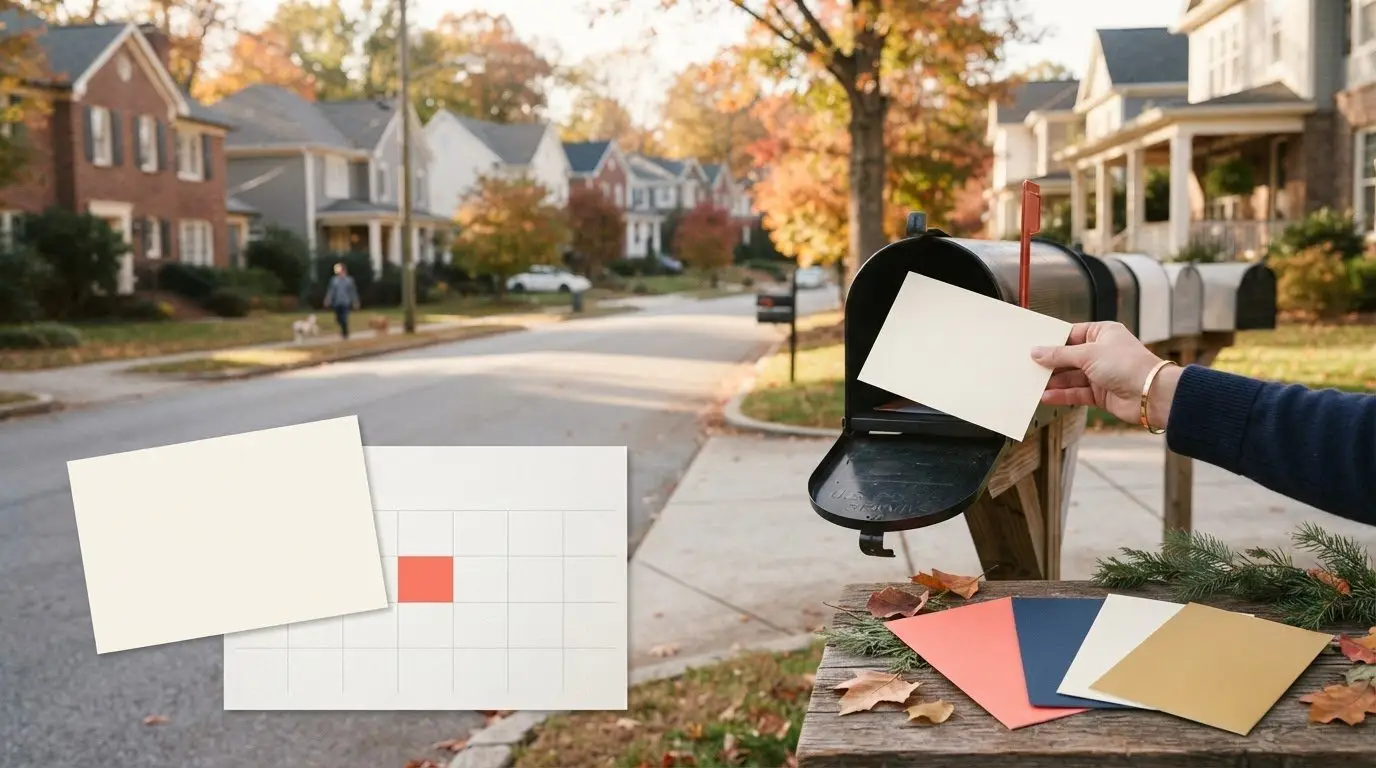
A clear deadline can create more urgency than a bigger discount. In seasonal postcard campaigns, pair a timely reason to act with a specific window, such as a 20% offer valid for one weekend; a discount isn’t essential if early access, a seasonal reminder, or an event gives customers a reason to respond now.
It’s natural to wonder whether a promotion needs a price cut to stand out. The right choice depends on what you offer and what will feel relevant to the people receiving your postcard. A focused message can make the timing clear without teaching customers to wait for discounts.
Learn how to set a credible deadline, decide when to include an offer, and tailor seasonal mailings to customers, prospects, and selected audiences. You’ll also see how timing and targeted direct mail can help your postcard reach people before they’re ready to make a seasonal purchase.
Key Takeaways
- Choose a seasonal incentive that fits the product and customer, then give people a clear reason to act within the campaign window.
- Make the postcard’s message, visual design, and response path work together, and use consistent tracking to learn what prompts action.
- Adjust the message for existing customers and prospects instead of sending every audience the same offer.
- Define neighborhood and audience criteria around the seasonal need your business can meet, then focus the mailing accordingly.
- Use targeted direct mail to put a tangible, timely message in front of people who are more likely to find it relevant.
1. Should seasonal postcards include a discount?
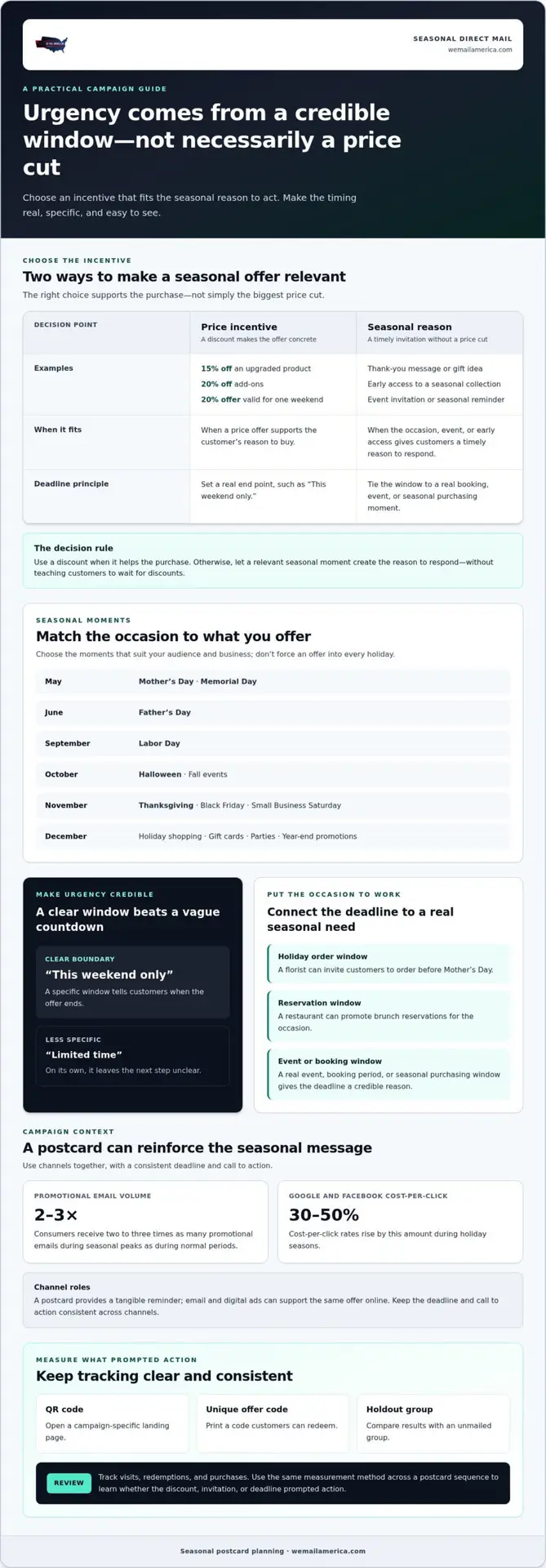
A discount can make a seasonal offer concrete, but it isn’t required. Match the incentive to the customer’s reason to act. For example, a retailer could offer 15% off an upgraded product, while an accessories promotion could offer 20% off add-ons. A holiday postcard can instead share a thank-you message, a gift idea, or early access to a seasonal collection. Choose the option that supports the purchase, not simply the biggest price cut.
Set a real deadline so the offer has a clear boundary. “This weekend only” gives customers a specific window, while “limited time” alone leaves the next step unclear. Tie the end date to a genuine seasonal moment, such as a Mother’s Day offer in May. A florist might invite customers to order before the holiday; a restaurant could promote brunch reservations. Make the deadline and response instructions prominent on the postcard.
Not every seasonal promotion needs a discount. A thank-you postcard, event invitation, or early-access message can give existing customers a timely reason to respond. For Mother’s Day, a business could invite customers to a special event or suggest a suitable gift. The key is to connect the offer to the occasion. A deadline works best when it reflects a real booking, event, or seasonal purchasing window.
Choose seasonal moments that suit your audience and business. Mother’s Day and Memorial Day fall in May, Father’s Day in June, and Labor Day in September. October brings Halloween and fall events; November includes Thanksgiving, Black Friday, and Small Business Saturday. December can suit holiday shopping, gift cards, parties, or year-end promotions. Focus on occasions that fit what you sell instead of forcing an offer into every holiday.
Seasonal postcard campaigns can stand apart from crowded digital channels, but each has a different role. Consumers receive two to three times as many promotional emails during seasonal peaks as during normal periods. Google and Facebook cost-per-click rates rise by 30-50% during holiday seasons. A postcard adds a tangible reminder, while email and digital ads can support the same offer online. Use the channels together, and give each one a consistent deadline and call to action.
Track each mailing with one clear measurement method. Add a QR code that opens a campaign-specific landing page, or print a unique offer code customers can redeem. An unmailed holdout group can help you compare results with those from recipients. Keep the tracking method consistent across a postcard sequence. Then review visits, redemptions, and purchases to see whether the discount, invitation, or deadline prompted action.
2. How do I create urgency on a seasonal postcard?
Give readers one timely reason to act and one clear next step. A deadline should connect to a real event, booking window, or seasonal need, not an arbitrary countdown. For Black Friday, state when the promotion ends and what customers should do next. Make the date easy to spot, then repeat it on the landing page. A focused message is easier to act on than several competing offers.
Use the postcard design to guide the eye from the seasonal image to the offer, deadline, and call to action. Spring promotions can use lively colors and a lighter visual style; summer postcards can use bright colors and lighter paper. For holiday designs, choose imagery suited to the occasion rather than adding details that compete with the offer. Keep the main action specific, such as “Book your spring service” or “Shop the Black Friday offer.”
Postcard formats can support different creative needs. The standard size is 4 by 6 inches, while larger formats include 5 by 7 inches and 6 by 9 inches. A 4 by 4 inch card can suit a brief coupon or reminder. Select a format that leaves enough room for the message, offer details, and response instructions. Choose paper stock and finish to support the image and readability, then review a proof for clear type, strong contrast, and accurate dates before mailing.
Design tools can help organize images, copy, and calls to action, but the finished layout needs a clear hierarchy. Personalize the message with a customer’s name or a relevant seasonal service when that information is available. Make the call to action direct: “Scan to reserve your place” tells readers what to do and why. Place the QR code beside its instruction, and test the landing page on a phone before mailing.
Make the landing page match the postcard’s offer, deadline, and wording. Since most landing pages convert at less than 10%, remove distractions and keep forms to 3 fields or fewer unless the campaign needs extensive information. A unique page for each send can help connect visits and conversions to the right design. Mail to Mobile Texting can also complement postcard marketing with a text response path.
Measure performance with the same tracking method across a postcard sequence. Compare visits, redemptions, and conversions, then refresh the creative if response remains flat or falls below 1%. Printing and postage costs depend on format, quantity, and mailing details; pricing is provided after a quote request. For help planning the campaign’s print and mailing details, use the direct mail inquiry form.
Mailing to existing customers and prospects
Start with distinct audience groups rather than one list for every seasonal offer. Existing customers have a purchase history you can use to make the message relevant. Someone who bought a product may respond to a replenishment reminder, while a first-time prospect may need a clear introduction and reason to try your business. Segment by past purchases, customer status, and the seasonal need each group is likely to have.
For seasonal planning, allocate 60% of the mailing budget to existing customers and 40% to prospects. Treat that split as a starting point, then compare response by group. A retailer might send customers a restocking message based on what they bought, while prospects receive a seasonal offer that introduces a related product. Keep each group’s headline and call to action distinct, so results show which audience and message drove the purchase.
Timing matters. Prepare the design two to three weeks before the desired delivery date, and plan for seasonal mailings to arrive five to seven days before a promotion begins. Allow three to five days for USPS delivery in seasonal planning. Mail the first holiday postcard before the end of October, and send reminders early enough for customers to see them before gift shopping begins. Work backward from the promotion date, leaving time for design, list preparation, printing, and mailing.
For USPS postcard campaigns, account for the mailpiece format, mailing class, addressing, and postage during preparation. Requirements depend on the piece and mailing method, so settle those details before approving the final design. This helps you avoid building a campaign around a format that doesn’t fit the planned mailing.
Use a campaign calendar to connect the season with customer behavior. Organizations with summer events can mail event details in spring, then send summer reminders to members and prospects. In January, businesses can target existing buyers with restocking or routine-building messages related to products they already purchase. For an anniversary message, refer to the customer’s first order and the product they chose.
Recent buyers can receive relevant cross-sell or upsell postcards a few days to a week after purchase. For example, a home goods retailer could feature a complementary item after a related purchase. Keep prospect records separate from customer records, and segment prospects using relevant criteria such as service eligibility, purchase interests, or demographic fit across the areas you serve. Explain why the seasonal offer suits each audience. Then track responses by segment, so the next campaign calendar reflects results rather than assumptions.
4. Audience and neighborhood targeting
Start by defining who can act on the seasonal offer and where your business can serve them. For a nationwide mailing, build geographic segments around service eligibility, delivery coverage, or seasonal conditions. A home services company, for example, can target areas where the advertised service is available. A retailer can group audiences by relevant purchase interests, regardless of state. Choose targets based on customer fit, not an arbitrary boundary.
Separate households with an existing relationship from prospects. Customer records can reveal past purchases, inquiries, or services used. Prospects may need a simpler introduction and a reason to consider the seasonal offer. A retailer could send repeat buyers a product-related reminder and introduce the same seasonal category to prospects. Give each group a distinct headline and call to action, so response data shows which audience and message performed better.
Choose between broad coverage and a more selective mailing based on the campaign goal. Broad coverage can suit an offer relevant to a wide customer base or an organization serving multiple markets. Targeted mailing focuses on addresses that match customer or geographic criteria. A business offering seasonal services could select only areas where those services are available. A national retailer could segment by relevant buying patterns. Match the mailing method to the offer and its intended audience.
Seasonal needs don’t begin at the same time everywhere. A national mailing can account for weather shifts and differences in when customers start planning. For instance, a postcard promoting spring services can be timed to conditions in each target area. Use the calendar to plan the mailing window, then make the reminder relevant to its recipients. Geographic segmentation helps a nationwide campaign feel timely without limiting it to one region.
Build the audience using useful, current information. Review customer and prospect records for location, purchase history, inquiry status, and the product or service that fits the promotion. Exclude addresses outside your service area and avoid sending the same message to someone who recently completed the advertised purchase. If an offer applies across several geographic segments, explain why it matters to each group. That connection makes the postcard feel tailored to its audience.
After mailing, compare responses by audience and geographic segment. If one segment shows stronger interest, examine whether the offer, timing, or relevance explains the difference. If responses vary across the country, refine the next target instead of automatically repeating the same coverage. Record the audience criteria and campaign message, so future seasonal mailings build on observed results. This makes geographic targeting a repeatable decision rather than a guess.
5. Benefits of targeted direct mail
Targeting gives each postcard a clear reason to arrive at a particular home. Instead of mailing the same message everywhere, match the offer to purchase history, customer needs, or a relevant area. A spring garden promotion, for example, can focus on households likely to use the products. The goal isn’t simply to reduce the mailing list. It’s to make the message useful to the people who receive it.
A postcard is physical, visible, and easy to revisit. Use those qualities thoughtfully: highlight the main benefit, explain why it matters now, and give readers one next step. A restaurant could promote a seasonal menu, while a service business could send a timely maintenance reminder.
Targeted direct mail can also help a business reach people beyond its current customer list. A house list speaks to existing relationships, while neighborhood targeting introduces an offer to potential customers in a chosen area. House-list direct mail is reported to deliver a 161% return on investment. Treat that figure as context, not a forecast for every campaign. Your audience, offer, mailing, and measurement method shape the result.
Relevance strengthens the message before the postcard reaches the mailbox. Segment customers by past purchases or service history, then create a separate prospect audience around the seasonal need. For example, a retailer can send repeat buyers a product-related reminder and introduce the same seasonal category to prospects. Match the offer and call to action to each group. A generic headline wastes the advantage of a carefully selected audience.
Use a QR code when a mobile next step supports the offer, such as viewing a seasonal menu or booking an appointment. Make the destination match the postcard’s message, so readers don’t land on a general page and have to search. Then compare audience groups using the same response measure. Redemptions, repeat purchases, revenue per mailed customer, and reactivated customers can each show a different aspect of campaign performance.
The strongest takeaway is simple: target for relevance, then measure what the mailing changes. A postcard can reinforce a digital promotion, introduce a business to prospects, or prompt customers to act on a seasonal need. Plan your next targeted direct mail effort around a defined audience and a clear response path. Plan a targeted direct mail campaign with the right audience and mailing approach.
We Mail America: Impact Post Card – 6 X 11
We Mail America’s Impact Post Card – 6 X 11 gives seasonal promotions a tangible format for a clear headline, timely offer, and response instruction. It can suit businesses planning a targeted mailing to customers or prospects across all 50 states. For campaigns that call for a different format, options include the Extra Large Card – 9 X 11, Mailbox Buster Post Card – 12 X 9, and The Giant Post Card – 10 X 14. Choose the piece that fits your message and audience, then build the mailing around a relevant seasonal reason to act. To discuss a postcard campaign for your business, contact We Mail America.
Turn your next seasonal idea into a focused plan
Choose the next seasonal moment that genuinely suits your customers, and give the mailing a purpose beyond filling a calendar slot. Decide which action matters most, such as booking, visiting, or placing an order. That choice will shape the message and help you assess whether the campaign achieved its goal.
Before launching, write down what you want to learn. You might test whether a reminder or invitation earns more responses, or whether different audiences act on different messages. Use what you learn to guide your next seasonal postcard campaigns, refining the approach instead of starting from scratch each time.
We Mail America offers postcard formats to support a range of campaign needs, including the Impact Post Card – 6 X 11, Extra Large Card – 9 X 11, and Mailbox Buster Post Card – 12 X 9. Bring your audience, timing, and campaign goal together into a practical mailing plan. Contact We Mail America to plan your mailing, and take the next step with confidence.
Frequently Asked Questions
How do I create urgency on a seasonal postcard?
Give readers a real reason to act within a clear window. A seasonal appointment business, for example, can invite customers to reserve before its holiday schedule fills. State the deadline and action plainly, such as booking or visiting a page. Make sure the deadline reflects the actual offer or event. A countdown without a genuine limit can weaken trust instead of motivating a response.
Can I schedule a mailing for a future date?
Yes. Plan a future mailing by choosing the intended arrival period first, then setting internal milestones for list review, copy approval, proofing, and print preparation. For a holiday promotion, align the postcard with when customers begin planning or shopping, rather than simply the holiday date. Connect the mailing schedule to the offer’s start and end dates, so recipients have a practical chance to respond.
How far ahead should I plan seasonal mailings?
Start planning as soon as you choose the seasonal occasion, especially if the campaign needs audience segmentation or a new offer. Work backward from when customers should act, allowing time to approve the message, check addresses, and prepare the artwork. A Mother’s Day invitation, for example, needs to reach recipients while they can still make plans, not after the occasion has passed.
How many seasonal postcards should I send per year?
Start with three or four seasonal moments per year that suit your products and customer journey. A retailer might choose spring replenishment, a back-to-school offer, and holiday shopping rather than mailing for every observance. Review responses after each send, then keep the occasions that support a clear business goal. The right cadence depends on relevance and audience readiness, not a crowded promotional calendar.
Should seasonal postcards include a discount?
No. A discount can help when price is the main barrier, but an invitation, early access, useful reminder, or seasonal gift suggestion can also motivate action. Before offering a reduction, decide what behavior you want: a first visit, repeat order, or event reservation. Then choose an incentive that supports that action and makes the offer easy to understand without obscuring its value.
What is postcard marketing?
Postcard marketing uses printed cards mailed to selected recipients to promote a business, offer, event, or reminder. This format puts a concise message directly in the mailbox, where recipients can see it without opening an envelope. For example, a fitness studio could announce a seasonal class schedule and direct readers to book. A clear audience and response path help connect the mailing to a business objective.
What seasonal campaigns generate the best ROI?
No single season guarantees the strongest return. Results depend on how well the occasion, audience, offer, and purchase timing align. A replenishment message may suit a repeat-buy product, while an event invitation may fit a business with seasonal bookings. Define the response you want, attribute sales or leads to the mailing, and compare results with the campaign’s total investment before deciding what to repeat.
What size postcard works best for seasonal promotions?
The best size depends on how much the design needs to communicate. A focused coupon or reminder can work on a compact card, while a promotion with strong imagery, several details, or multiple calls to action may need more room. Prioritize readability and a clear visual hierarchy rather than filling every available space. Choose a format that gives the headline, offer, deadline, and response instruction enough breathing room.