
What if the postcard’s biggest job isn’t to look impressive, but to make the next step obvious? A free dental consultation postcard needs to explain the offer clearly, reach households that make sense for the practice, and show recipients exactly how to respond. If any part is vague, interested readers may move on without getting in touch.
It’s understandable to wonder what to say, what to show, and how to reach the right people. A strong postcard keeps the message simple: state what the consultation includes, make the offer easy to understand, and give people a clear way to request an appointment. Thoughtful audience selection can focus a mailing across chosen U.S. ZIP codes, while a QR code or text-response option gives recipients a direct next step.
This guide walks through the essentials, from shaping a clear offer and choosing postcard content to planning geographic targeting and tracking responses. You’ll learn how to connect each part of the campaign without adding unnecessary complexity, so your postcard is practical, easy to understand, and ready to invite appointment inquiries.
Key Takeaways
- Make the free dental consultation postcard offer specific, credible, and clear about the terms set by the practice.
- Use a simple design hierarchy: headline, offer, supporting proof, and response instruction.
- Choose between EDDM® saturation outreach and targeted mail based on the audience and campaign objective.
- Give recipients a clear response route, then review campaign activity to understand engagement.
- Plan the launch in practical steps, with design, printing, routing, mailing, and tracking coordinated together.
What Should a Free Dental Consultation Postcard Promise?
A free dental consultation postcard is a direct-mail promotion that invites recipients to contact a dental practice about a consultation offered at no charge. The practice defines the consultation and its terms, while We Mail America supports the advertising campaign with design, printing, routing, mailing, and tracking.
That distinction should shape the copy from the start. Before drafting, identify who the practice hopes to reach and what the campaign should accomplish. Is the goal to generate inquiries from prospective patients, introduce a particular service, or invite people to discuss their dental needs? A defined audience and objective help keep the message focused. The postcard is one form of advertising mail, so its promise needs to be understandable at a glance and clear enough to guide a response.
Define the consultation offer before designing the postcard
Write down the offer in plain language before choosing headlines or visuals. Specify what happens during the consultation, who it’s intended for, and any conditions that apply. Use wording the practice can honor consistently. If eligibility is limited, or the offer has an end date or other condition, make that information easy to notice rather than burying it in small print.
A useful test: could someone who has never visited the practice explain what’s being offered after reading the main message? If not, replace broad language with a more concrete description supplied by the practice. Avoid implying that a consultation includes a diagnosis, treatment, or other service unless the practice has defined that as part of the offer.
For example, a concise offer sentence could read: “New patients can request a complimentary consultation to discuss their dental needs with our practice.” The practice should adapt this wording to match the actual consultation, intended audience, and terms. This sentence describes the invitation without promising a particular treatment outcome.
Choose one primary goal for the dental postcard
Decide what success means before selecting the response instruction. If the objective is to generate inquiries, make that the campaign’s central purpose and choose one main action for the recipient. A postcard can invite someone to call, scan a QR code, or text, but giving all options equal weight can make the next step less obvious. Match the primary route to the practice’s booking process and make it easy to spot.
Keep the campaign objective distinct from the consultation offer. The offer explains what a recipient may request; the objective defines what the practice wants the postcard to prompt, such as an inquiry or appointment request. That focus helps the design and copy work together. Avoid claims about guaranteed results, pain relief, or improved oral health unless the practice can substantiate them and they accurately describe the offer.
- Offer: What the consultation includes and who it’s for.
- Objective: The response the campaign is designed to encourage.
- Next step: One clear action recipients can take.
With those decisions settled, the practice has a solid message to carry into postcard design and audience planning.
How to Design a Free Dental Consultation Postcard That Gets Noticed
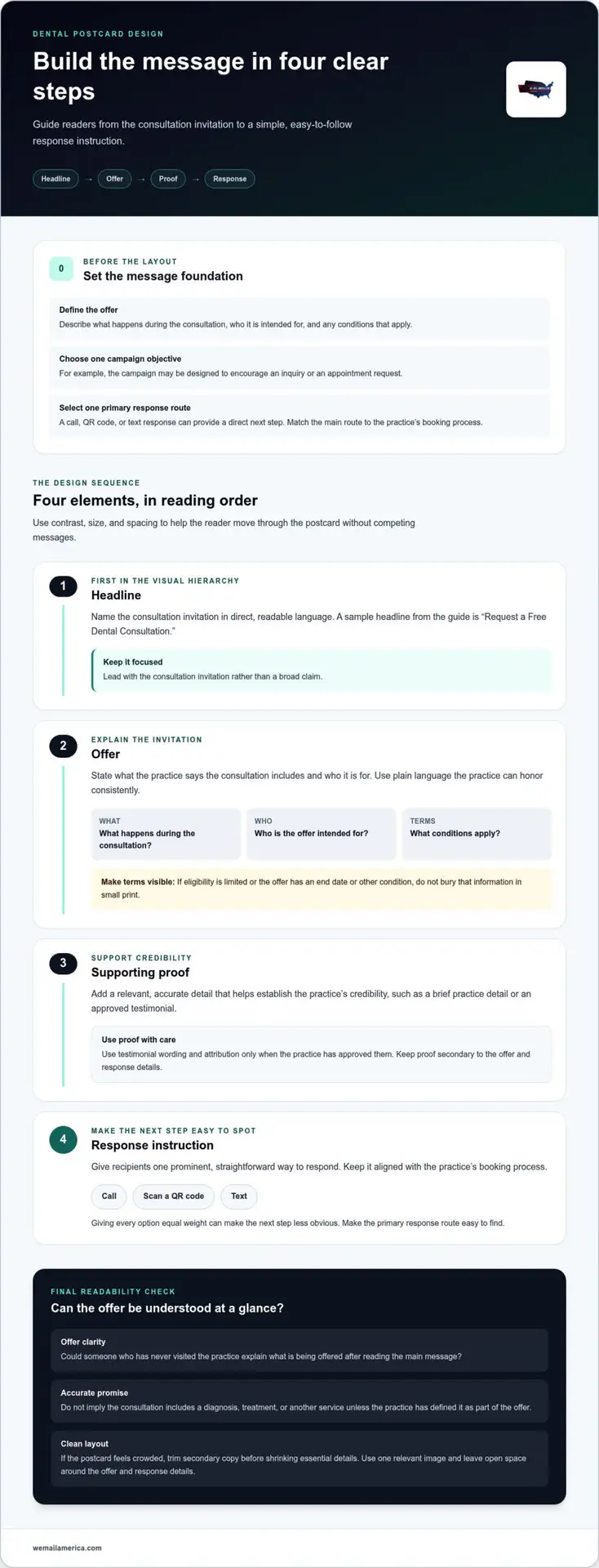
A clear design helps a recipient move from noticing the postcard to understanding the offer and choosing what to do next. Use a simple visual hierarchy: headline first, consultation offer second, supporting proof third, and response instruction last. Each element should earn its place. If the postcard feels crowded, trim secondary copy before shrinking essential details.
Write a headline and offer recipients can understand
Lead with the consultation invitation, not a broad claim like “Your best smile starts here.” A direct headline such as “Request a Free Dental Consultation” tells readers what the postcard is about. Follow it with the practice-approved description of the offer, then a short instruction such as “Call to request an appointment.” Keep supporting copy focused; listing every service can distract from the reason for the mailing.
Build the message in this order:
- Headline: Name the consultation invitation in direct, readable language.
- Offer: State what the practice says the consultation includes and who it’s for.
- Supporting proof: Add a relevant, accurate detail that helps establish the practice’s credibility.
- Response instruction: Make the next action prominent and easy to follow.
Visual hierarchy is the arrangement of text and design elements that helps readers identify the main offer and next step quickly. Use contrast, size, and spacing to guide the eye through the sequence. The practice name and identity should be easy to find, but they shouldn’t compete with the headline or call to action.
Use imagery and proof with care
Choose one relevant image, such as a welcoming smile, the dental team, or the practice setting. The image should reinforce the invitation and feel appropriate for the intended audience. Avoid using several competing visuals or placing text over a busy background. Leave enough open space around the offer and response details so they remain legible when the postcard is viewed at a glance.
Supporting proof should be specific and accurate. A brief practice detail or a testimonial may help make the message feel more credible, but use a testimonial only when the practice has approved its wording and attribution. Don’t let proof take over the design. The recipient still needs to spot the consultation invitation and know how to respond.
Before approving the artwork, proof every key detail: the offer wording, practice name, contact information, and the destination behind the QR code. Scan the code and confirm it leads to the intended booking or inquiry path. Check that the call to action appears clearly and matches the route the practice is prepared to handle.
For a coordinated campaign, share your postcard campaign details with We Mail America’s team for one-on-one design support.
EDDM or Targeted Mail: Choose the Audience for Your Dental Postcard
The audience strategy should match the campaign objective. A broad saturation mailing can put an offer in front of households across selected ZIP codes and carrier routes. Targeted mail can focus on an audience defined by selected filters. Neither approach means every recipient is a likely patient or will respond. The goal is to choose a reach strategy that fits the practice’s intended service area and the kind of inquiry it wants to generate.
We Mail America creates a custom geographic report and carrier-route map for each client. These tools help practices plan outreach by ZIP code and route, then decide whether broad household coverage or narrower audience selection makes more sense. A free dental consultation postcard can support either approach; the difference is how the mailing audience is defined.
Reach approach: EDDM® is designed for saturation outreach across chosen carrier routes. Targeted mail selects recipients using chosen audience filters.
Audience selection: EDDM® emphasizes route-level household coverage. Targeted mail can account for filters such as home value, income, and owner occupancy.
Suitable campaign goal: EDDM® may suit a practice seeking broad awareness across its service area. Targeted mail may suit a campaign focused on a more specifically defined audience.
When a broad EDDM® approach may fit
Consider saturation mailing when the practice wants to reach households across chosen ZIP codes and carrier routes, rather than selecting recipients by individual demographic filters. Route planning can help align coverage with the area the practice intends to serve. It’s a way to build broad visibility, not a promise that every household is a prospective patient. The offer and response path still need to give interested recipients a clear reason to inquire.
When targeted mail may fit
Targeted mail can help shape an audience around campaign priorities, using filters such as home value, income, and owner occupancy alongside carrier-route planning. These selections can make the intended audience more specific than broad route coverage, but they don’t predict individual interest or guarantee responses. Practices comparing the approaches can explore this overview of direct mail campaign planning as they define their outreach needs.
For a practical comparison, consider which choice better matches the objective: broad awareness across selected routes, or a mailing audience shaped by specific filters. The answer can also guide postcard quantity and geographic coverage. Keep the distinction clear as you plan your direct mail postcards campaign, and use the carrier-route map to connect the mailing plan with the practice’s intended service area.
Make the Dental Postcard Easy to Respond to and Measure
A compelling offer needs a clear response path. Choose one prominent action that fits the practice’s booking process, then make it easy to spot on the postcard. A custom QR code is included on every We Mail America direct-mail campaign. The practice can direct it to its chosen information or contact destination, such as a page with consultation details or a way to submit an inquiry.
Choose a simple response route
Keep the instruction specific. “Scan to request a consultation” tells recipients what to do and why. If the practice prefers calls, give the phone number clear placement and use a direct prompt. A text option is available on each postcard at no additional charge; if using it, state the action plainly so recipients know what to text and where. Keep the primary route consistent with the practice’s process for handling inquiries.
Before the postcard is printed, check that the QR code opens the intended destination and that its content matches the offer. Review phone numbers, web addresses, and text instructions for accuracy. The QR code can make the next step convenient, but don’t assume that its presence alone measures response. Set up a simple way to identify inquiries connected to the mailing.
Connect responses to campaign reporting
Have the practice team record inquiries that mention the postcard promotion. A short intake prompt, such as “How did you hear about us?”, can help identify responses from recipients who call or text rather than using the QR code. For online inquiries, the practice can review submissions that arrive through the destination selected for the campaign. Keep the method manageable so staff can use it consistently.
We Mail America provides daily updates on mail delivery. Use these updates to follow delivery activity, then compare that timeline with the practice’s inquiry records. Delivery information and response information answer different questions: one shows mailing progress, while the other helps the practice assess incoming interest. Neither alone establishes that the campaign caused an appointment, so review the results in context and avoid assuming a particular response rate or return.
- Before mailing: Confirm the QR destination and printed contact details.
- As inquiries arrive: Record which ones reference the postcard or offer.
- During follow-up: Compare inquiry timing with delivery updates and note what the practice learns.
With a clear response route and a practical way to log inquiries, a free dental consultation postcard becomes easier to act on and evaluate. Plan a dental postcard campaign with response options and delivery tracking built into the mailing process.
Launch a Free Dental Consultation Postcard Campaign Nationwide
A nationwide postcard campaign still starts with a focused plan. Define the consultation offer, choose the audience and coverage area, approve the design, mail the campaign, then review delivery and inquiry activity. Each step builds on the last. Clear decisions up front help keep the campaign coordinated from the first draft through post-mailing review.
Prepare the campaign for production
Gather the practice-approved offer wording, practice name and contact details, chosen response destination, and audience criteria. Include the ZIP codes or geographic coverage the practice wants to consider, along with any audience filters that support the campaign objective. This gives the team a practical starting point for planning a free dental consultation postcard.
We Mail America provides one-on-one design support to refine the postcard before approval. Review the final artwork with the practice team. Confirm that the offer and terms are accurate, the contact details are correct, and the QR code leads to the intended destination. Approving these details before production helps prevent avoidable corrections after the mailing is underway.
Coordinate mailing and review activity
Campaign planning can bring geographic research, carrier-route selection, printing, and mailing preparation into one workflow. We Mail America supports campaigns across design, printing, routing, mailing, and tracking for businesses nationwide. These connected steps support the campaign from planning through delivery.
The all-inclusive per-piece model brings campaign services together in one per-piece structure rather than separating each component into disconnected steps. The details can be shaped around the selected audience and mailing plan. No particular response or appointment volume is guaranteed; tracking helps the practice understand what happened and inform decisions about future outreach.
Delivery updates help the practice follow mailing activity, but they aren’t a promised arrival date for each recipient. As inquiries come in, record which ones relate to the postcard and compare that activity with the campaign’s delivery information. The practice can then review what the campaign generated, how recipients responded, and whether the offer, audience, or response path should be adjusted in a future mailing.
With one team coordinating the moving parts, launching a postcard campaign can feel manageable rather than fragmented. Start planning your dental postcard campaign.
Turn Your Postcard Plan Into a Practical Next Step
A campaign can do more than prompt immediate inquiries. It can help a practice learn which message and audience deserve another look. Before launch, decide what the team will consider a useful response and how it will capture that information. After the mailing, use what you learn to make one thoughtful adjustment for the next campaign, rather than changing everything at once.
That steady process keeps each free dental consultation postcard connected to a clear purpose. The practice defines the consultation and handles the patient conversation; the campaign gives potential patients a way to begin it. With a specific plan in place, the next step is to turn the idea into a coordinated mailing.
Plan your dental postcard campaign with We Mail America. Bring your campaign goal and the consultation offer you want to promote, and start shaping a postcard plan for your intended audience. A clear first step can make the work ahead feel manageable and put your practice on its way to reaching prospective patients across the country.
Frequently Asked Questions
What should a free dental consultation postcard include?
A free dental consultation postcard should identify the practice, explain the consultation offer, and show recipients how to respond. Include enough detail to set clear expectations, such as who the offer is intended for and what the practice says the consultation covers. Add accurate contact information and a response instruction that matches the practice’s process. Before printing, have someone unfamiliar with the campaign review it for clarity.
Can a dental practice promote a free consultation by postcard?
Yes. A dental practice can use a postcard to invite people to inquire about a consultation it offers. The practice sets the offer and its terms, including what the consultation covers and who it is for. Keep the wording aligned with what the practice can provide. We Mail America supports the advertising campaign, while the practice sets and delivers the consultation offer.
How do you make a dental consultation postcard more likely to get a response?
Make responding feel straightforward: use a direct invitation, give one main action, and make sure the practice can handle inquiries through that route. For instance, if the postcard asks people to request information online, test the destination on a phone and confirm the form works. A clear message can reduce friction, but no design or response method can guarantee that recipients will contact the practice.
Is EDDM® or targeted mail better for a dental consultation postcard?
Neither is automatically better; choose based on the audience the practice wants to reach. EDDM® can suit a campaign seeking broad household coverage across selected postal routes. Targeted mail can narrow the audience using chosen filters, such as home value, income, or owner occupancy. Consider whether broad awareness or a more defined audience is the priority, then align the mailing plan with that goal.
How can a dental practice track responses from a postcard?
Give the mailing a response path the practice can identify, then record inquiries connected to the promotion. Staff can ask callers how they heard about the practice and use a consistent note or intake field for postcard responses. If recipients scan a QR code, review inquiries from its destination as well. Compare these records with mail-delivery updates, while remembering that timing alone doesn’t prove what prompted an inquiry.
How much does a free dental consultation postcard campaign cost?
Campaign cost depends on the selected postcard and mailing quantity. We Mail America’s listed 6×11 postcard price is $0.940 per piece for 2,000-2,999 pieces and $0.447 per piece for 100,000 or more, with tiered per-piece pricing for quantities in between. Full-service direct-mail campaigns use an all-inclusive per-piece model, bringing campaign components together. The mailing plan and selected services determine the campaign scope. Request campaign details based on the practice’s intended audience and quantity.