

What if a market update postcard earned attention by explaining less, but explaining it better? Real estate market update postcards can feel useful and credible when they focus on a few verified indicators instead of squeezing every available number onto a small card.
Choosing which figures matter, keeping the message concise, and avoiding generic promotional language takes planning. Readers need context they can understand and a relevant next step, not a wall of statistics or a sales pitch.
This guide shows you how to plan, write, target, and assess a market update postcard for a nationwide audience. You’ll learn how to select meaningful measures such as sale-price trends, inventory, and days on market; present them with clear dates and sources; and shape a focused message around recipients’ likely questions. We’ll also compare targeted mail with saturation strategies and show how to connect a printed postcard to a digital response option. The result is a practical framework for turning market information into a clear, measurable conversation starter.
Key Takeaways
- Make real estate market update postcards useful by building the message around a reader’s question, not a crowded list of figures.
- Choose a small set of relevant indicators, verify the data, and explain what each change means in context.
- Match the format to the amount of information, then choose targeted mail or EDDM® based on your audience and campaign purpose.
- Set one clear campaign objective and give recipients a focused next step, such as requesting a valuation conversation or visiting a landing page.
- Use geographic reports and carrier-route maps to plan audience selection for a nationwide mailing campaign.
Why Real Estate Market Update Postcards Need a Clear Reader Benefit
A postcard can carry plenty of figures and still leave recipients wondering what they mean. A useful update starts with a reader’s question, then selects only the information that helps answer it. Real estate market update postcards are concise printed summaries of selected housing-market indicators, such as sale prices, days on market, or active inventory. The goal isn’t to squeeze in every available statistic. It’s to give recipients clear context they can understand at a glance.
That context needs to match the people receiving the card. Housing conditions vary by market, so don’t present data from one area as a universal national trend. State the geography, reporting period, and source for every figure. A headline such as “What’s changing in your market?” can attract attention, but the details should identify which market the update describes.
A market update also has a different job from a listing announcement or general promotional postcard. A listing card highlights a property; a promotional card may introduce an agent or service. A market update puts useful information first. The agent’s name and contact details establish who prepared it, while one relevant next step can invite recipients to discuss how the figures relate to their plans.
Recurring updates can help an agent stay visible while sharing timely information, provided each mailing uses current, verified data. Set a practical cadence around when relevant figures become available, and label the period covered. Repeating the same broad claim without refreshed context can make a campaign feel generic. Give recipients a clear reason to keep the card and revisit the information.
What should a real estate market update postcard help recipients understand?
Start with a reader question: “What might current conditions mean if I’m considering a move?” Then choose a few indicators that help frame the answer. A price trend may show direction, while days on market can add context about the pace of sales. Define terms in plain language and connect each figure to a practical takeaway, without suggesting it predicts an individual home’s value or guarantees a result.
For example, don’t list a change in active inventory without explaining what the figure measures. Briefly state how many homes were available under the source’s definition and why a buyer or seller might care. Keep the wording neutral. The postcard should inform and invite a conversation, not turn a market-wide statistic into a personal forecast.
Why send a market update by postcard?
A printed postcard is tangible. Recipients can hold it, set it aside, and revisit the figures when they’re ready. Advertising mail, also known as direct mail, encompasses various marketing materials like postcards. A market update can be one touchpoint in a broader relationship-building plan, alongside personal conversations and other useful communications. Treat it as a way to share relevant information, not a promise of leads, listings, or sales.
How to Choose and Explain Market Data for a Real Estate Postcard
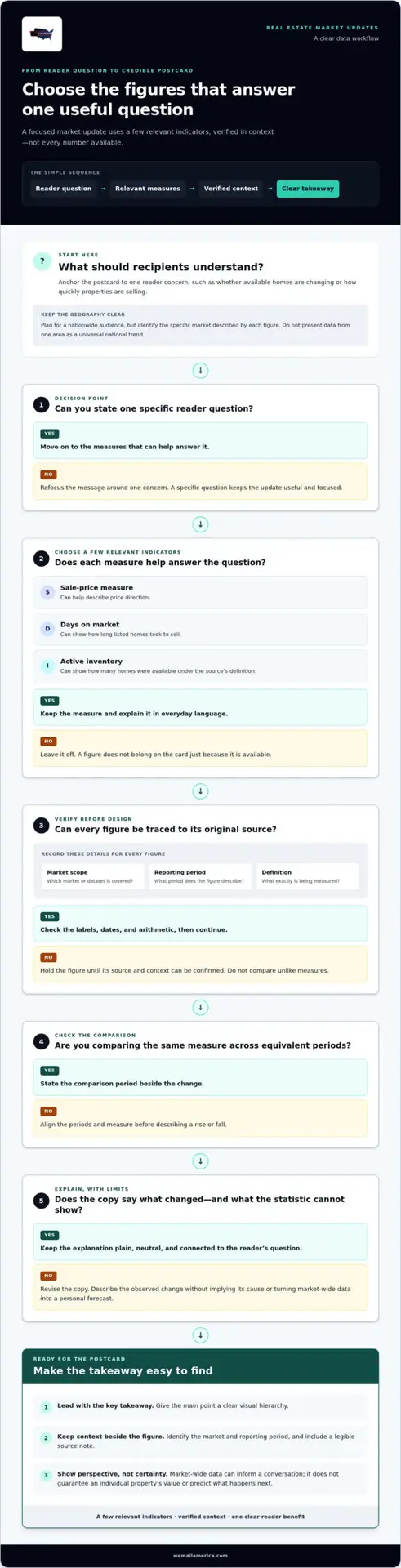
A credible postcard starts before design. Decide what recipients should understand, then build the message around figures that help answer that question. For real estate market update postcards, a straightforward data workflow can prevent clutter, confusing comparisons, and claims that go beyond what the numbers show.
- Define the reader question. Focus on one concern, such as whether available homes are changing or how quickly properties are selling. A specific question keeps the update useful and focused.
- Choose relevant indicators. Select only a few measures that help answer the question. Sale prices, days on market, and active inventory each offer a different view, but none needs to appear on every card.
- Verify the figures. Trace every number to its original source before approving the artwork. Record the market scope, reporting period, and definition so the final copy doesn’t compare unlike measures.
- Explain what changed. Describe the comparison in plain language. If a figure rose or fell, state the comparison period and avoid implying that the change alone explains why it happened.
- Add context and limits. Clarify what the statistic can and can’t show. Market-wide data offers perspective, not a guarantee about an individual property or a forecast of what will happen next.
Which housing-market indicators belong on a postcard?
Choose indicators based on the reader’s central question, not simply because a figure is available. A sale-price measure may help describe price direction; days on market can indicate how long listed homes took to sell; active inventory can show how many homes were available under the source’s definition. Explain each term in everyday language and place the reporting period beside the figure. Keep comparisons consistent by comparing the same measure across equivalent periods.
How can agents make market statistics credible and readable?
Before finalizing the design, compare every figure with its source and check the arithmetic, labels, and dates. Add a legible source note and identify the market scope, such as the defined area or dataset covered. Separate observed data from interpretation: “inventory increased during the reporting period” describes a result, while “buyers now have more negotiating power” is an interpretation that needs careful qualification.
Use visual hierarchy to make the key takeaway easy to find. Give the main figure room to breathe, pair it with a short explanation, and keep definitions or source details in readable supporting copy. If space is tight, remove a metric rather than shrinking the text until it becomes difficult to read. Recipients need to see not just the numbers, but what they refer to.
A consistent review process helps keep each update clear as new data becomes available. To plan a mailing around verified market information, share your direct-mail campaign details.
How to Compare Postcard Formats and Mailing Strategies
The right mailing plan depends on who should receive the update and how much information the card needs to carry. Real estate market update postcards work best when audience selection, message, and format support the same campaign goal. A defined audience may call for targeted mail; a broader awareness effort may suit a saturation approach. Neither guarantees a particular response. Choose based on the people you want to reach and the purpose of the update.
| Consideration | Targeted mail | EDDM® |
|---|---|---|
| Audience control | Focuses on a selected audience using the campaign’s targeting criteria. | Uses selected carrier routes to reach addresses across those routes. |
| Reach | Concentrates delivery on recipients who match the defined audience. | Provides broader coverage within the chosen route areas. |
| Campaign purpose | Fits an update designed for a specific group of prospective buyers or sellers. | Fits a market snapshot intended to build awareness across a wider delivery area. |
When does targeted mail fit a market update campaign?
Targeted mail can make sense when you have a clearly defined audience. Campaign filtering can use factors such as home value, income, or owner occupancy. A Custom Geographic Report and carrier-route map help organize the plan and identify delivery areas aligned with the audience. Tie the selection to the update’s purpose instead of assuming a particular household will buy or sell.
When can EDDM® or a larger postcard format make sense?
EDDM® is a saturation approach for reaching addresses along selected carrier routes. Consider it when broad coverage matters more than individual-recipient filtering. A larger card can provide room for a chart, definitions, branding, and a response prompt; a concise layout can make one key statistic easier to scan. Choose a format that supports the content without crowding it.
Think of format as an information-design decision. A compact card suits one takeaway and a brief explanation. A larger option, such as a 6 × 11 or 9 × 12 postcard, offers more layout space, but every element still needs a clear purpose. Give the headline and central figure visual priority, keep source notes readable, and leave room for one response action.
Before committing, write down the intended audience, coverage goal, and amount of content. Then compare the mailing approach and card size against those needs. If the campaign calls for recipient-level selection, targeted mail may be the better fit; if route-wide awareness is the priority, consider EDDM®. A market update mailing plan can align audience strategy with postcard format.
How to Plan, Send, and Assess a Market Update Postcard Campaign
A reliable campaign moves through clear checkpoints, from audience selection to post-mail review. Set the objective first, then align the content, format, delivery plan, and measurement method with that goal. This gives you a practical basis for evaluating the mailing without assuming it will produce a particular number of responses.
- Define the audience and objective. Decide who the update is for and what you want the mailing to do, such as invite a valuation conversation or direct recipients to a market-information page.
- Prepare and approve the content. Gather verified figures, reporting dates, source notes, and market scope. Confirm that the headline and explanation accurately reflect the data before design begins.
- Design for quick understanding. Give the headline, main statistic, plain-language explanation, and response prompt distinct roles. Use one-on-one design support to shape the approved content into a readable mail piece.
- Coordinate the mailing. Confirm the audience or route plan, final artwork, and intended delivery window with the campaign team. Keep a record of the approved version and mailing details for later review.
- Review delivery and response. Follow delivery progress, record responses connected to the call to action, and compare what happened with the original campaign objective.
What should agents prepare before sending?
Bring the essentials together before artwork is finalized: the data source, reporting period, market scope, approved figures, agent branding, and one recipient action. A clear call to action might invite a recipient to request a valuation conversation or visit a landing page. Avoid competing prompts. If the card asks readers to call, scan a code, and follow a social account, it becomes harder to tell which response matters most.
Use the layout to guide the eye. Make the main statistic prominent, place its explanation nearby, and keep the source note and response instructions easy to find. We Mail America provides one-on-one design support to turn approved content into a clear printed piece. Review a proof for accuracy and readability before the campaign moves forward.
How should agents review campaign delivery and response?
Daily mail-delivery tracking updates help you follow the mailing’s delivery progress. A custom QR code is included on every direct-mail campaign and can connect the printed postcard to a relevant digital destination, such as a landing page. Decide in advance how responses will be recorded, including calls, form submissions, or QR visits if those are part of the plan. Then assess the records against the campaign’s stated objective, not an assumed result.
Keep the review simple and useful. Note what was mailed, to whom, which call to action appeared, and what responses were observed. That record can guide the next campaign’s message, audience, or design. To put your market update into a coordinated direct-mail campaign, start planning your postcard mailing.
How We Mail America Supports Nationwide Real Estate Market Update Postcards
Planning a market update mailing takes more than a finished design. The audience, route strategy, accurate content, printing, and delivery all need to work together. We Mail America supports real estate market update postcards for businesses across all 50 states, coordinating campaign steps so agents can focus on the information they want recipients to receive.
What does WMA handle in a market update mailing?
Start with the audience and campaign objective. A Custom Geographic Report and carrier-route map help inform route selection, while targeted filtering can help define the mailing audience. These tools offer a structured way to plan delivery around campaign goals, whether the update is intended for a selected audience or broader route coverage.
We Mail America provides one-on-one design support to shape approved market content into a readable postcard. The all-inclusive per-piece service covers carrier-route research, market analysis, strategic route selection, targeted filtering, professional design, full-color printing, USPS saturation postage, mailing preparation, sorting, tray preparation, and bulk-mail drop shipment. Coordinating these steps through one direct-mail partner connects the approved artwork with the mailing process.
Campaign support continues after the mail is prepared. Daily delivery tracking updates help agents follow the mailing’s progress. Every direct-mail campaign includes a custom QR code, connecting the physical postcard with a digital destination, such as a landing page with additional market information or a form to request a conversation. Mail-to-Mobile Texting adds another response option, and each postcard includes the text option at no additional charge.
How can agents take the next step?
Bring three things to the campaign discussion: the audience you want to reach, the market-update content you plan to share, and the action you want recipients to take. For example, an agent might pair a concise market snapshot with an invitation to request a valuation conversation. A clear objective helps align the geographic plan, postcard design, and response option.
We Mail America coordinates direct-mail campaigns from design support through printing and mailing, with options shaped around the campaign’s audience and goals. The process helps make nationwide mailing more manageable without promising a particular response or business result. You provide the campaign direction, and the team brings the mailing together.
Ready to put your market information into a tangible, coordinated campaign? Discuss your real estate postcard campaign and share your audience, content, and objective to request a tailored plan.
Make Your Next Market Update a Better Conversation Starter
Think beyond a single mailing. A steady series of useful updates can give your audience a reason to keep paying attention, with each installment answering a fresh question about the market. For real estate market update postcards, plan what you’ll explain next and keep the message grounded in information recipients can use.
Start with one practical step: decide which reader question your next update should address and what action would make sense after they read it. Keep a record of the campaign objective and the responses you observe. That gives you a clearer starting point for refining future messages without assuming every recipient is ready to move or make a decision.
When you’re ready to turn that plan into a mailing, share your campaign goals and audience with We Mail America. Plan your next real estate postcard campaign and take the next step with confidence.
Frequently Asked Questions
What should a real estate market update postcard include?
Include a clear headline, a few verified indicators, the reporting period and source, a plain-language takeaway, agent contact details, and one useful next step. Real estate market update postcards should reflect the market relevant to their intended recipients. For example, a card aimed at prospective sellers can explain what an inventory figure measures and invite a conversation. Make clear that broad market figures offer context, not a prediction of an individual home’s value or outcome.
How often should real estate agents send market update postcards?
Set a schedule based on how often reliable data changes enough to be useful. Leave time to confirm figures, review source notes, and prepare a clear update rather than sending a card simply to meet a calendar date. Agents can plan updates around the release of relevant market information, then adjust if the data shows little meaningful change. No single frequency fits every audience or guarantees engagement.
Can real estate market update postcards include a QR code?
Yes. A QR code can take readers from the printed update to a digital destination, such as a page with additional explanation or a response form. Match the destination to the card’s main call to action, and tell readers what they’ll find after scanning. For instance, “Scan for the full market report” sets a clearer expectation than a bare code. We Mail America includes a custom QR code on every direct-mail campaign.
Should agents use targeted mail or EDDM® for market update postcards?
Targeted mail can suit a defined audience and filtering strategy, while EDDM® can support saturation delivery along selected carrier routes. First decide whether the campaign needs to reach a particular group or build broader awareness within chosen delivery areas. Then align the audience definition with the update’s purpose. Neither approach guarantees a response, and the best fit depends on the campaign rather than a universal performance claim.
What market statistics should appear on a real estate postcard?
Choose a small number of indicators that answer the postcard’s central question, such as sale prices, days on market, or active inventory, when reliable data is available. Explain what each measure represents and show its reporting period and source. A price figure, for example, should make clear whether it refers to sale prices or another measure. Avoid mixing comparison periods, leaving numbers unexplained, or presenting a forecast as a certain outcome.
How do you measure a real estate market update postcard campaign?
Measure the campaign against its original objective and track responses tied to its specific call to action, such as QR visits or inquiries. Keep delivery progress separate from recipient response: delivery alone doesn’t establish that someone acted. Record the response type and how it connects to the campaign, then review the findings in context. Don’t assume a standard response rate or attribute a business outcome without evidence.
What does a full-service real estate postcard campaign include?
A full-service campaign coordinates planning, audience and route strategy, design, printing, mailing preparation, postage, and delivery tracking. This keeps the approved message and distribution plan connected throughout production. We Mail America’s campaign support includes a Custom Geographic Report and carrier-route map, one-on-one design support, daily delivery updates, and a custom QR code on each direct-mail campaign. The plan can be shaped around the campaign objective and intended audience.